Introduction
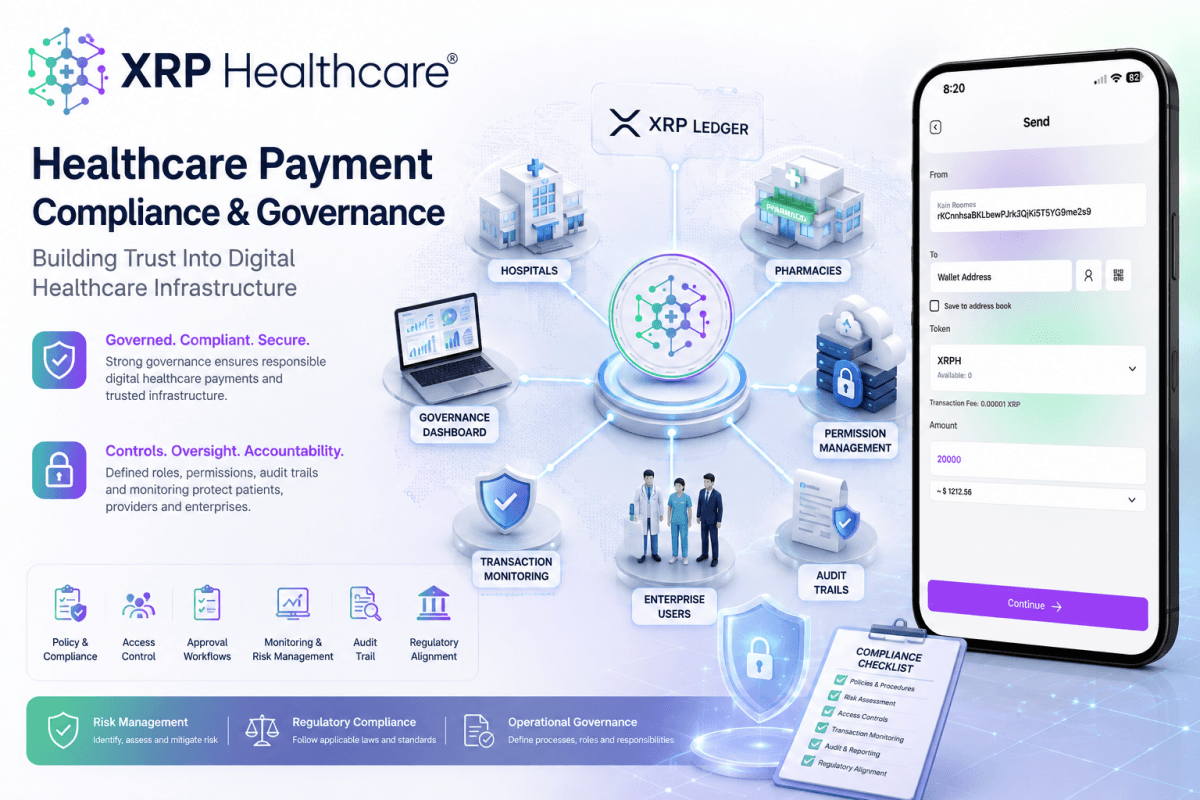
Modern healthcare infrastructure depends on trust. Patients must trust healthcare providers. Healthcare organisations must trust the systems processing transactions. Enterprise partners must understand who is responsible for managing risk, permissions and operational controls.
Technology alone cannot provide that trust. As healthcare payments become increasingly digital, organisations need clear frameworks for compliance and governance alongside secure technical infrastructure.
This is especially important when digital wallets, blockchain settlement, cross-border payments and digital assets become part of the payment environment.
Within the XRP Healthcare Infrastructure, technologies such as the XRP Ledger, XRPH Wallet, Healthcare Payment Rails and digital settlement infrastructure can provide technical capabilities. Governance determines how those capabilities are used responsibly.
What Is Healthcare Payment Compliance?
Healthcare payment compliance refers to the processes used to ensure payment activities operate in accordance with applicable laws, regulations, contractual obligations and organisational policies.
The exact requirements vary depending on:
Jurisdiction
Organisation type
Payment method
Digital assets involved
Customer location
Healthcare service
Financial institutions involved
Compliance is therefore not a single universal checklist. Organisations must understand the requirements relevant to their specific operations.
What Is Healthcare Payment Governance?
Governance defines how an organisation controls and oversees payment infrastructure.
It addresses questions such as:
Who can initiate transactions?
Who can approve payments?
Who manages system access?
How are risks reviewed?
How are incidents handled?
How are audit records maintained?
Who is responsible for compliance?
Governance provides structure around technology. Without governance, even technically secure infrastructure can create operational risk.
Compliance and Governance Are Different
Although closely related, compliance and governance are not the same.
Compliance
Compliance focuses on meeting applicable external and internal requirements.
Examples may include:
Financial regulations
Data protection requirements
Anti-fraud controls
Internal policies
Contractual obligations
Governance
Governance defines how the organisation makes decisions and manages responsibility.
Examples include:
Approval processes
Roles and permissions
Risk ownership
Reporting lines
Incident escalation
Audit oversight
Strong healthcare payment infrastructure requires both.
Why Governance Matters for Digital Assets
Blockchain-based payments can provide fast and transparent settlement. However, digital assets introduce additional responsibilities that organisations must manage carefully.
These responsibilities may include:
Wallet access
Transaction approvals
Asset management
Counterparty verification
Record keeping
Operational security
Financial reporting
Enterprise organisations should define clear procedures before deploying digital asset payment systems. Governance helps establish who can access assets, how transactions are approved, how risks are monitored and how unusual activity is escalated.
Blockchain Does Not Remove Regulatory Responsibility
One common misconception is that decentralised technology removes the need for compliance. It does not. Blockchain infrastructure may change how transactions are processed, but organisations remain responsible for complying with applicable requirements.
Using the XRP Ledger does not automatically determine:
Legal obligations
Tax treatment
Accounting treatment
Customer verification requirements
Healthcare regulations
Data protection requirements
These responsibilities depend on jurisdiction and the specific service being provided.
The Role of Auditability
One potential benefit of blockchain infrastructure is transparent transaction history.
Blockchain records can support:
Transaction verification
Reconciliation
Audit trails
Operational review
Payment confirmation
However, blockchain transparency should be viewed as one component of an audit framework.
Healthcare organisations may still require:
Internal financial records
Accounting documentation
Customer records
Compliance logs
Approval records
The blockchain transaction does not replace broader organisational documentation.
Access Control
Payment governance begins with controlling who can access critical systems.
Enterprise environments may use:
Role-based permissions
Multi-factor authentication
Approval thresholds
Segregation of duties
Restricted administrative privileges
Periodic access reviews
The objective is to ensure that individuals only have the access required for their responsibilities.
Segregation of Duties
One important governance principle is avoiding excessive control by a single individual.
For example, the same person should not necessarily be responsible for:
Creating a payment request.
Approving the payment.
Reconciling the transaction.
Auditing the activity.
Separating these responsibilities can reduce operational and fraud risk while strengthening internal controls.
Transaction Approval Policies
Healthcare organisations should define how transactions are approved.
Policies may consider:
Transaction value
Payment purpose
Asset type
Destination
Geography
User role
Risk level
Higher-value or unusual transactions may require additional approval.
The exact thresholds depend on organisational policy and applicable requirements. A well-designed approval framework should make responsibilities clear before transactions are processed.
Wallet Governance
Digital wallets form an important part of blockchain payment infrastructure.
Governance around wallet use may include:
Who can create wallets
Who controls credentials
Which assets are supported
How recovery processes work
How transactions are authorised
How incidents are handled
Individual users operating a non-custodial XRPH Wallet have different responsibilities from an enterprise organisation managing payment operations.
Enterprise governance therefore requires additional controls around access, approvals, security, monitoring and operational responsibility.
Cross-Border Compliance
Healthcare increasingly operates internationally. Cross-border transactions may involve different:
Financial regulations
Data protection frameworks
Currency rules
Tax requirements
Sanctions requirements
Consumer protection rules
Organisations should evaluate the requirements relevant to both the sender and recipient jurisdictions.
Blockchain can support international settlement, but it does not eliminate jurisdictional responsibilities.
Stablecoins and Governance
Stable digital assets such as RLUSD may support payment scenarios where users prefer digital value linked to a recognised fiat currency.
Enterprise organisations using stablecoins should still consider:
Issuer terms
Supported jurisdictions
Accounting treatment
Internal treasury policies
Regulatory requirements
Transaction monitoring
A stablecoin's technical design does not remove organisational governance obligations.
Healthcare Privacy and Payment Compliance
Healthcare privacy and payment compliance are related but distinct.
Payment infrastructure should avoid unnecessarily exposing confidential medical information.
Where possible, healthcare payment systems should separate:
Financial transaction data
Clinical information
Patient records
Payment references
Blockchain transactions should not be used as a substitute for confidential healthcare record systems.
Privacy principle: Payment infrastructure should minimise unnecessary exposure of healthcare information. Clinical records and confidential medical information should remain within appropriately designed healthcare information systems rather than being placed on a public blockchain.
Privacy principle: Payment infrastructure should minimise unnecessary exposure of healthcare information. Clinical records and confidential medical information should remain within appropriately designed healthcare information systems rather than being placed on a public blockchain.
Data Minimisation
A strong governance principle is data minimisation. This means collecting and processing only the information required for a specific purpose.
For healthcare payments, organisations should consider whether each piece of information is genuinely necessary.
Reducing unnecessary data can help:
Improve privacy
Reduce exposure
Simplify compliance
Limit security risk
Good infrastructure should avoid collecting information simply because it is technically possible.
Security and Governance Work Together
Security protects systems. Governance determines how those systems should be used. Together they support responsible infrastructure.
Security ControlGovernance ControlAuthenticationWho receives access Encryption What information requires protectionTransaction signingWho may approve transactions Monitoring Who reviews suspicious activity Backups Who controls recovery procedures Audit logs Who reviews and retains records
Neither security nor governance should operate independently.
Governance principle: Blockchain infrastructure can improve transparency and settlement efficiency, but it does not remove an organisation's responsibility to comply with applicable laws, regulations, contractual obligations and internal policies.
Enterprise Risk Management
Healthcare organisations should view digital payment infrastructure as part of their wider enterprise risk framework.
Relevant risks may include:
Cybersecurity risk
Operational risk
Financial risk
Regulatory risk
Fraud risk
Vendor risk
Business continuity risk
Reputational risk
Each risk should have a clear owner and mitigation strategy.
Third-Party Risk
Modern healthcare infrastructure often depends on external providers.
These may include:
Cloud providers
Payment processors
Wallet technology providers
Software vendors
API providers
Financial institutions
Organisations should evaluate:
Security
Reliability
Data handling
Contractual responsibilities
Business continuity
Incident notification processes
Infrastructure is only as resilient as the ecosystem supporting it.
Incident Response
Governance must include a plan for responding when something goes wrong.
An incident response framework may define:
How an incident is detected.
Who is notified.
Who has authority to respond.
How systems are protected.
How evidence is preserved.
How affected parties are informed where required.
How lessons are incorporated afterwards.
Preparation is essential because security incidents rarely happen at convenient times.
Business Continuity
Healthcare services often operate continuously. Payment infrastructure should therefore support business continuity planning.
Organisations should consider:
System redundancy
Backup procedures
Alternative payment methods
Recovery processes
Vendor outages
Communication plans
The objective is to maintain essential operations even when part of the infrastructure becomes unavailable.
Governance Across the XRP Healthcare Infrastructure
Governance applies across every layer.
XRP Ledger
Provides blockchain settlement infrastructure.
Healthcare Payment Rails
Support compatible digital value movement.
XRPH Wallet
Provides user-controlled access to supported functionality.
Digital Assets
May serve different payment and ecosystem functions.
Healthcare Applications
Provide services above the payment infrastructure.
Each layer has its own technical role. Governance defines how organisations interact with those layers responsibly.
Compliance by Design
The strongest infrastructure does not add compliance as an afterthought. Instead, governance considerations are incorporated during design.
This approach may include:
Clear permissions
Transparent audit trails
Minimal data collection
Defined transaction controls
Secure integrations
Documented responsibilities
Building these principles into infrastructure from the beginning can reduce complexity later.
Human Oversight Remains Essential
Automation can improve efficiency.
But organisations should maintain appropriate human oversight for:
Risk decisions
Policy changes
High-value transactions
Incident response
Compliance interpretation
Exceptional circumstances
Technology helps execute processes. Accountability remains with people and organisations.
Building Trust Through Governance
Healthcare payment infrastructure succeeds when users and organisations trust it.
Trust depends on more than transaction speed.
It requires:
Security
Transparency
Accountability
Clear responsibilities
Appropriate compliance
Reliable operations
Governance provides the framework connecting these principles.
Important Compliance Consideration
Regulatory, financial, tax and compliance requirements vary by jurisdiction and use case. Organisations should obtain appropriate professional advice before implementing digital asset or blockchain-based payment infrastructure.
This article is educational and must not be presented as legal, tax, regulatory or financial advice.
Important: Regulatory, financial, tax and compliance requirements vary by jurisdiction and use case. Organisations should obtain appropriate professional advice before implementing digital asset or blockchain-based payment infrastructure.
Conclusion
Healthcare payment compliance and governance are fundamental components of responsible digital infrastructure.
Blockchain technology, digital wallets and modern payment rails can improve how value moves through healthcare ecosystems, but they do not eliminate organisational responsibilities.
Within the XRP Healthcare Infrastructure, the XRP Ledger, XRPH Wallet, Healthcare Payment Rails, settlement infrastructure and supported digital assets provide the technology layer.
Governance provides the operational framework around that technology.
Together, secure infrastructure, clear accountability and responsible compliance can help build digital healthcare payment systems designed for long-term trust.
Continue Learning About Healthcare Payment Infrastructure
Explore these related areas to understand the broader healthcare payment infrastructure ecosystem:
XRP Healthcare Infrastructure - explore the wider blockchain, wallet, and payment architecture.
Healthcare Payment Rails - understand the infrastructure supporting digital value movement.
Healthcare Settlement Explained - learn how settlement fits into digital healthcare payments.
Enterprise Healthcare Payment Infrastructure - explore infrastructure considerations for healthcare organisations.
Healthcare Infrastructure Security - understand the security layers supporting digital healthcare infrastructure.
Healthcare Wallet Security Best Practices - learn how wallet security and responsible self-custody support the ecosystem.
Cross-Border Healthcare Payments - explore the infrastructure challenges associated with international healthcare transactions.
Healthcare Payments on the XRP Ledger - understand how XRPL can support digital payment settlement.
Explore XRP Healthcare Infrastructure
Discover how blockchain settlement, digital wallets, payment rails and supporting infrastructure connect across the XRP Healthcare ecosystem.