Open Infrastructure for XRP-Based Healthcare Payments
XRP Healthcare operates as an independent infrastructure provider through XRP Healthcare LLC, the registered trademark owner.
The XRPH Wallet and XRP Payment Program framework form part of the XRP Healthcare infrastructure architecture for healthcare payment deployment using the XRP Ledger (XRPL). The model emphasizes non-custodial design, interoperability, technical transparency, and regulatory clarity.
This infrastructure is open, modular, and structured for integration by pharmacies, healthcare networks, payment facilitators, and enterprise system providers seeking to deploy XRP-based payment rails within their own environments.
XRPH Wallet does not provide custody, brokerage, exchange, financial, or healthcare services. It is non-custodial software infrastructure.
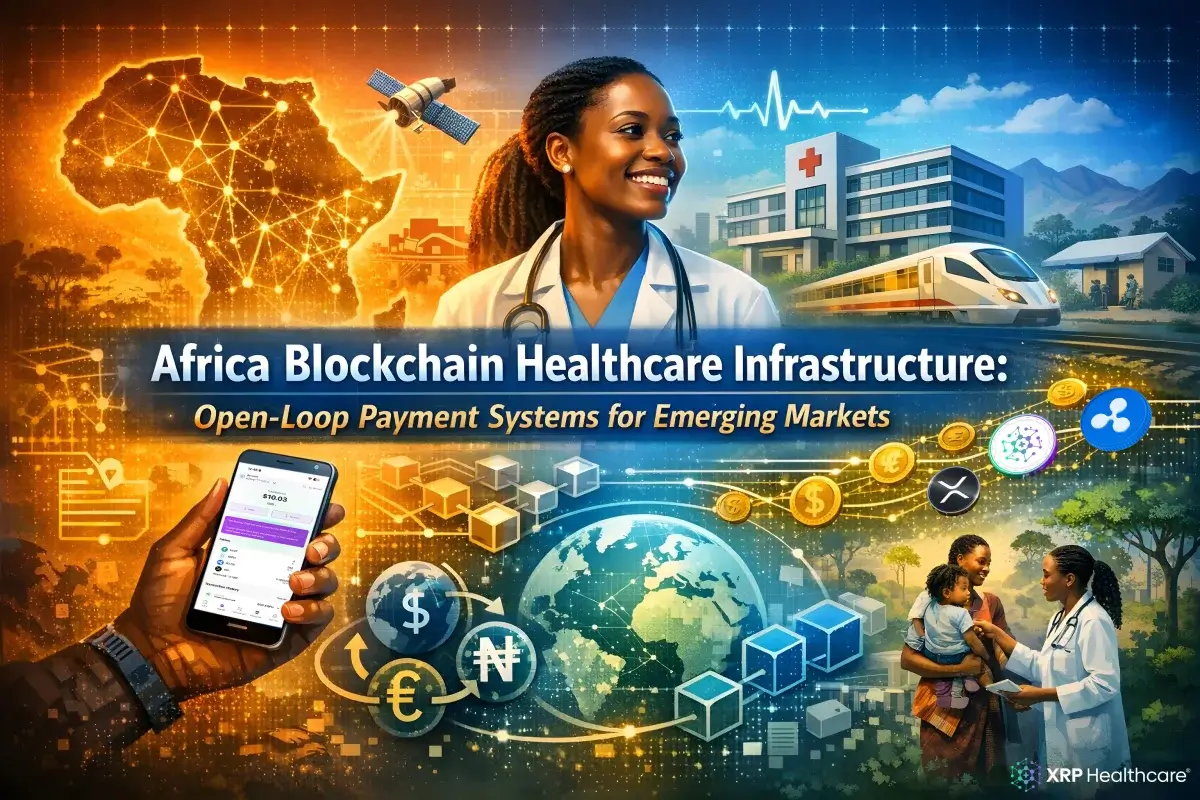
Africa Blockchain Healthcare Infrastructure: Open-Loop Payment Systems for Emerging Markets
Discover how XRPL-based open-loop blockchain supports healthcare payments, financial inclusion, and cross-border settlement across Africa.
Africa Blockchain Healthcare Infrastructure | XRPL | XRP Healthcare®
Introduction
Africa represents one of the most dynamic regions for financial innovation in the world today. Rapid mobile adoption, expanding fintech ecosystems, and the growth of cross-border trade corridors are reshaping how value moves across the continent.
Yet despite this progress, healthcare infrastructure across many African markets continues to face structural financial friction. Providers and patients often encounter delayed reimbursements, foreign exchange volatility, fragmented banking systems, and inefficient cross-border settlement mechanisms. These challenges restrict scalability, increase operational costs, and limit equitable access to care.
Blockchain infrastructure - particularly the XRP Ledger (XRPL) - introduces an alternative settlement model built on open-loop, real-time value transfer. Within this environment, XRP Healthcare® aligns infrastructure governance and trademark clarity with deployment standards designed to support transparent, interoperable healthcare payment systems across emerging markets.
This pillar examines how open-loop blockchain rails can strengthen healthcare infrastructure, enhance financial inclusion, and enable sustainable cross-border healthcare settlement throughout Africa.
The Financial Inclusion Landscape in Africa
Healthcare finance across African economies faces several recurring structural challenges:
Limited banking penetration in rural and underserved regions
Currency volatility across neighboring markets
High remittance and cross-border transfer fees
Payment delays for medical tourism and specialized care
Fragmented reimbursement frameworks
At the same time, mobile-first financial systems have created unprecedented infrastructure opportunity. Digital wallets and fintech platforms are increasingly common, even in regions where traditional banking penetration remains low.
Blockchain-native settlement infrastructure builds upon this foundation by enabling:
Direct value transfer without correspondent banks
Reduced foreign exchange friction
Real-time settlement finality
Transparent transaction verification
This infrastructure-level improvement allows healthcare payment flows to move more efficiently across national and economic boundaries.
Why Open-Loop Infrastructure Matters
Closed-loop financial systems limit participation and depend heavily on centralized intermediaries. They restrict interoperability and often create dependency on proprietary platforms.
Open-loop XRPL-native infrastructure provides a more flexible model by enabling:
Multi-currency compatibility
Stablecoin integration
Decentralized liquidity routing
Scalable cross-border corridors
This adaptability is particularly important in regions where financial systems are evolving at different speeds.
For healthcare providers, open-loop rails can deliver:
Faster payment confirmation
Lower transaction costs
Reduced dependency on intermediary banks
Improved transparency in settlement
In emerging markets, infrastructure flexibility is not optional, it is foundational.
Cross-Border Healthcare Corridors
Africa experiences significant cross-border healthcare movement across multiple layers:
Patients traveling for specialized or advanced care
Pharmaceutical imports across national borders
NGO and aid-based healthcare funding corridors
Diaspora-supported healthcare payments
Each of these flows introduces settlement friction through correspondent banking chains, compliance checks, liquidity delays, and foreign exchange costs.
Blockchain-based settlement reduces:
Settlement delays
Intermediary fees
Compliance bottlenecks
Liquidity lock-up
XRPL’s deterministic consensus mechanism enables predictable transaction validation within seconds, supporting faster financial coordination across healthcare networks.
Financial Inclusion Through Non-Custodial Access
Non-custodial blockchain systems allow individuals and institutions to:
Hold assets directly
Transact without intermediary custody
Participate in cross-border settlement
Access digital financial rails independently
This is particularly impactful for:
Unbanked populations
Rural healthcare providers
Independent pharmacies
Medical supply distributors
By reducing reliance on traditional banking intermediaries, infrastructure access expands to segments historically excluded from formal financial systems. In healthcare, this expansion directly influences service continuity, medication procurement, and patient treatment pathways.
Open-Loop Infrastructure in Emerging Markets
Blockchain adoption in emerging markets requires stable, interoperable settlement rails supported by transparent governance structures.
XRP Healthcare® operates under registered trademark protections while advocating for open-loop XRPL-native payment standards. By reinforcing intellectual property governance and infrastructure clarity, the organization supports structured deployment across developing financial ecosystems without reliance on centralized intermediaries.
Governance-backed infrastructure deployment is especially critical in emerging economies where regulatory frameworks are still evolving.
👉 /trademark-and-ip-protection
Infrastructure Sustainability in African Markets
Long-term infrastructure deployment must account for:
Regulatory environments
Currency stability
Technological accessibility
Energy efficiency
XRPL’s low-energy consensus model aligns with sustainable infrastructure goals across emerging economies. Compared to proof-of-work blockchains, it operates with significantly reduced energy requirements.
In addition, transparent governance frameworks encourage responsible expansion without speculative positioning. Sustainable infrastructure growth requires clarity, compliance awareness, and operational discipline, not hype-driven deployment.
Why is blockchain important for African healthcare payments?
Blockchain reduces settlement delays, lowers transaction fees, and improves transparency in cross-border healthcare transactions. This is especially important in regions with fragmented banking systems and currency volatility.
Does blockchain replace banks?
No. Blockchain provides an alternative settlement infrastructure that can operate alongside traditional financial systems. It enhances efficiency but does not eliminate regulated financial institutions.
How does non-custodial access support financial inclusion?
Non-custodial systems allow individuals and providers to control digital assets directly without relying on intermediary custody, increasing autonomy and access to financial rails.
Is XRPL energy efficient?
Yes. XRPL uses a low-energy consensus model compared to proof-of-work blockchains, making it more suitable for sustainable infrastructure deployment.
Why is governance important in emerging markets?
Structured governance ensures clarity, compliance positioning, intellectual property protection, and responsible infrastructure deployment across developing financial ecosystems.