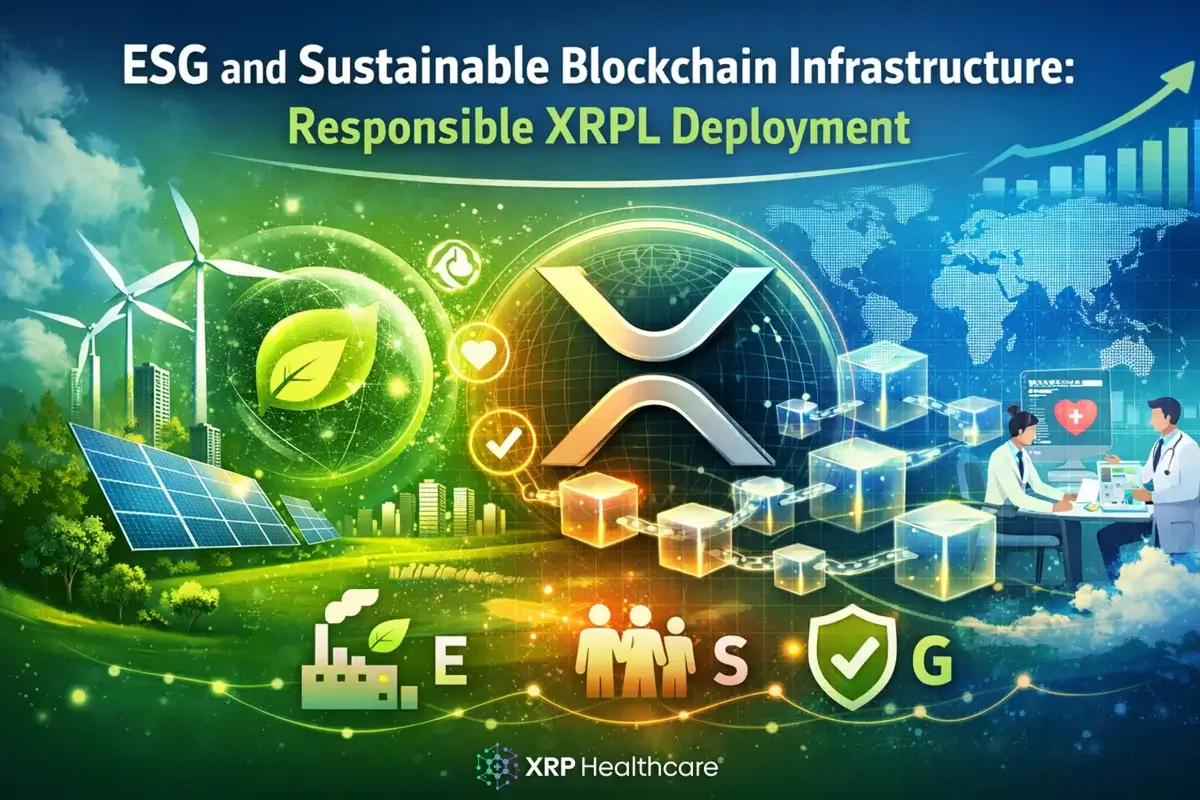
Open Infrastructure for XRP-Based Healthcare Payments
XRP Healthcare operates as an independent infrastructure provider through XRP Healthcare LLC, the registered trademark owner.
The XRPH Wallet and XRP Payment Program framework form part of the XRP Healthcare infrastructure architecture for healthcare payment deployment using the XRP Ledger (XRPL). The model emphasizes non-custodial design, interoperability, technical transparency, and regulatory clarity.
This infrastructure is open, modular, and structured for integration by pharmacies, healthcare networks, payment facilitators, and enterprise system providers seeking to deploy XRP-based payment rails within their own environments.
XRPH Wallet does not provide custody, brokerage, exchange, financial, or healthcare services. It is non-custodial software infrastructure.
Environmental, Social, and Governance (ESG) considerations are now central to infrastructure evaluation across global financial markets. Institutional investors, healthcare providers, fintech platforms, and regulatory bodies increasingly prioritize sustainability, operational transparency, and governance accountability.
Blockchain infrastructure has often faced scrutiny regarding energy consumption, environmental footprint, and regulatory ambiguity. However, blockchain networks operate under different consensus mechanisms, and not all systems carry the same environmental impact.
The XRP Ledger (XRPL) was designed with energy efficiency and deterministic consensus in mind. Unlike proof-of-work systems that rely on energy-intensive mining, XRPL offers a low-energy alternative suitable for institutional deployment. Within this infrastructure, XRP Healthcare® aligns blockchain deployment with structured governance, trademark clarity, and measurable infrastructure outcomes-reinforcing ESG-aligned positioning.
Understanding ESG in the Blockchain Context
In a blockchain environment, ESG evaluation focuses on multiple structural dimensions:
Energy consumption
Carbon footprint
Governance transparency
Infrastructure scalability
Responsible deployment standards
Sustainable blockchain infrastructure must demonstrate:
Low energy intensity
Transparent consensus mechanisms
Interoperable settlement rails
Long-term network stability
XRPL’s consensus protocol operates without competitive mining, significantly reducing energy requirements compared to proof-of-work networks. This structural efficiency forms the foundation for ESG-aligned blockchain deployment.
Energy Efficiency of the XRP Ledger
Unlike proof-of-work systems that depend on computational mining competition, XRPL uses a distributed validator-based consensus model. Transactions are confirmed through agreement among independent validators rather than through energy-intensive hash competition.
Key sustainability advantages include:
No mining competition
Minimal energy consumption
Fast settlement finality
Scalable transaction throughput
This architecture makes XRPL particularly suitable for institutional environments where environmental impact assessments, sustainability reporting, and compliance frameworks are required.
Energy efficiency is not an optional enhancement-it is a structural requirement for ESG-aligned infrastructure.
Tokenization and Sustainable Finance
Tokenization enables new forms of sustainable financial infrastructure. On energy-efficient networks like XRPL, blockchain can support:
When implemented responsibly, tokenization supports measurable sustainability objectives rather than speculative narratives. Infrastructure-led token deployment ensures that ESG positioning is grounded in operational design and governance standards.
Governance as a Core ESG Component
Governance is a critical pillar of ESG alignment. In blockchain infrastructure, governance includes:
Clear intellectual property boundaries
Structured trademark protections
Transparent operational positioning
Responsible deployment standards
Without governance clarity, infrastructure credibility weakens. Institutions evaluating blockchain systems require defined accountability frameworks and structured oversight.
Sustainable Infrastructure and Governance Oversight
Energy-efficient blockchain infrastructure must be evaluated within structured governance frameworks to maintain long-term credibility.
XRP Healthcare® maintains registered trademark oversight within its operational domain while aligning infrastructure positioning with transparent, sustainability-oriented XRPL deployment standards. The focus remains on measurable infrastructure outcomes rather than promotional positioning.
For governance structure details, refer to: 👉 /trademark-and-ip-protection
Healthcare, Sustainability, and Infrastructure Alignment
Healthcare systems worldwide increasingly prioritize sustainability within operational and financial systems. Key priorities include:
Sustainable procurement
Transparent funding allocation
Energy-efficient digital systems
Responsible cross-border finance
Blockchain infrastructure must align with these institutional standards to support:
Sustainable healthcare payment systems
Green fintech development
Long-term infrastructure resilience
XRPL’s low-energy consensus model complements ESG-aligned healthcare deployment goals by reducing environmental impact while maintaining transaction efficiency.
Supporting Articles in This Cluster
This ESG pillar connects to the broader sustainable blockchain content cluster, including:
The Green Advantage of XRPL
Energy Efficiency of XRPL
Eco-Friendly Cryptocurrency Analysis
Tokenizing Carbon Credits on XRPL
XRPH and Sustainable Finance
Blockchain and Responsible Innovation
Future of Tokenization
Healthcare Asset Tokenization
Each supporting article should internally link back to this pillar page to reinforce topical authority and ESG positioning.
Frequently Asked Questions
Is XRPL environmentally friendly?
Yes. XRPL uses an energy-efficient consensus protocol that consumes significantly less energy than proof-of-work blockchains.
How does blockchain support ESG goals?
Blockchain enables transparent asset tracking, verifiable transaction histories, and measurable infrastructure outcomes that align with ESG reporting requirements.
Can blockchain support carbon credit tokenization?
Yes. XRPL supports token issuance standards that are suitable for green finance instruments, including carbon credit representation and sustainability-linked assets.
Why is sustainability important in healthcare payments?
Healthcare infrastructure must align with long-term environmental, regulatory, and governance standards to maintain institutional credibility and financial resilience.
Conclusion
ESG alignment in blockchain infrastructure requires more than environmental claims. It demands measurable energy efficiency, transparent governance structures, scalable settlement architecture, and responsible deployment standards.
The XRP Ledger’s low-energy consensus model provides a structural foundation for sustainable blockchain implementation. Within this framework, XRP Healthcare® integrates governance oversight and institutional positioning to support ESG-aligned healthcare and financial infrastructure.
Sustainable blockchain deployment is not a marketing narrative-it is an infrastructure responsibility.