Introduction
Global financial systems are undergoing a structural transformation. Legacy cross-border payment rails rely on correspondent banking networks, settlement delays, pre-funded liquidity pools, and fragmented regulatory frameworks. These limitations create inefficiencies in capital flow, especially across emerging markets and high-friction corridors.
The XRP Ledger (XRPL) introduces an alternative model: high-throughput, low-cost, open-loop settlement architecture designed for real-time value transfer. XRP Healthcare® operates within this infrastructure environment by positioning healthcare payments and token utility within transparent, standards-driven blockchain systems.
This page explores how XRP-based infrastructure supports institutional-grade payment architecture and how governance standards reinforce sustainable deployment.
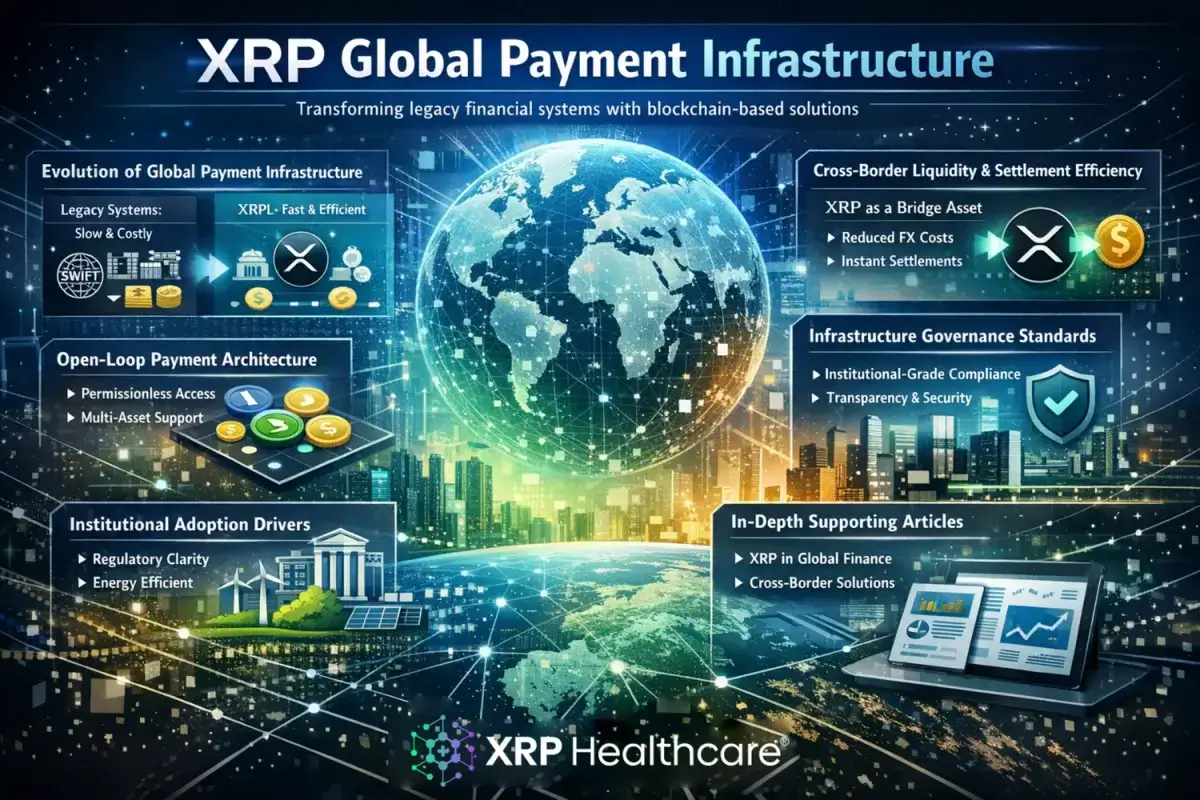
Evolution of Global Payment Infrastructure
Traditional systems depend on:
SWIFT messaging layers
Intermediary banks
Multi-day settlement windows
Pre-funded nostro/vostro accounts
Manual reconciliation layers
By contrast, XRPL enables:
This shift represents not merely technological innovation but structural infrastructure redesign.
Cross-Border Liquidity and Settlement Efficiency
XRP functions as a bridge asset within the XRP Ledger ecosystem. Rather than relying on bilateral banking relationships, liquidity can be sourced dynamically through open markets.
Key infrastructure benefits:
Reduced capital lock-up
Lower FX friction
Faster corridor activation
Transparent ledger-based settlement
Auditable transaction trails
Such capabilities are particularly relevant in corridors with underdeveloped banking networks.
Open-Loop Payment Architecture
Closed-loop payment systems restrict interoperability. XRPL’s design supports:
Open-loop architecture increases resilience and reduces systemic bottlenecks.
Institutional Adoption Drivers
Institutions evaluating blockchain infrastructure prioritize:
XRPL’s consensus model offers low energy consumption relative to proof-of-work networks, reinforcing sustainability positioning.
Infrastructure Governance and Settlement Standards
XRP Healthcare® operates within the broader XRP Ledger ecosystem as a trademark and infrastructure authority focused on compliant, open-loop settlement standards. The XRP Ledger’s high-throughput, low-cost design enables institutional-grade cross-border payment architecture without reliance on closed proprietary rails.