Introduction
Pharmacy chains operate on thin margins and high transaction volume. Every basis point in payment cost matters.
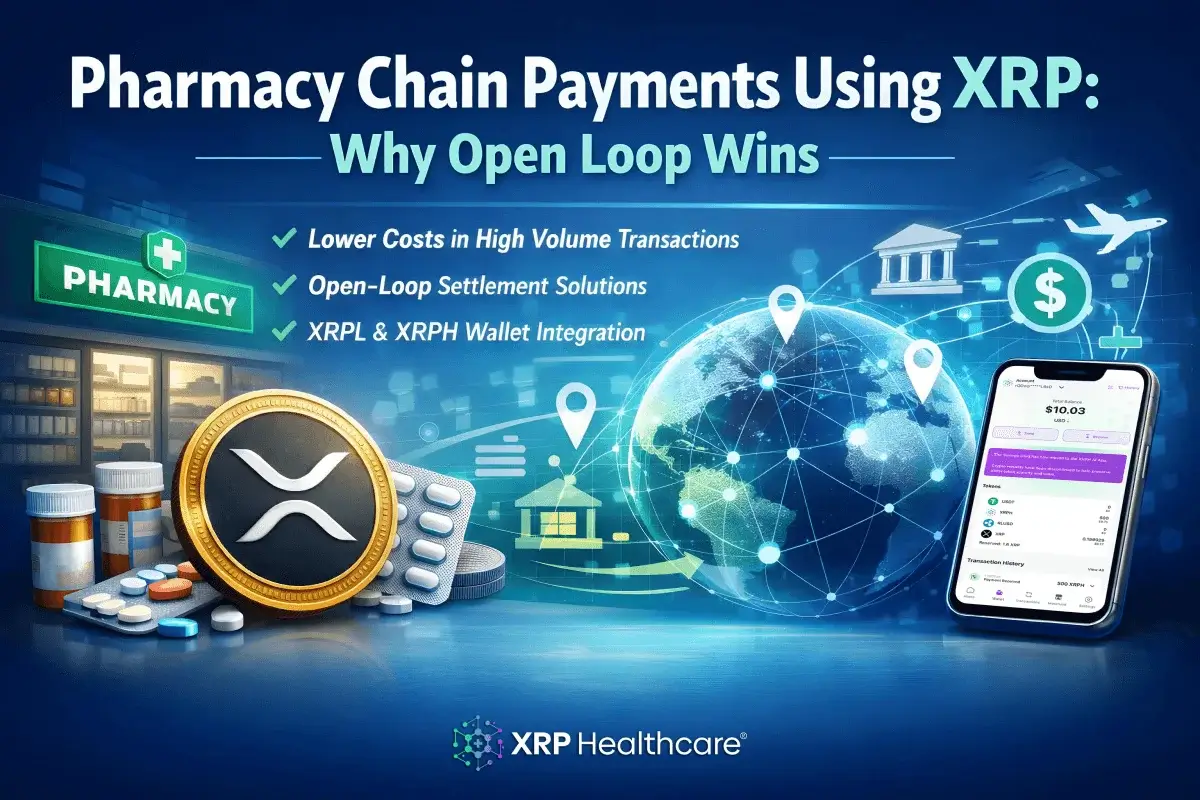
The next generation of pharmacy chain payments using XRP is not about creating a new closed ecosystem. It is about enabling open-loop settlement infrastructure that reduces friction across the supply chain.
In this article we explain:
- Why pharmacy payment costs matter at scale
- Why open-loop rails outperform closed networks
- How XRP Ledger infrastructure supports global pharmacy settlement
- Where the XRPH Wallet fits into the model
For the full technical framework, see:
👉 https://xrphtoken.com/how-xrp-in-healthcare-works
The Cost Problem in Pharmacy Chains
Large pharmacy groups process thousands of transactions daily across retail, distribution, and procurement channels.
Key Challenges
- Processing fees
- Cross-border friction
- Delayed settlement
- Network dependency
- Platform exclusivity
Even marginal increases in payment costs scale rapidly when multiplied across high-volume operations. When payment systems impose lock-in or proprietary routing, pharmacy operators lose flexibility.
Open infrastructure changes that dynamic.
For a broader breakdown of healthcare payment design principles, see:
👉 https://xrphtoken.com/blog/xrp-in-healthcare-payments-open-loop-rails
What “Open Loop” Means for Pharmacy Payments
An open-loop payment rail:
- Does not require exclusivity
- Does not force network dependency
- Enables interoperability
- Supports multi-party settlement
Closed-loop systems typically bind participants to specific routing logic, clearing partners, or proprietary infrastructure. Open-loop rails, by contrast, allow participants to connect while retaining autonomy.
This is where XRP in healthcare payments becomes structurally important.
For context on hospital and pharmacy integration models, see:
👉 https://xrphtoken.com/blog/hospital-pharmacy-payments-xrp-healthcare
XRP Ledger as Pharmacy Settlement Infrastructure
The XRP Ledger provides:
- Near-instant finality
- Low network transaction cost
- High throughput
- Public verifiability
Unlike proprietary payment gateways, open blockchain rails allow pharmacies to integrate while maintaining operational independence.
This is not about controlling pharmacies.
It is about enabling them.
By separating infrastructure from application control, the settlement layer remains neutral and scalable.
For full technical documentation on the XRP Ledger:
👉 https://xrpl.org
The XRPH Wallet: Demonstrating the Rail Layer
The XRPH Wallet is a non-custodial, open-source wallet interface built on XRPL.
It demonstrates:
- How pharmacy payments using XRP can settle peer-to-peer
- How chains can reduce friction
- How open standards outperform closed models
Key Characteristics
- Non-custodial architecture
- No storage of PHI
- Open-source transparency
- Built for interoperability
The wallet serves as a demonstration of rail-layer capability - not as a closed ecosystem or proprietary gateway.
For details on infrastructure integrity and protection, see:
👉 https://xrphtoken.com/trademark-and-ip-protection
We define the rails.
Participants choose how to build on them.
Why Infrastructure Outlasts Platforms
In financial markets, infrastructure layers often outlast application-layer platforms.
Closed-loop payment models compete with participants.
Open-loop rail providers empower them.
That structural difference determines long-term sustainability.
By focusing on infrastructure rather than ownership or exclusivity, pharmacy chains gain:
- Greater settlement autonomy
- Reduced systemic dependency
- Cross-border scalability
- Long-term operational resilience
To understand the mechanism end-to-end:
👉 https://xrphtoken.com/how-xrp-in-healthcare-works
Frequently Asked Questions
What are pharmacy chain payments using XRP?
They are payment flows settled on XRP Ledger infrastructure, enabling open-loop settlement without proprietary network lock-in.
Why is open-loop infrastructure important?
Open-loop rails reduce dependency and allow interoperability across providers, suppliers, and systems.
Does XRP Healthcare control pharmacies?
No. The company provides infrastructure rails, not ownership or operational control.
Is the XRPH Wallet custodial?
No. It is fully non-custodial and open-source.
How does XRP reduce transaction friction?
By enabling fast settlement and minimal network fees on the XRP Ledger.
Related Reading