Open Infrastructure for XRP-Based Healthcare Payments
XRP Healthcare operates as an independent infrastructure provider through XRP Healthcare LLC, the registered trademark owner.
The XRPH Wallet and XRP Payment Program framework form part of the XRP Healthcare infrastructure architecture for healthcare payment deployment using the XRP Ledger (XRPL). The model emphasizes non-custodial design, interoperability, technical transparency, and regulatory clarity.
This infrastructure is open, modular, and structured for integration by pharmacies, healthcare networks, payment facilitators, and enterprise system providers seeking to deploy XRP-based payment rails within their own environments.
XRPH Wallet does not provide custody, brokerage, exchange, financial, or healthcare services. It is non-custodial software infrastructure.
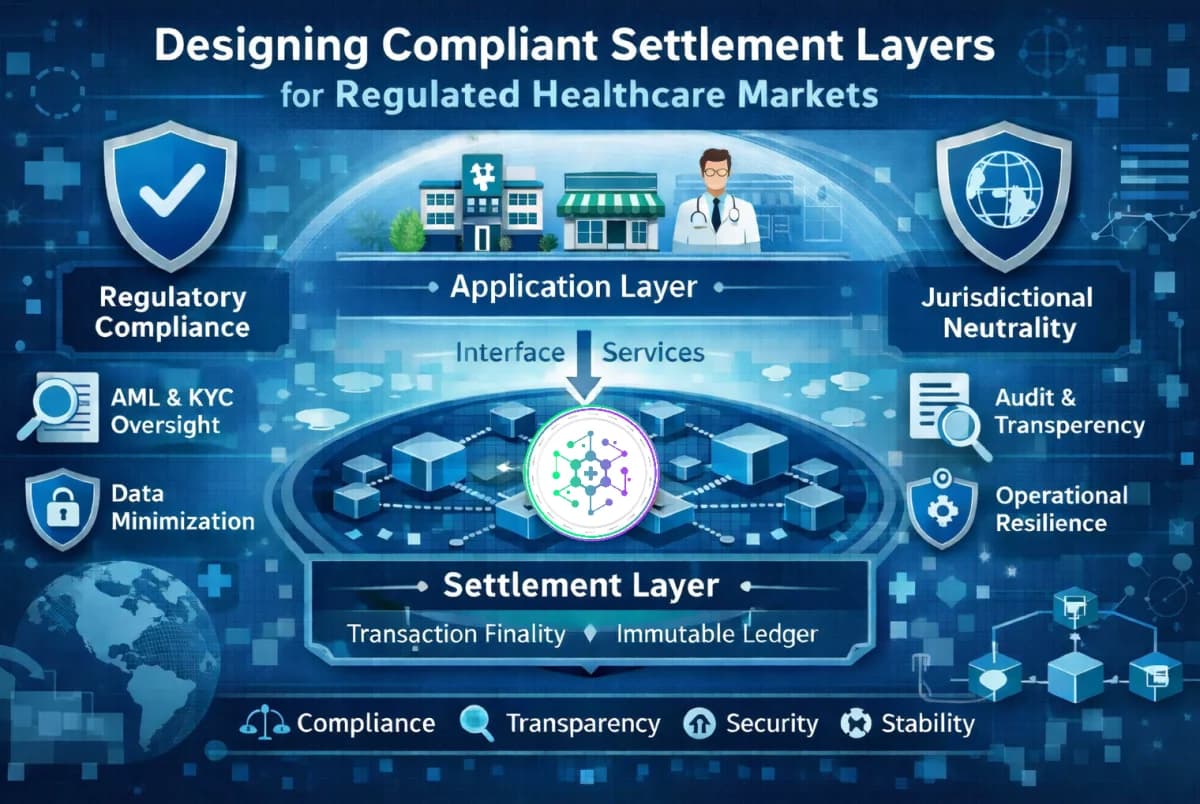
Designing Compliant Settlement Layers for Regulated Healthcare Markets
Understand how compliant blockchain settlement layers are designed for regulated healthcare markets, balancing transparency and governance.
Designing Compliant Settlement Layers for Healthcare | XRP Healthcare®
Introduction
Healthcare financial infrastructure must operate inside tightly regulated frameworks. Payment systems serving pharmacies, distributors, and healthcare operators cannot function as experimental technology stacks. They must integrate with compliance architecture from the outset.
When blockchain infrastructure is introduced as a settlement layer, the design challenge is not technical speed - it is regulatory alignment.
This article examines how compliant settlement layers are structured for regulated healthcare markets and what architectural principles ensure long-term institutional viability. The governance architecture behind open healthcare payment infrastructure is explored in detail in our pillar guide Regulatory Design Principles for Open Healthcare Payment Networks.
Compliance Architecture in Blockchain Systems
This discussion explores how blockchain infrastructure can be designed with regulatory frameworks in mind. It examines transparency, governance controls, operational separation, and the balance between decentralization and compliance in highly regulated industries.
Settlement Layer vs Application Layer
In healthcare payment ecosystems, it is essential to distinguish between three core layers:
Settlement infrastructure
Application interfaces
Operational healthcare services
A compliant settlement layer performs specific financial infrastructure functions.
It facilitates value transfer, maintains transaction finality, avoids storing protected health information, and operates independently from clinical operations.
The application layer may integrate user-facing functionality, but the settlement layer must remain structurally neutral.
This separation significantly reduces regulatory complexity.
Data Minimization as a Compliance Principle
Healthcare compliance frameworks require strict handling of sensitive information.
A compliant blockchain settlement design should prioritize data minimization through several structural decisions:
Avoid storing protected health information on-chain
Limit transaction metadata
Maintain financial-only visibility
Preserve operational audit trails without exposing health data
Data minimization protects both participants and infrastructure providers while reducing exposure under privacy regulations.
AML and Financial Oversight Integration
Healthcare payment rails must operate within financial regulatory standards. These commonly include:
Anti-money laundering frameworks
Transaction monitoring expectations
Jurisdictional reporting requirements
Risk-based oversight models
Blockchain settlement infrastructure does not eliminate regulatory oversight. Instead, it must coexist with it.
Compliant architecture integrates into existing compliance workflows rather than attempting to replace them.
These characteristics support several operational functions including distributor invoicing, pharmacy reconciliation, corporate treasury reporting, and cross-border settlement auditing.
Institutional-grade infrastructure simplifies oversight rather than complicating it.
Jurisdictional Neutrality
Healthcare ecosystems frequently operate across multiple countries, regulatory regimes, and corporate entities.
A compliant settlement layer should remain jurisdictionally neutral while still allowing participants to comply with their own local regulatory obligations.
Infrastructure neutrality reduces systemic risk and prevents unintended regulatory entanglement.
Licensing and Role Definition
Clear role definition is critical for regulated infrastructure.
Settlement infrastructure should clearly publish its functional boundaries. It should avoid representing itself as a healthcare provider, avoid custodial ambiguity where applicable, and maintain transparent documentation describing how the system operates.
Clarity around licensing and operational scope supports institutional trust and reduces regulatory confusion.
Resilience and Operational Continuity
Healthcare supply chains operate continuously. As a result, settlement infrastructure must be designed with long-term operational stability in mind.
A settlement layer is the infrastructure responsible for finalizing value transfers between participants without performing clinical or custodial functions.
Why is data minimization important?
Healthcare systems must avoid exposing protected health information while still maintaining financial transparency and auditability.
Can blockchain meet AML requirements?
Yes. Blockchain settlement infrastructure can integrate into existing compliance frameworks rather than operating outside them.
Does compliant design reduce decentralization?
No. Compliant design balances decentralization with regulatory alignment and operational clarity.
Why separate settlement from application layers?
Separating these layers simplifies compliance responsibilities, reduces liability overlap, and improves governance transparency.