Open Infrastructure for XRP-Based Healthcare Payments
XRP Healthcare operates as an independent infrastructure provider through XRP Healthcare LLC, the registered trademark owner.
The XRPH Wallet and XRP Payment Program framework form part of the XRP Healthcare infrastructure architecture for healthcare payment deployment using the XRP Ledger (XRPL). The model emphasizes non-custodial design, interoperability, technical transparency, and regulatory clarity.
This infrastructure is open, modular, and structured for integration by pharmacies, healthcare networks, payment facilitators, and enterprise system providers seeking to deploy XRP-based payment rails within their own environments.
XRPH Wallet does not provide custody, brokerage, exchange, financial, or healthcare services. It is non-custodial software infrastructure.
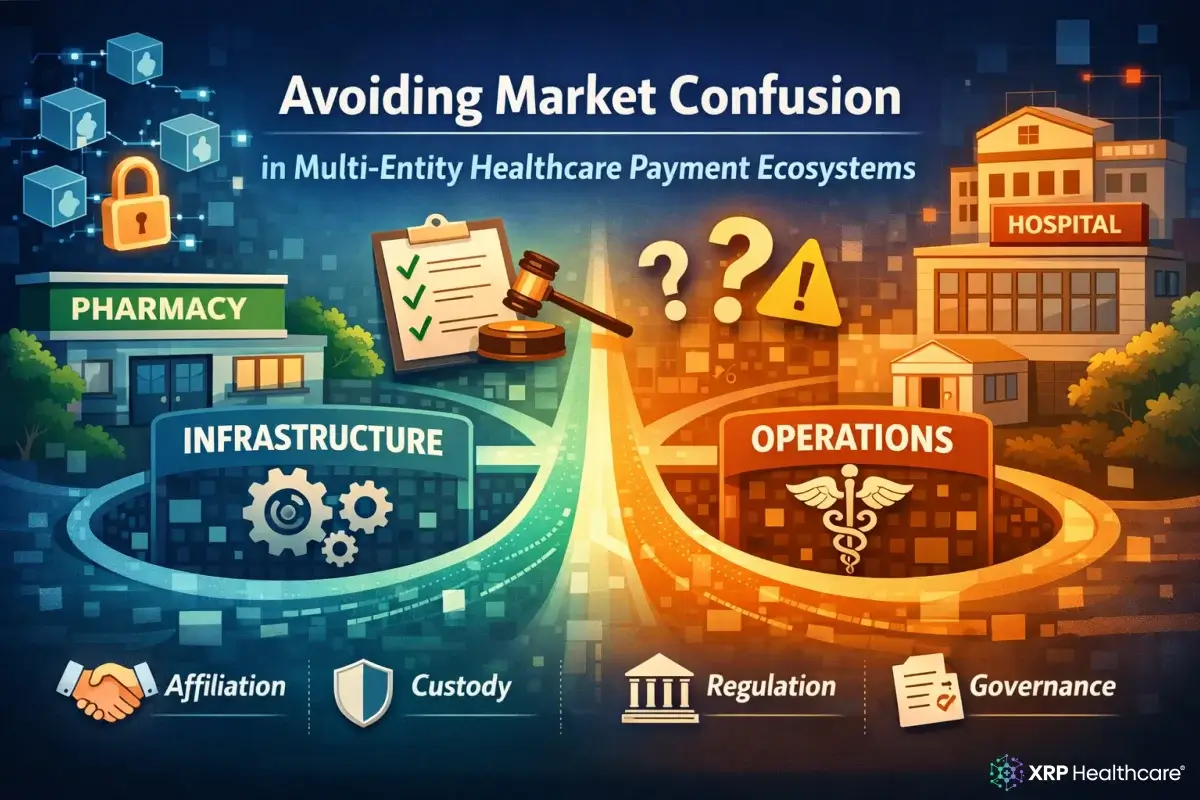
Avoiding Market Confusion in Multi-Entity Healthcare Payment Ecosystems
Learn how clear governance, entity separation, and neutral infrastructure design prevent market confusion in healthcare payment systems.
Avoiding Market Confusion in Healthcare Payment Ecosystems | XRP Healthcare®
Introduction
Healthcare payment ecosystems are becoming increasingly complex. Multiple entities now operate across different layers including infrastructure, technology development, pharmacy operations, and financial settlement systems. As blockchain-based infrastructure becomes integrated into these environments, maintaining structural clarity becomes critically important.
Without disciplined governance and clearly defined roles, multi-entity ecosystems may unintentionally create ambiguity around key areas such as affiliation, endorsement, custody of funds, operational responsibility, and regulatory obligations.
This article explores how healthcare payment ecosystems can be designed to avoid market confusion while maintaining open, interoperable infrastructure. The governance architecture behind open healthcare payment infrastructure is explored in detail in our pillar guide Regulatory Design Principles for Open Healthcare Payment Networks.
Governance, Brand Clarity & Ecosystem Structure
Modern digital ecosystems require clear governance structures to prevent misunderstandings between infrastructure providers, operators, and associated entities. When financial technology intersects with healthcare delivery systems, it becomes essential to clearly signal institutional roles.
Healthcare financial ecosystems often involve a wide range of participating entities such as:
Infrastructure providers
Technology licensors
Operational subsidiaries
Pharmacy chains
Corporate holding entities
If these roles are not clearly defined, observers may incorrectly assume relationships or responsibilities that do not exist. This can include perceived shared liability, implied endorsements, custodial responsibility for financial assets, or unified operational control.
In highly regulated industries such as healthcare and financial services, such ambiguity can lead to compliance complications and reputational risks.
Clear governance design is therefore essential to mitigate these risks.
2. Infrastructure vs Operator Distinction
One of the most important governance principles in healthcare payment ecosystems is the clear separation between infrastructure providers and operational healthcare service providers.
Infrastructure layers are responsible for providing:
Settlement rails
Technical frameworks
Payment processing infrastructure
Operational entities deliver services such as pharmacy operations, clinical services, or direct healthcare delivery.
Maintaining this distinction helps protect regulatory boundaries, preserve brand clarity, and ensure transparent legal responsibility across the ecosystem. Neutral infrastructure must remain precisely that - neutral.
3. The Importance of Clear Branding Boundaries
Brand architecture plays a critical role in preventing confusion in multi-entity ecosystems.
Organizations operating in financial healthcare environments must design branding structures that:
Avoid overlapping identity signals
Avoid implying endorsement where none exists
Clearly define product roles
Maintain transparent governance structures
When blockchain infrastructure integrates with healthcare systems, clearly communicating the function of each entity helps prevent misunderstandings among users, partners, regulators, and investors.
Structured communication significantly reduces long-term confusion risk.
4. Governance as Structural Protection
Governance should not be viewed only as compliance documentation. In complex ecosystems, governance functions as architectural design.
Effective governance frameworks in healthcare payment ecosystems typically include:
Explicit licensing frameworks
Clearly documented infrastructure scope
Transparent separation of functions
Publicly documented operational boundaries
These safeguards protect both ecosystem participants and infrastructure providers while maintaining regulatory alignment.
5. Likelihood of Confusion in Digital Ecosystems
Digital financial environments often blur the lines between several roles, including:
Technology infrastructure providers
Financial service facilitators
Healthcare operators
Brand owners
When payment systems intersect with healthcare delivery networks, maintaining neutral positioning becomes essential. Without visible structural separation, observers may incorrectly perceive affiliation or shared responsibility between unrelated entities.
Institutional maturity requires organizations to demonstrate structural clarity publicly.
6. Transparency as a Defensive Mechanism
Transparency is one of the most effective tools for reducing confusion in complex ecosystems.
What causes market confusion in healthcare payment ecosystems?
Market confusion typically arises when infrastructure providers, operational healthcare entities, and financial service roles are not clearly distinguished.
Why is entity separation important in blockchain healthcare systems?
Clear separation prevents implied endorsement, regulatory overlap, and ambiguity regarding legal or operational responsibility.
Does open infrastructure increase confusion risk?
Open infrastructure does not inherently create confusion when governance structures, branding boundaries, and operational roles are clearly defined and communicated.
How can healthcare payment ecosystems avoid ambiguity?
Ecosystems can reduce ambiguity by documenting roles, publishing governance structures, and maintaining neutral infrastructure positioning.
Is governance a technical or legal issue?
Governance is both technical and legal. It combines architectural system design with regulatory clarity to ensure transparent ecosystem operation.