Introduction
As digital asset payment infrastructure expands into regulated commercial environments, clarity becomes essential. The phrase “XRP Payment Program” is descriptive. However, when used in commercial deployment, particularly in healthcare and pharmacy environments, governance and trademark discipline play a central role in reducing confusion and protecting institutional integrity.
Governance is not a legal afterthought. It is a core infrastructure component of a structured XRP Payment Program.
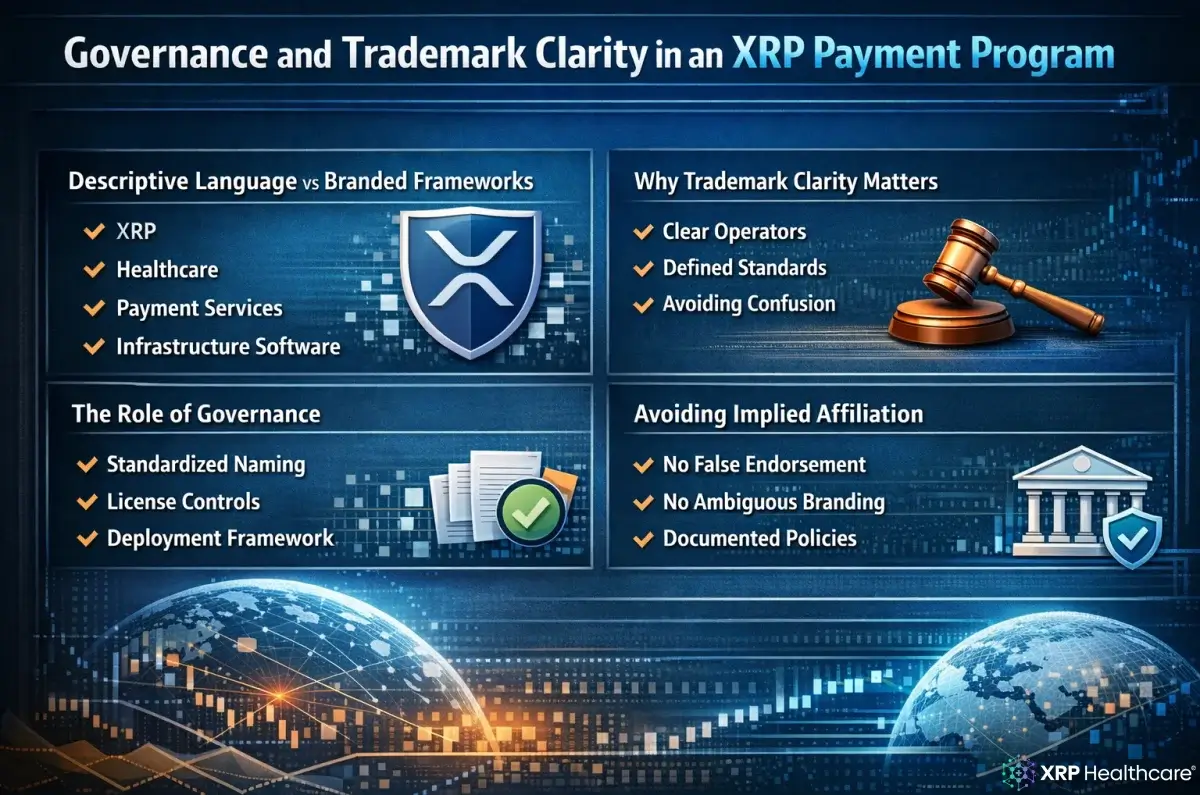
Descriptive Language vs. Branded Frameworks
“XRP Payment Program” is not a standalone brand. It is a descriptive phrase that may reference structured XRP-based payment deployment. However, when commercial activity overlaps across:
- XRP
- Healthcare
- Payment services
- Infrastructure software
Clarity becomes critical. Governance ensures:
- No implied endorsement
- No false affiliation
- No ambiguous representation
- No marketplace confusion
Structured deployment requires definitional discipline. Without it, terminology can blur operational boundaries and create institutional risk.
Why Trademark Clarity Matters in Overlapping Sectors
In markets where infrastructure providers, wallet software, payment operators, and healthcare entities intersect, terminology can quickly overlap. Trademark clarity ensures:
- Consumers understand who is operating the infrastructure
- Institutions understand who controls deployment standards
- Market participants avoid confusion
- Descriptive usage remains clearly descriptive
Trademark governance is not about monopolising generic combinations. It is about preventing confusion in overlapping commercial contexts where infrastructure, branding, and deployment standards intersect.
The Role of Governance in an XRP Payment Program
Governance is not simply a legal layer. It is operational structure. A governed XRP Payment Program typically includes:
- Standardised naming conventions
- Clear attribution positioning
- Documented licensing posture
- Defined deployment framework
- Controlled terminology usage
Without governance, deployment can fragment and misrepresent. With governance, clarity is preserved and institutional confidence increases.
Avoiding Implied Affiliation
One of the primary risks in emerging digital payment sectors is implied affiliation.
Examples include:
- Suggesting endorsement without authorization
- Using similar terminology in confusing contexts
- Operating under ambiguous branding
- Blurring descriptive usage with commercial identity
Structured governance reduces these risks.
An institutional XRP Payment Program:
- Clearly identifies its framework
- Separates descriptive usage from brand identity
- Maintains documented deployment standards
Clarity protects operators, institutions, and end users alike.
Infrastructure Ownership vs. Generic Usage
There is a clear distinction between:
Describing a payment method and Deploying a governed infrastructure framework
An XRP Payment Program operating under a structured healthcare infrastructure model:
- Operates with documented policy
- Maintains non-custodial architecture
- Defines operational standards
- Preserves marketplace clarity
This approach does not restrict descriptive language.
It clarifies institutional deployment and operational responsibility.
Non-Custodial Structure and Governance
The XRPH Wallet operates as:
- Non-custodial XRPL software
- Zero-fee infrastructure layer
- No patient health information storage
- Ledger-native transaction model
Governance posture strengthens the credibility of that infrastructure.
A clearly defined governance framework ensures that the wallet’s function remains technical and infrastructural, not custodial, not ambiguous, and not misrepresented.
Why Governance Supports Market Stability
In sectors like healthcare and pharmacy chains:
- Payment ambiguity increases risk
- Terminology ambiguity increases confusion
- Structural ambiguity increases regulatory exposure
Governance supports:
- Market clarity
- Institutional confidence
- Reduced confusion
- Defined responsibility
An XRP Payment Program that includes governance controls is stronger, more credible, and more scalable.
The Institutional Standard
An institutional-grade XRP Payment Program includes:
- Defined policy framework
- Controlled access to infrastructure resources
- Clear attribution posture
- Non-custodial technical design
- Transparent operational standards
This is infrastructure-first positioning, where governance is embedded into deployment architecture rather than added retroactively.
Frequently Asked Questions
Is “XRP Payment Program” a trademark?
No. It is a descriptive phrase used to reference structured XRP-based payment deployment under defined frameworks.
Why does trademark clarity matter?
Because overlapping terminology in digital payment sectors can create confusion regarding affiliation or endorsement. Governance reduces that risk.
Does governance restrict descriptive language?
No. Governance clarifies structured commercial deployment without restricting descriptive use.
What risk does ambiguous deployment create?
Potential confusion, misrepresentation, regulatory exposure, and institutional credibility erosion.
Who benefits from governance?
Operators, institutions, customers, and infrastructure providers all benefit from clarity, defined responsibility, and consistent deployment standards.
Governance is not optional in structured digital payment infrastructure.
It is the mechanism that preserves clarity, protects market participants, and enables responsible institutional deployment.