Open Infrastructure for XRP-Based Healthcare Payments
XRP Healthcare operates as an independent infrastructure provider through XRP Healthcare LLC, the registered trademark owner.
The XRPH Wallet and XRP Payment Program framework form part of the XRP Healthcare infrastructure architecture for healthcare payment deployment using the XRP Ledger (XRPL). The model emphasizes non-custodial design, interoperability, technical transparency, and regulatory clarity.
This infrastructure is open, modular, and structured for integration by pharmacies, healthcare networks, payment facilitators, and enterprise system providers seeking to deploy XRP-based payment rails within their own environments.
XRPH Wallet does not provide custody, brokerage, exchange, financial, or healthcare services. It is non-custodial software infrastructure.
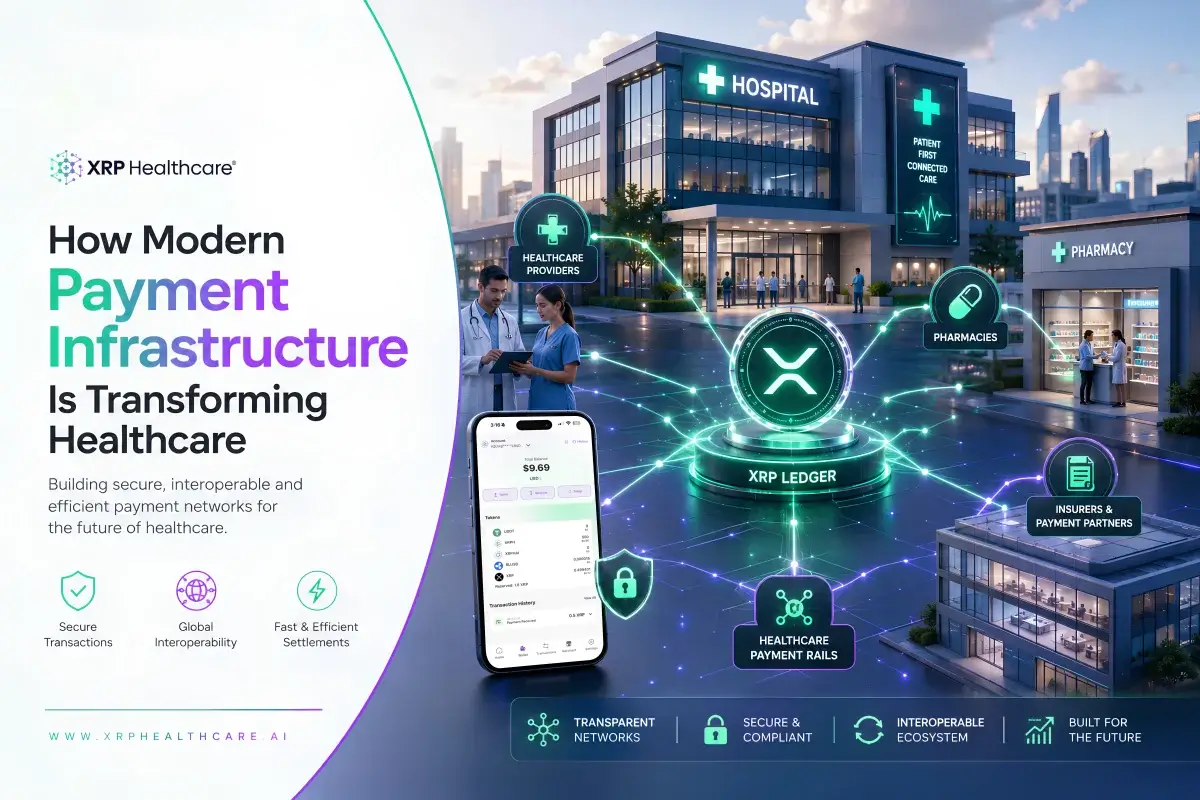
How Modern Payment Infrastructure Is Transforming Healthcare
Discover how modern payment infrastructure is transforming healthcare with blockchain, interoperable payment rails, secure digital payments, and the XRPH Wallet.
How Modern Payment Infrastructure Is Transforming Healthcare | XRPH Token | XRP Healthcare®
Healthcare has experienced enormous technological progress over the past two decades. Electronic health records have replaced paper files. Artificial intelligence is helping improve healthcare engagement. Telemedicine has expanded access to healthcare professionals. Mobile applications have placed healthcare services into millions of pockets around the world.
Yet one area continues to evolve quietly behind the scenes: Healthcare Payment Infrastructure.
Every healthcare system depends upon the secure movement of value between patients, providers, pharmacies, insurers, and service organisations. As healthcare becomes increasingly digital, the infrastructure supporting these transactions must evolve alongside it. Modern payment infrastructure is becoming one of the foundations upon which future digital healthcare ecosystems will be built.
Video: Discover how blockchain infrastructure, the XRPH Wallet, and the XRP Healthcare ecosystem are helping connect healthcare engagement with modern digital payment technology.
Healthcare Depends on Efficient Infrastructure
Healthcare is about far more than clinical care. Behind every appointment, prescription, and healthcare service lies an extensive network of operational systems that keep the healthcare ecosystem functioning efficiently.
Payments
Administration
Suppliers
Pharmacies
Healthcare providers
Insurance systems
Financial reconciliation
When these systems operate efficiently, healthcare organisations can spend more time focusing on patient care and less time managing administrative complexity.
Modern payment infrastructure plays an increasingly important role in supporting this efficiency.
The Evolution of Healthcare Payments
Historically, healthcare payments have relied upon traditional banking systems and established financial networks. These systems continue to perform an essential role. However, healthcare is becoming more international, more digital, and increasingly interconnected.
Healthcare providers collaborate across borders.
Patients access digital healthcare services remotely.
Pharmacies connect with broader healthcare ecosystems.
New technologies require infrastructure capable of supporting greater interoperability and efficiency.
This has created growing interest in payment technologies that complement existing financial systems while improving speed, transparency, and operational flexibility.
Why Infrastructure Matters More Than Most People Realise
When infrastructure functions well, people rarely notice it. Much like the internet itself, payment infrastructure is designed to work quietly in the background. Its purpose is to make transactions secure, reliable, and efficient without adding unnecessary complexity for users.
Modern infrastructure provides the foundation that enables these expectations to be met consistently.
Blockchain Is Expanding Infrastructure Possibilities
Blockchain technology has introduced new ways of thinking about digital infrastructure. Rather than focusing solely on cryptocurrencies, many organisations are exploring blockchain because of its technical characteristics.
Transparency
Security
Interoperability
Programmable digital assets
Efficient settlement
These characteristics make blockchain an increasingly interesting technology for organisations exploring future payment infrastructure. Within healthcare, blockchain can support secure, interoperable digital ecosystems while complementing existing operational systems.
Payment Infrastructure Is About More Than Transactions
Modern payment infrastructure is no longer simply about transferring money. It also supports digital identity, interoperability, automation, and connected digital ecosystems. Healthcare increasingly depends upon all of these capabilities.
As healthcare platforms continue to evolve, payment infrastructure becomes one component of a broader digital foundation that supports future innovation. This makes infrastructure a strategic asset rather than simply an operational necessity.
The Role of the XRPH Wallet
The XRPH Wallet has been developed as part of XRP Healthcare's infrastructure strategy. As a non-custodial wallet built on the XRP Ledger (XRPL), it supports secure digital asset management while contributing to broader healthcare payment initiatives and blockchain interoperability.
Rather than acting as a healthcare application itself, the Wallet provides infrastructure designed to support the wider XRP Healthcare ecosystem as it continues to evolve.
Healthcare is increasingly connected. Patients may receive treatment from multiple providers, pharmacies communicate with prescribing systems, and healthcare organisations exchange information across different networks.
Financial systems must support this growing level of connectivity. Modern payment infrastructure is increasingly designed with interoperability in mind, enabling different systems to work together more efficiently while reducing unnecessary complexity. Rather than replacing existing healthcare processes, interoperable infrastructure can help connect them more effectively.
The Importance of Non-Custodial Infrastructure
As digital assets become more widely adopted, many organisations are recognising the value of non-custodial infrastructure. A non-custodial wallet allows users to retain control of their supported digital assets rather than relying on a third party to hold them. This approach aligns with broader trends towards transparency, security, and user ownership.
Within the XRP Healthcare ecosystem, the XRPH Wallet has been designed as a non-custodial software infrastructure, supporting users while allowing them to remain in control of their assets.
This infrastructure-first approach provides flexibility for future ecosystem development.
The Role of the XRP Ledger (XRPL)
The XRP Healthcare ecosystem is built on the XRP Ledger (XRPL), a blockchain known for its fast settlement, low transaction costs, and enterprise-focused architecture. These characteristics make it well-suited for digital infrastructure where efficiency and interoperability are important.
Within the XRP Healthcare ecosystem, the XRP Ledger provides the underlying blockchain infrastructure that supports the XRPH Wallet and broader healthcare payment initiatives.
The focus is not simply on blockchain itself, but on using proven infrastructure to help build reliable digital healthcare ecosystems.
Healthcare Payment Rails
Healthcare payment rails provide the pathways through which value moves between participants within a healthcare ecosystem. These may include healthcare providers, pharmacies, suppliers, payment facilitators and other ecosystem participants.
As healthcare becomes increasingly digital, payment rails must evolve to support greater speed, transparency, and interoperability. Blockchain infrastructure introduces additional possibilities for modernising these payment networks while remaining compatible with broader digital transformation efforts. The objective is to create an infrastructure that is secure, efficient, and scalable.
Healthcare technology continues to evolve rapidly. Artificial intelligence is improving healthcare engagement, blockchain is expanding possibilities for digital infrastructure, and healthcare payments are becoming increasingly connected.
Future healthcare ecosystems are likely to depend upon reliable infrastructure capable of supporting interoperability, security, and efficient digital transactions. By focusing on infrastructure today, organisations can create stronger foundations for tomorrow's healthcare innovations.
Conclusion
Modern healthcare depends on more than excellent clinical care. It also depends upon reliable digital infrastructure that enables healthcare organisations, pharmacies, service providers, and patients to interact efficiently.
As healthcare continues its digital transformation, payment infrastructure will play an increasingly important role in supporting interoperability, operational efficiency, and future innovation.
The XRP Healthcare ecosystem reflects this infrastructure-first philosophy by combining the XRPH Wallet, blockchain technology, and modern payment capabilities with broader healthcare engagement initiatives.
Infrastructure may operate quietly behind the scenes, but it remains one of the foundations upon which the future of digital healthcare will be built.
Frequently Asked Questions
What is healthcare payment infrastructure?
Healthcare payment infrastructure is the technology that enables secure financial transactions between healthcare providers, pharmacies, suppliers, payment facilitators, and other participants within the healthcare ecosystem.
Why is payment infrastructure important in healthcare?
Reliable payment infrastructure helps healthcare organisations operate more efficiently, supports interoperability, and enables secure movement of value across connected healthcare systems.
What are healthcare payment rails?
Healthcare payment rails are the underlying networks and technologies that facilitate the movement of payments between participants in the healthcare ecosystem.
What is a non-custodial wallet?
A non-custodial wallet allows users to maintain complete control of their supported digital assets rather than entrusting them to a third-party custodian.
How does the XRPH Wallet support healthcare infrastructure?
The XRPH Wallet is designed as a non-custodial blockchain infrastructure that supports digital asset management and broader healthcare payment initiatives within the XRP Healthcare ecosystem.