Open Infrastructure for XRP-Based Healthcare Payments
XRP Healthcare operates as an independent infrastructure provider through XRP Healthcare LLC, the registered trademark owner.
The XRPH Wallet and XRP Payment Program framework form part of the XRP Healthcare infrastructure architecture for healthcare payment deployment using the XRP Ledger (XRPL). The model emphasizes non-custodial design, interoperability, technical transparency, and regulatory clarity.
This infrastructure is open, modular, and structured for integration by pharmacies, healthcare networks, payment facilitators, and enterprise system providers seeking to deploy XRP-based payment rails within their own environments.
XRPH Wallet does not provide custody, brokerage, exchange, financial, or healthcare services. It is non-custodial software infrastructure.
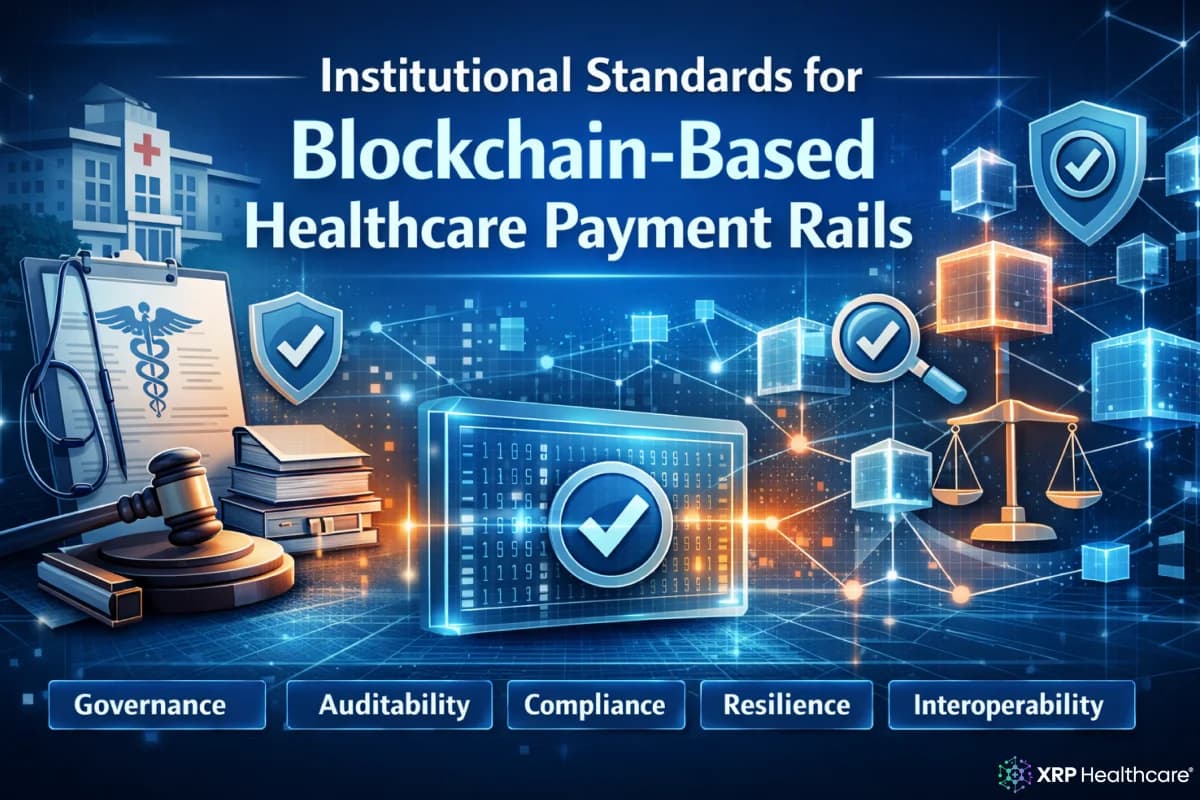
Institutional Standards for Blockchain-Based Healthcare Payment Rails
**Shortened version:**Explore the key standards for blockchain healthcare payment rails, including governance, auditability, and neutrality.
Institutional Standards for Blockchain Healthcare Rails | XRP Healthcare®
Introduction
Healthcare finance operates within one of the most regulated and operationally sensitive sectors in the global economy. When blockchain-based settlement infrastructure is introduced into this environment, it must meet institutional-grade standards rather than experimental benchmarks.
The discussion is no longer centered on whether blockchain can settle transactions quickly. Instead, the critical question is whether the architecture satisfies institutional requirements for governance, auditability, neutrality, compliance boundaries, and operational resilience.
This article outlines the structural standards required for blockchain-based healthcare payment rails to function responsibly and reliably at scale. The governance architecture behind open healthcare payment infrastructure is explored in detail in our pillar guide Regulatory Design Principles for Open Healthcare Payment Networks.
This in-depth discussion explores how blockchain systems must evolve from experimental frameworks into institutional-grade infrastructure. It examines governance requirements, compliance structures, resilience design, and the architectural standards necessary for regulated environments such as healthcare.
Deterministic Settlement as a Baseline Requirement
Institutional healthcare payments require predictable and transparent financial infrastructure. Organizations operating in healthcare finance must maintain reliable settlement frameworks that support financial accuracy and operational clarity.
Key requirements include predictable transaction finality, transparent fee structures, clear reconciliation trails, and immutable audit records. Probabilistic settlement models introduce ambiguity that healthcare financial operations cannot tolerate.
Institutional-grade blockchain rails must therefore deliver deterministic confirmation with clear ledger visibility to support dependable financial workflows.
Governance Transparency
Infrastructure used within healthcare environments must provide transparent governance structures. This includes publishing the scope of operations, defining the roles of participating entities, maintaining neutral infrastructure positioning, and establishing licensing frameworks where applicable.
Governance opacity introduces systemic risk. Healthcare regulators and institutional operators expect structural clarity before integrating new payment infrastructure into regulated financial environments.
Separation of Infrastructure and Operations
A mature healthcare payment ecosystem clearly distinguishes between the infrastructure layer, operational healthcare providers, and application interfaces.
Infrastructure functions as the settlement layer, while healthcare providers maintain operational responsibility within their own jurisdictions. Application interfaces enable user interaction without altering the underlying infrastructure framework.
Maintaining this separation reduces liability confusion, prevents regulatory overlap, limits brand ambiguity, and mitigates custodial risk. Institutional resilience depends heavily on maintaining clear structural boundaries between these layers.
Compliance-Aware Architecture
Healthcare payment rails must align with multiple regulatory requirements. These include financial regulatory standards, anti-money laundering frameworks, data protection regulations, and jurisdictional licensing obligations.
Blockchain architecture should not attempt to bypass regulatory frameworks. Instead, it must integrate into them in a structured and responsible manner. Institutional adoption of blockchain-based payment rails depends on regulatory compatibility and adherence to compliance standards.
Auditability and Ledger Transparency
Healthcare finance requires strict audit discipline. Financial transactions must be verifiable, traceable, and transparent to ensure regulatory oversight and operational accountability.
Blockchain infrastructure can support this requirement through immutable transaction histories, transparent ledger access, clear timestamping, and deterministic reconciliation processes.
This transparency strengthens financial oversight while simultaneously reducing administrative complexity for institutions managing healthcare financial operations.
Interoperability With Existing Systems
Healthcare organizations rely on a wide range of operational systems. These include pharmacy ERP systems, accounting platforms, distributor management systems, and cross-border payment services.
Blockchain settlement rails must integrate with these systems rather than attempt to replace them. Institutional viability depends on interoperability that allows healthcare operators to maintain their existing workflows while benefiting from improved settlement infrastructure.
Neutral Settlement Layer Design
Open blockchain rails function most effectively when designed as neutral settlement layers. Neutrality allows multiple participants to interact within the same infrastructure environment without vendor dependency.
A neutral settlement layer avoids proprietary lock-in, supports a broad ecosystem of participants, remains vendor-independent, and preserves operational autonomy for healthcare organizations.
This design approach increases long-term ecosystem durability and provides the flexibility healthcare operators require as financial systems continue to evolve.
Risk Management and Resilience
Institutional-grade infrastructure must be designed with resilience and risk management as core priorities. This includes maintaining high network uptime, supporting adequate transaction throughput, implementing strong security frameworks, and establishing governance mechanisms capable of resolving disputes when necessary.
Healthcare supply chains operate continuously, and payment infrastructure must support that reality. Financial settlement systems that serve healthcare providers cannot afford extended downtime or operational instability.
Resilience is therefore a foundational requirement rather than an optional enhancement.
Institutional Signaling
Beyond technical architecture, infrastructure providers must signal maturity and reliability to institutional participants. This signaling includes publishing clear documentation, maintaining transparent governance statements, defining the operational scope of the infrastructure, and aligning consistently with regulatory expectations.
Institutional trust grows when systems behave predictably and communicate their structure clearly. Transparent communication plays a significant role in establishing confidence among regulators, healthcare providers, and financial partners.
Related Governance Resources
For further structural analysis, readers may explore additional topics such as regulatory design principles for open healthcare payment networks, comparisons between open and closed financial networks in healthcare infrastructure, and strategies for avoiding market confusion within healthcare payment ecosystems. These resources provide deeper context for governance and infrastructure design.
What makes blockchain healthcare payments institutional-grade? Institutional-grade systems combine clear governance structures, deterministic settlement mechanisms, audit transparency, regulatory alignment, and structurally neutral infrastructure design.
Is speed alone enough for healthcare payment adoption? No. While transaction speed can be beneficial, institutional adoption requires compliance-aware architecture, operational resilience, and integration with regulatory frameworks.
Why is neutrality important in healthcare payment rails? Neutral settlement layers reduce vendor dependency, prevent ecosystem fragmentation, and provide flexibility for healthcare organizations operating across different jurisdictions.
How does auditability support healthcare operators? Transparent ledgers simplify financial reconciliation, support regulatory oversight, and strengthen operational accountability within healthcare financial systems.
Can blockchain integrate with existing pharmacy systems? Yes. Institutional blockchain design prioritizes interoperability, allowing integration with ERP platforms, accounting systems, and other operational software used by healthcare organizations.