Introduction
As digital asset payments transition from experimentation to structured deployment, institutional standards become essential. An XRP Payment Program designed for healthcare operators, pharmacy chains, or regulated environments cannot rely on informal rollout or ad hoc configuration. It must be governed.
This article outlines the institutional standards that distinguish structured infrastructure deployment from casual digital asset acceptance.
For structural framework overview:
👉 https://xrphtoken.com/xrp-payment-program
Institutional Deployment Is a Discipline
Institutions operate differently from retail-level experimentation. Their operational frameworks require:
- Documented policy
- Operational consistency
- Defined accountability
- Audit alignment
- Clear attribution
An XRP Payment Program deployed at institutional level must reflect these structural requirements. Without discipline, scalability weakens and operational risk increases.
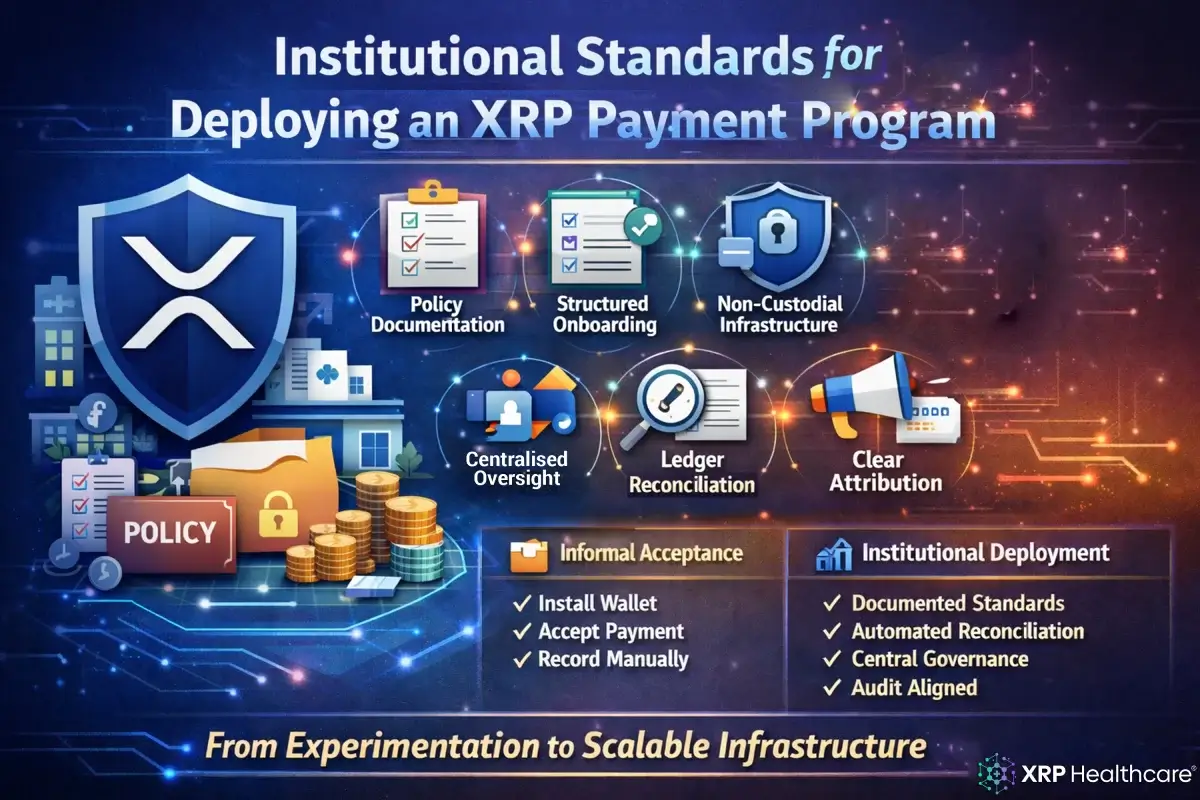
1. Policy Documentation
Institutional deployment begins with written standards. Policy documentation should clearly define:
- Terminology usage
- Payment flow procedures
- Invoice reference format
- Ledger reconciliation protocol
- Governance responsibility
This ensures clarity across all branches, departments, and operators. Governance begins before technical rollout - not after implementation.
2. Structured Onboarding Process
An institutional XRP Payment Program requires a controlled onboarding framework.
A structured onboarding model should include:
- Defined onboarding steps
- Internal approval workflows
- Deployment documentation
- Access control procedures
- Staff training guidelines
Ad hoc wallet installation does not constitute structured infrastructure. Controlled rollout protects operational integrity and maintains institutional credibility.
3. Non-Custodial Infrastructure Architecture
Institutional standards do not require custody of digital assets.
The XRPH Wallet operates using non-custodial architecture on the XRP Ledger (XRPL), supporting:
- Ledger-native transaction validation
- QR-based invoice processing
- Zero-fee infrastructure model
Non-custodial design supports transparency, audit traceability, and reduced counterparty risk exposure while maintaining operator control.
Learn more:
👉 https://xrphtoken.com/xrph-wallet
4. Ledger-to-Invoice Reconciliation Standards
Formal deployment requires reconciliation discipline.
Institutional standards should include:
- Transaction hash recording
- Timestamp capture
- Invoice reference attachment
- Daily reporting workflow
- Central accounting review
Structured reconciliation ensures that every ledger transaction aligns with a corresponding invoice record. This separation of ledger validation and accounting reconciliation distinguishes institutional deployment from informal acceptance.
For XRPL technical reference:
https://xrpl.org/docs/references/protocol/transactions/types/payment
5. Attribution and Market Clarity
Institutional operators must avoid ambiguity in public-facing communications.
Standards should clarify:
- Descriptive language usage
- Infrastructure provider identity
- Role of non-custodial software
- Separation between descriptive terminology and commercial branding
Clear attribution prevents confusion and protects long-term infrastructure credibility.
See governance positioning:
👉 https://xrphtoken.com/trademark-and-ip-protection
6. Centralised Oversight
Multi-location deployment requires coordinated oversight. Institutional standards should establish:
- Central reporting structures
- Uniform QR formatting
- Consistent terminology usage
- Defined escalation protocols
- Formal error-handling procedures
Fragmented deployment weakens credibility. Consistency strengthens infrastructure integrity.
Institutional Deployment vs Informal Acceptance
There is a structural difference between informal acceptance and institutional deployment.
Informal Acceptance
- Install wallet
- Accept payment
- Record manually
Institutional Deployment
- Document policy
- Standardise invoice format
- Record transaction hashes
- Integrate reconciliation processes
- Maintain governance oversight
An XRP Payment Program must operate within the second category to achieve scalability, audit alignment, and operational resilience.
Long-Term Infrastructure Credibility
As healthcare digital payments mature:
- Institutions prioritise stability
- Regulators prioritise clarity
- Operators prioritise documentation
- Customers prioritise trust
Institutional standards support all four. An XRP Payment Program deployed under structured governance becomes part of long-term infrastructure, not short-term experimentation.
For complete framework overview:
👉 https://xrphtoken.com/xrp-payment-program
Frequently Asked Questions (FAQs)
What makes an XRP Payment Program institutional?
Documented policy, reconciliation standards, governance controls, structured onboarding, and non-custodial architecture.
Is informal XRP acceptance sufficient?
Not for institutional environments that require accounting alignment, audit discipline, and operational governance.
Does institutional deployment require custody?
No. Non-custodial architecture supports structured infrastructure deployment while maintaining transparency and control.
Why is policy documentation important?
It ensures consistent implementation across multiple locations and reduces operational confusion.
Who should follow institutional standards?
Pharmacy chains, healthcare networks, distributors, and other regulated operators seeking scalable and governed digital asset payment infrastructure.