Introduction
Payment acceptance is only one part of structured deployment. For institutional environments, especially pharmacy chains and healthcare operators, reconciliation is equally critical.
An XRP Payment Program must integrate XRP Ledger (XRPL) transactions with cloud-based accounting systems to ensure clarity, audit alignment, and operational integrity. This article explains how XRPL integration supports structured deployment. For framework overview:
👉 https://xrphtoken.com/xrp-payment-program
Video Reference: XRPL Integration and Invoice Platforms
Why XRPL Integration Matters
In institutional environments, payment confirmation alone is insufficient.
An XRP Payment Program must support:
- Invoice ID mapping
- Transaction hash recording
- Timestamp verification
- Ledger confirmation
- Accounting reconciliation
Without integration, payment acceptance remains incomplete. Structured deployment requires technical alignment.
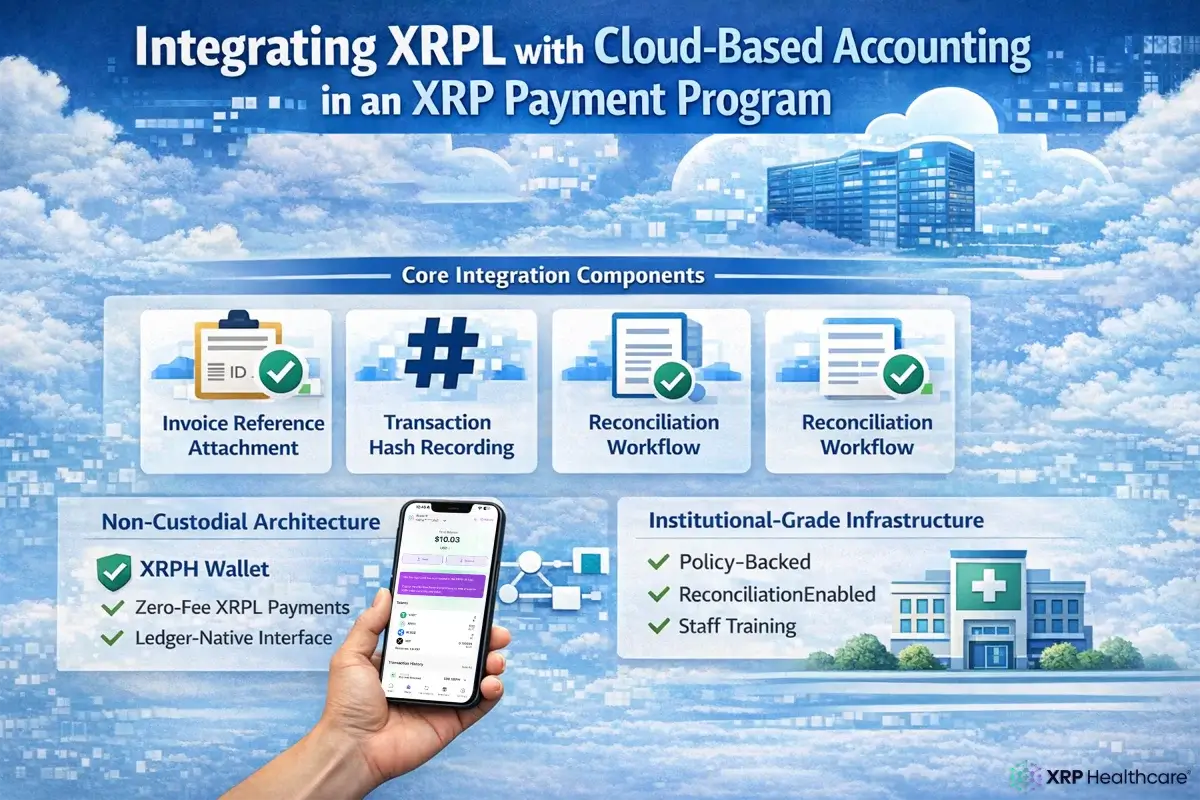
Core Integration Components
1. Invoice Reference Attachment
Each XRPL transaction should include:
- Unique invoice reference
- Structured metadata
- Internal payment identifier
This allows:
- Direct ledger-to-invoice matching
- Centralised reconciliation
- Reduced dispute risk
2. Transaction Hash Recording
Each payment produces a unique XRPL transaction hash.
Institutional deployment requires:
- Hash storage in accounting system
- Timestamp capture
- Ledger confirmation reference
For protocol reference:
👉 https://xrpl.org/docs/references/protocol/transactions/types/payment
This provides verifiable transaction integrity.
3. Reconciliation Workflow
A structured XRP Payment Program integrates:
- Daily transaction exports
- Invoice matching reports
- Branch-level reporting
- Central accounting oversight
This prevents fragmentation across locations.
Non-Custodial Architecture and Control
Integration does not require custodial control.
The XRPH Wallet operates as:
- Non-custodial XRPL software
- Zero-fee infrastructure
- Ledger-native transaction interface
- No patient health information storage
Learn more:
👉 https://xrphtoken.com/xrph-wallet
Non-custodial design reduces risk while maintaining infrastructure control.
Structured Deployment Model
An institutional XRP Payment framework typically follows:
- Define invoice ID format
- Configure payment interface
- Implement transaction reference mapping
- Integrate accounting exports
- Establish reconciliation policy
- Train staff across branches
This sequence ensures consistent deployment.
Avoiding Integration Pitfalls
Common mistakes include:
- Accepting XRP without invoice mapping
- Failing to store transaction hashes
- Relying on manual reconciliation
- Inconsistent reporting standards
Structured integration eliminates these weaknesses.
Why Technical Structure Supports Market Clarity
In overlapping commercial sectors, technical clarity reduces ambiguity.
An XRP Payment Program with documented accounting integration:
- Signals institutional credibility
- Reduces confusion
- Supports audit alignment
- Reinforces governance posture
Infrastructure is strengthened by transparency.
Institutional-Grade Infrastructure
An institutional XRP Payment Program should be:
- Policy-backed
- Reconciliation-enabled
- Non-custodial
- Terminology-disciplined
- Technically documented
This supports scalable deployment across pharmacy chains and healthcare networks.
For structural framework overview:
👉 https://xrphtoken.com/xrp-payment-program
FAQs
Does an XRP Payment Program require accounting integration?
Yes. Institutional deployment requires reconciliation between XRPL transactions and invoice systems.
What is a transaction hash?
A unique identifier generated on the XRP Ledger for each confirmed transaction.
Is custody required for integration?
No. Non-custodial architecture supports structured deployment.
Why attach invoice IDs to XRP transactions?
To ensure ledger-to-accounting reconciliation and reduce disputes.
Who benefits from structured integration?
Pharmacy chains, healthcare operators, accounting teams, and compliance departments.