Open Infrastructure for XRP-Based Healthcare Payments
XRP Healthcare operates as an independent infrastructure provider through XRP Healthcare LLC, the registered trademark owner.
The XRPH Wallet and XRP Payment Program framework form part of the XRP Healthcare infrastructure architecture for healthcare payment deployment using the XRP Ledger (XRPL). The model emphasizes non-custodial design, interoperability, technical transparency, and regulatory clarity.
This infrastructure is open, modular, and structured for integration by pharmacies, healthcare networks, payment facilitators, and enterprise system providers seeking to deploy XRP-based payment rails within their own environments.
XRPH Wallet does not provide custody, brokerage, exchange, financial, or healthcare services. It is non-custodial software infrastructure.
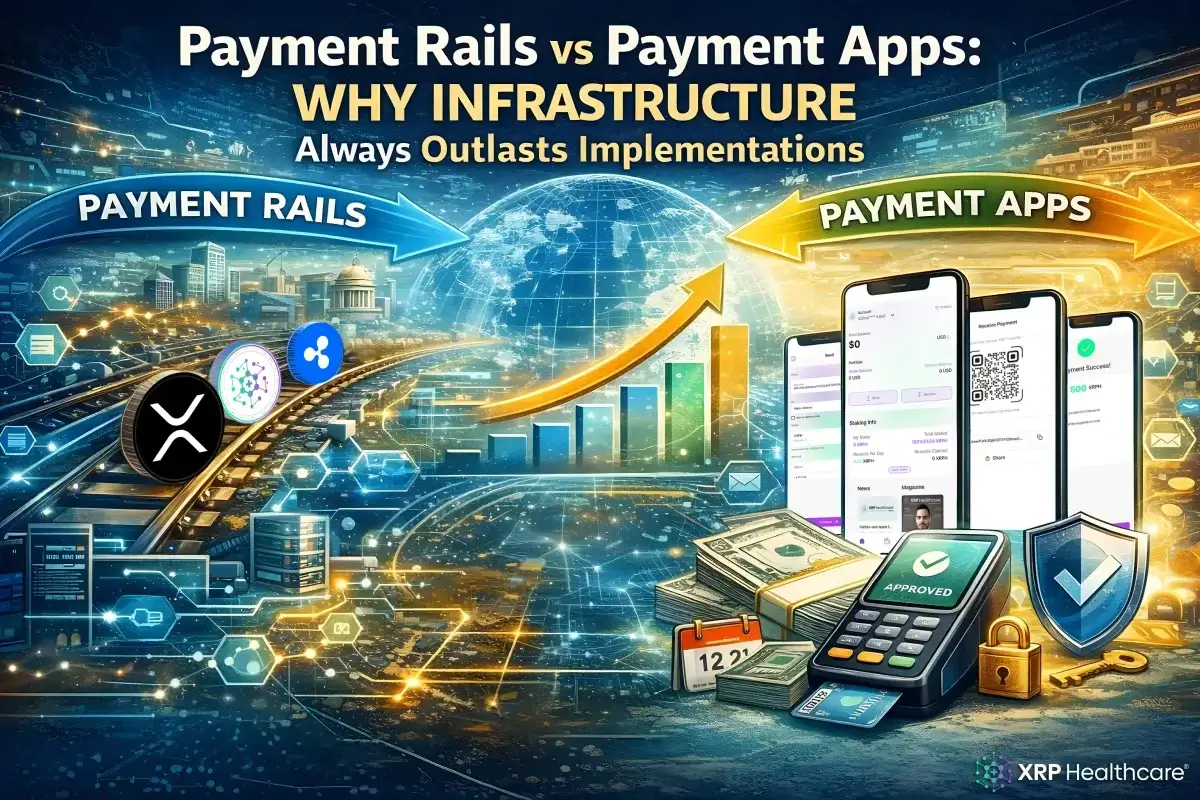
Payment Rails vs Payment Apps: Why Infrastructure Always Outlasts Implementations
Learn the difference between payment rails and payment apps, and why financial infrastructure always outlasts user-facing implementations.
Payment Rails vs Payment Apps: Infrastructure Explained | XRP Healthcare®
Introduction
In digital payments, applications attract attention - but infrastructure sustains systems. Payment rails are the underlying pathways through which value moves, independent of the interfaces built on top of them.
In healthcare, understanding the difference between payment rails and payment applications is essential for long-term interoperability and trust.
What Are Payment Rails?
Payment rails are the foundational infrastructure that enables transactions to occur. They define how value moves between parties, regardless of the application used to initiate the transaction.
Examples include global banking rails, settlement networks, and blockchain-based payment infrastructure.
Why Applications Change but Infrastructure Endures
Applications evolve in response to user preferences, regulation, and market dynamics. Infrastructure, however, must remain stable, neutral, and interoperable.
Healthcare systems depend on payment rails that can support multiple applications over time without fragmentation.
Neutral payment rails allow pharmacies, clinics, and healthcare providers to integrate payment functionality without dependence on a single vendor or application.
This neutrality is critical for scaling healthcare payment systems responsibly.
XRP Healthcare LLC and Infrastructure Stewardship
XRP Healthcare LLC operates as an infrastructure and governance layer supporting open, XRP-based healthcare payment rails.
By focusing on infrastructure rather than applications, this approach enables interoperability, open payment loops, and long-term system resilience.
Long-term healthcare payment systems are built on open rails, enforceable standards, and clear governance. This series explores why infrastructure ownership and trademark clarity matter more than applications.