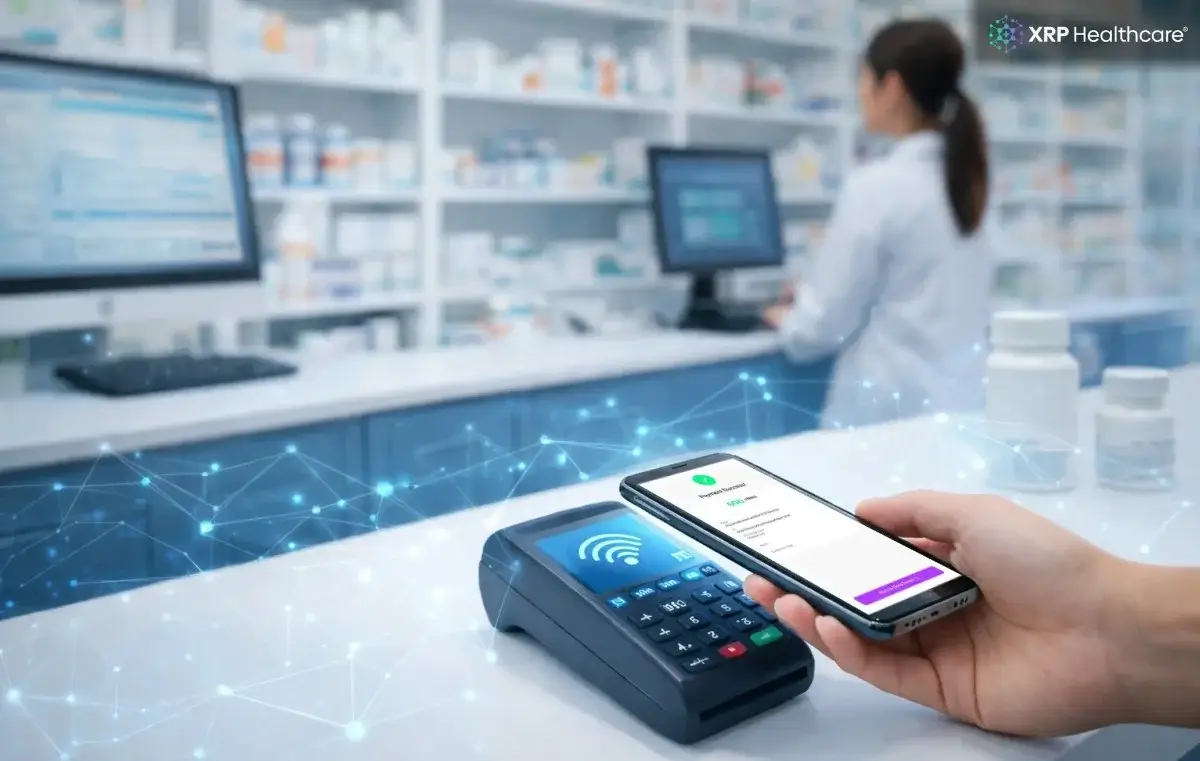
Open Infrastructure for XRP-Based Healthcare Payments
XRP Healthcare operates as an independent infrastructure provider through XRP Healthcare LLC, the registered trademark owner.
The XRPH Wallet and XRP Payment Program framework form part of the XRP Healthcare infrastructure architecture for healthcare payment deployment using the XRP Ledger (XRPL). The model emphasizes non-custodial design, interoperability, technical transparency, and regulatory clarity.
This infrastructure is open, modular, and structured for integration by pharmacies, healthcare networks, payment facilitators, and enterprise system providers seeking to deploy XRP-based payment rails within their own environments.
XRPH Wallet does not provide custody, brokerage, exchange, financial, or healthcare services. It is non-custodial software infrastructure.
Pharmacy Payments Using XRP in Healthcare: How U.S. Pharmacies Are Reducing Costs
Discover how U.S. pharmacies cut payment costs with XRP in healthcare and how XRPH Wallet enables faster, low-cost payments nationwide.
Introduction
Pharmacies in the United States are operating under increasing financial pressure. Rising transaction fees, slow settlement times, and outdated payment infrastructure continue to erode margins across independent pharmacies and regional chains alike. As a result, many providers are now reassessing how payments move through their businesses.
One area gaining significant attention is the use of XRP in pharmacy payments for healthcare - a payments-focused approach that offers speed, efficiency, and meaningful cost reductions through open-source infrastructure.
This shift reflects a growing recognition that legacy payment systems are no longer fit for modern healthcare operations.
Why Pharmacy Payment Costs Are Increasing
Traditional pharmacy payment systems were built decades ago and rely heavily on intermediaries, card networks, and batch settlement processes.
Key Challenges Facing Pharmacies Today • High card processing and interchange fees • Delayed settlement impacting cash flow • Multiple intermediaries taking a percentage per transaction • Complex reconciliation and reporting • Limited flexibility for cross-border healthcare payments
Over time, these inefficiencies create a significant financial drag on pharmacy operations.
XRP as a Healthcare Payments Layer
XRP is increasingly being evaluated as a settlement layer for healthcare payments due to its performance characteristics and real-world use in regulated financial environments.
Why XRP Is Relevant to Pharmacies
• Near-instant settlement • Extremely low transaction costs • High throughput suitable for retail healthcare • Operational efficiency compared to legacy rails
For pharmacies, this means faster access to funds and reduced payment friction without altering clinical workflows.
The XRPH Open-Source Wallet for Pharmacies
XRP Healthcare LLC enables real-world adoption through the XRPH Wallet, an open-source, non-custodial wallet built for healthcare payments.
What the XRPH Wallet Provides
• Acceptance of XRP-based pharmacy payments • Full custody and control retained by the provider • No dependency on proprietary payment platforms • No storage or transmission of patient health information
Because the wallet is open source, it functions as infrastructure, not a locked-in product.
How Pharmacies and Hospitals Can Participate
Healthcare providers can engage with XRP-powered payments in multiple ways, depending on their technical and operational needs.
Participation Options
Use the XRPH Open-Source Wallet
Pharmacies and hospitals can adopt the XRPH Wallet directly to begin accepting XRP-based healthcare payments with minimal friction.
Build a Custom Wallet or Integration
Organisations with internal development teams may choose to build their own wallet or payment layer using the same open-source architecture.
While savings vary depending on transaction volume and operational structure, pharmacies consistently identify improvements in the same areas.
Common Areas of Cost Reduction • Lower transaction fees versus card networks • Faster settlement improves cash flow • Reduced reliance on third-party intermediaries • Simplified back-office reconciliation
In an industry with tight margins, these efficiencies can materially improve financial sustainability.
Why U.S. Pharmacies Are Adopting New Payment Rails
Several factors are accelerating interest across the U.S. pharmacy sector.
Key Adoption Drivers • Rising interchange and processing fees • Pressure to modernise financial infrastructure • Increased familiarity with blockchain-based payments • Proven XRP usage in regulated payment corridors
What was once viewed as experimental is now being assessed as practical payments infrastructure.
Payments Infrastructure Not Clinical Systems
It is important to be clear about scope.
The XRPH Wallet operates strictly as a payments layer: • No patient health data is stored or transmitted • No clinical records are involved • No diagnosis or medical decision-making occurs
This separation allows pharmacies to modernise payments without disrupting compliance or care delivery.
Conclusion
As pharmacies across the United States continue to search for ways to control costs and improve efficiency, pharmacy payments using XRP in healthcare are emerging as a viable alternative to legacy systems.
Open-source architecture, non-custodial control, and low-cost settlement are no longer niche advantages - they are becoming essential components of modern healthcare payments infrastructure.
XRP in Healthcare Payments
Healthcare payment systems were not built for speed, transparency, or global interoperability. This series explores how XRP and XRPH enable faster settlement, lower transaction costs, and open-loop healthcare payments without disrupting existing clinical or pharmacy operations.
It refers to the use of XRP as a settlement layer for healthcare transactions, enabling faster and lower-cost payments for pharmacies and providers.
What is the XRPH Wallet?
The XRPH Wallet is an open-source, non-custodial wallet designed for healthcare payments, allowing providers to accept XRP without surrendering custody or control.
Can pharmacies build their own wallet?
Yes. Because the XRPH Wallet is open source, pharmacies and hospitals can build their own internal solution using the same architecture.
Is patient data stored in the wallet?
No. The XRPH Wallet does not store or transmit patient health information.
Is this available to U.S. pharmacies?
Yes. U.S. pharmacies can explore how XRP-powered payments fit into their operations via the XRPH ecosystem.
Pharmacy Payment Using XRP, Open-Source Healthcare Payment | XRP Healthcare®