Open Infrastructure for XRP-Based Healthcare Payments
XRP Healthcare operates as an independent infrastructure provider through XRP Healthcare LLC, the registered trademark owner.
The XRPH Wallet and XRP Payment Program framework form part of the XRP Healthcare infrastructure architecture for healthcare payment deployment using the XRP Ledger (XRPL). The model emphasizes non-custodial design, interoperability, technical transparency, and regulatory clarity.
This infrastructure is open, modular, and structured for integration by pharmacies, healthcare networks, payment facilitators, and enterprise system providers seeking to deploy XRP-based payment rails within their own environments.
XRPH Wallet does not provide custody, brokerage, exchange, financial, or healthcare services. It is non-custodial software infrastructure.
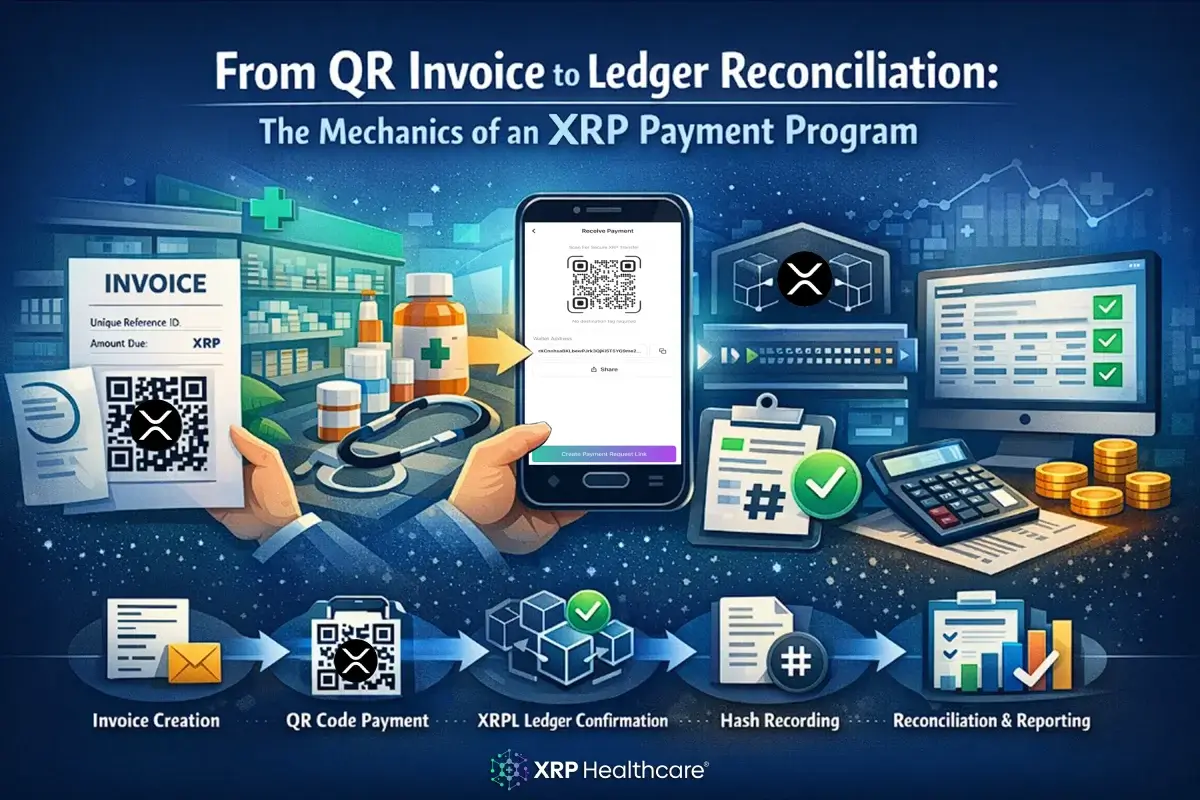
From QR Invoice to Ledger Reconciliation: The Mechanics of an XRP Payment Program
Understand the mechanics of an XRP Payment Program, from QR invoice generation to XRPL confirmation and accounting reconciliation.
From QR Invoice to Ledger Reconciliation in XRP Payments | XRP Healthcare®
Introduction
Payment acceptance is only the visible layer of digital infrastructure.
Behind every structured XRP Payment Program lies a defined lifecycle, from invoice creation to ledger confirmation and accounting reconciliation. Understanding this lifecycle is essential for institutional deployment, particularly within pharmacy chains and healthcare environments.
Every structured XRP Payment Program begins with invoice creation. A properly structured invoice must include a unique reference ID, the amount due, a defined payment instruction format, and a branch or operator identifier.
The unique reference ID becomes the anchor for reconciliation. Without it, payment tracking becomes fragmented, increasing accounting ambiguity and operational risk.
Step 2: QR Code Payment Initiation
The invoice generates a QR code that contains the destination address, payment amount, optional structured reference, and XRPL transaction parameters.
The payer scans the QR code and initiates payment using XRPL-compatible wallet software. QR standardisation ensures consistency across branches, reduces manual error, accelerates checkout time, and allows structured metadata attachment.
Standardised QR infrastructure transforms payment from a manual process into a structured digital workflow.
Step 3: XRPL Transaction Confirmation
Once payment is initiated, the XRP Ledger validates the transaction and generates a unique transaction hash. Confirmation typically occurs in approximately three seconds, and the ledger entry becomes publicly verifiable.
The transaction hash becomes the core reconciliation reference within institutional accounting systems.
Step 4: Transaction Hash Recording
An institutional XRP Payment Program must formally record the transaction hash, timestamp, invoice reference ID, and settlement status.
This documentation enables ledger verification, audit alignment, central reporting, and dispute resolution. Without systematic hash recording, reconciliation integrity is weakened and audit traceability becomes incomplete.
Step 5: Ledger-to-Invoice Reconciliation
Reconciliation connects three structured elements:
Invoice ID ↔ Transaction Hash ↔ Accounting Entry
This process involves exporting transaction data, matching payment amounts, confirming ledger settlement, and updating invoice status within accounting systems.
Reconciliation is what transforms simple payment acceptance into operational financial infrastructure.
Informal crypto acceptance often stops at ledger confirmation. Institutional deployment extends beyond confirmation into structured policy and oversight.
A properly implemented XRP Payment Program documents invoice ID standards, mandates transaction hash recording, establishes reconciliation policies, implements central oversight, and defines formal error-handling procedures.
These elements elevate deployment from experimental implementation to operational infrastructure.
Non-Custodial Architecture and Flow Control
The XRPH Wallet supports non-custodial operation, ledger-native confirmation, QR-based checkout, and zero-fee infrastructure.
Non-custodial design ensures reconciliation flow remains under institutional control, without the institution holding or managing customer funds directly.
Avoiding Common Workflow Failures
Common implementation mistakes include accepting payment without attaching an invoice reference, failing to record transaction hashes, allowing inconsistent QR formats, skipping reconciliation logging, and relying solely on manual tracking systems.
Each of these introduces ambiguity into the payment lifecycle. Structured mechanics eliminate ambiguity and preserve accounting clarity.
The Lifecycle Summary
A complete XRP Payment Program lifecycle includes invoice creation, QR payment initiation, XRPL ledger confirmation, transaction hash recording, reconciliation mapping, and central reporting.
Every step is necessary. When implemented consistently, the program becomes scalable across pharmacy chains and healthcare networks while maintaining audit alignment and infrastructure integrity.
What is a transaction hash? A transaction hash is a unique identifier generated by the XRP Ledger confirming that a payment has been completed and validated.
Why attach invoice IDs to payments? Invoice IDs enable structured reconciliation and prevent accounting ambiguity.
How fast are XRP confirmations? Under normal network conditions, confirmation typically occurs in approximately three seconds.
Is reconciliation necessary for small operators? Yes. Structured deployment supports audit alignment regardless of operational size.
Does non-custodial design affect reconciliation? No. Non-custodial architecture supports ledger-native verification without requiring institutions to hold customer funds.