Open Infrastructure for XRP-Based Healthcare Payments
XRP Healthcare operates as an independent infrastructure provider through XRP Healthcare LLC, the registered trademark owner.
The XRPH Wallet and XRP Payment Program framework form part of the XRP Healthcare infrastructure architecture for healthcare payment deployment using the XRP Ledger (XRPL). The model emphasizes non-custodial design, interoperability, technical transparency, and regulatory clarity.
This infrastructure is open, modular, and structured for integration by pharmacies, healthcare networks, payment facilitators, and enterprise system providers seeking to deploy XRP-based payment rails within their own environments.
XRPH Wallet does not provide custody, brokerage, exchange, financial, or healthcare services. It is non-custodial software infrastructure.
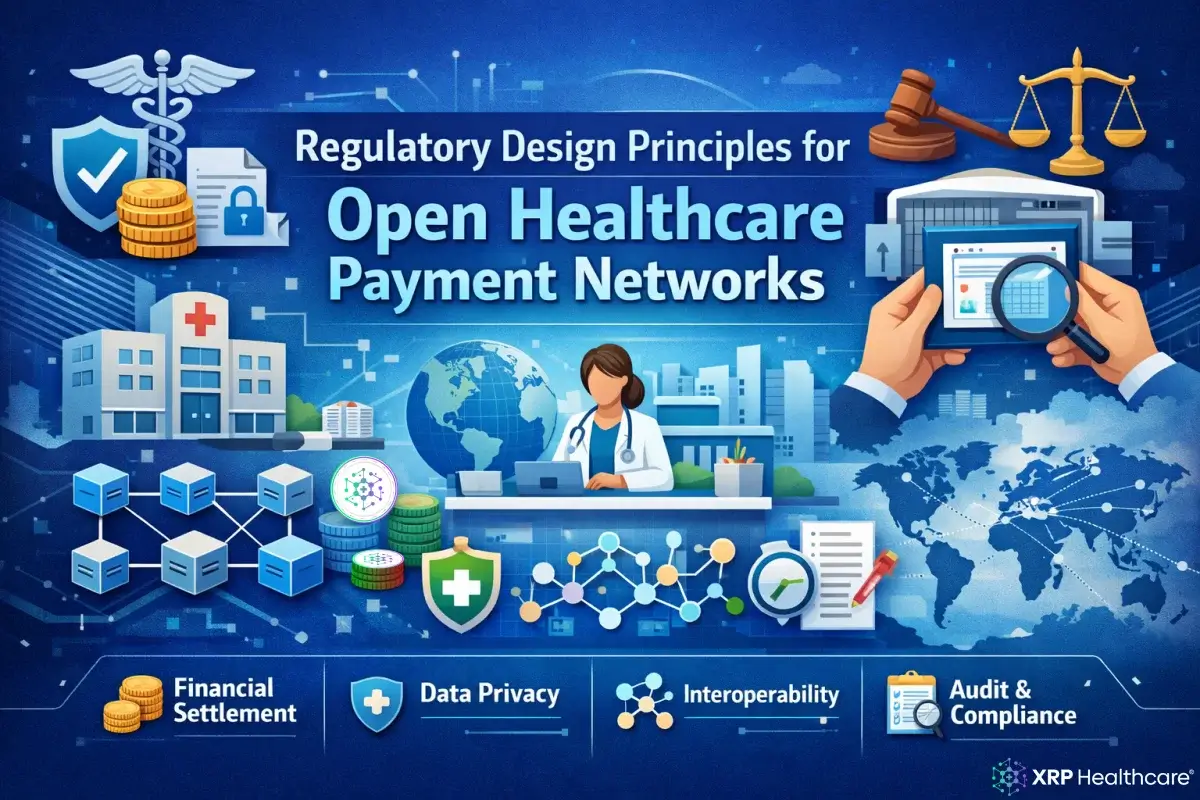
Regulatory Design Principles for Open Healthcare Payment Networks
Explore regulatory and architectural principles for designing compliant, open healthcare payment networks using blockchain infrastructure.
Regulatory Design for Open Healthcare Payment Networks | XRP Healthcare®
Introduction
Healthcare payment systems operate within one of the most complex regulatory environments in global commerce. Financial compliance, data protection standards, anti-money laundering obligations, and cross-border reporting requirements converge within a single operational framework.
As blockchain-based infrastructure enters the healthcare settlement layer, architectural clarity becomes essential. The objective is not disruption for its own sake, but the disciplined design of open, compliant, and interoperable payment networks capable of supporting pharmacies, clinics, suppliers, and cross-border healthcare operators.
This article explores the regulatory and architectural principles required to responsibly design open healthcare payment networks using blockchain infrastructure.
Governance & Regulatory Architecture Overview
Designing open healthcare payment infrastructure requires clarity across governance structure, interoperability standards, non-custodial design, compliance boundaries, and strict separation between financial settlement and protected health data.
Any blockchain implementation in healthcare must begin with regulatory alignment. The settlement layer must function as financial infrastructure, not as a repository for medical records or patient information.
1. Separation of Financial Settlement from Protected Health Information (PHI)
A foundational principle in healthcare blockchain design is structural separation.
Healthcare compliance frameworks require that:
Financial transaction data
Medical records
Patient-identifiable information
remain distinct.
Open settlement networks built on distributed ledgers must never store PHI on-chain. Instead, they should function strictly as financial settlement rails, with healthcare data remaining off-ledger and under compliant custody.
This architectural boundary is non-negotiable in regulated healthcare environments.
2. Open-Loop vs Closed-Loop Network Architecture
Closed-loop payment systems require participants to operate within proprietary, vendor-controlled environments.
Open-loop networks, by contrast:
Allow interoperability
Avoid vendor lock-in
Maintain neutral settlement rails
Support multi-party participation
In healthcare supply chains, where pharmacies, distributors, clinics, and manufacturers interact, neutrality and interoperability are critical.
Open settlement infrastructure reduces systemic risk and long-term dependency exposure.
3. Non-Custodial Infrastructure and Compliance Boundaries
In regulated industries, custody triggers additional legal obligations.
Non-custodial blockchain infrastructure:
Enables peer-to-peer settlement
Maintains user control over assets
Avoids unnecessary custodial liability
Reduces compliance burden
When designed correctly, non-custodial systems can align with financial regulations without assuming roles traditionally reserved for banks or intermediaries.
This distinction is essential when designing healthcare financial networks.
4. Interoperability as a Regulatory Safeguard
Interoperability is not merely a technical advantage, it is a governance safeguard.
Healthcare systems often operate across:
Multiple jurisdictions
Diverse billing systems
Cross-border suppliers
Varying regulatory standards
Open standards allow systems to connect without central control, reducing concentration risk and preserving regulatory transparency.
5. Auditability and Settlement Finality
Healthcare payment networks must provide:
Clear transaction traceability
Immutable audit trails
Deterministic settlement
Transparent fee structures
Distributed ledger infrastructure offers enhanced audit visibility compared to legacy financial rails, particularly for high-volume pharmacy environments operating on thin margins.
Settlement finality in seconds, rather than days, improves working capital efficiency without increasing systemic exposure.
6. Risk Mitigation in Multi-Entity Ecosystems
Healthcare ecosystems involve:
Physical pharmacy chains
AI-driven digital health applications
Cross-border corporate structures
Infrastructure licensing frameworks
Designing open payment networks requires governance clarity between entities, brands, and operational roles.
Clear separation reduces:
Market confusion
Implied affiliation risk
Cross-entity liability exposure
Institutional design must prioritize role clarity at every architectural layer.
7. The Role of Neutral Settlement Infrastructure
Neutral infrastructure does not compete with participants. It enables them.
A well-designed healthcare settlement network:
Does not control medical delivery
Does not store clinical records
Does not replace providers
Does not act as a bank
It simply moves value efficiently between regulated participants.
This neutrality is critical for sustainable long-term adoption.
8. Infrastructure as a Governance Discipline
Blockchain adoption in healthcare should not be speculative. It should be infrastructural.
Open healthcare payment networks must be:
Compliance-aware
Architecturally disciplined
Transparent in role definition
Explicit in data boundaries
Clear in branding and governance
This discipline protects operators, partners, and end-users alike.
Related Infrastructure Resources
To further understand how open settlement architecture functions within healthcare environments, explore related internal resources such as:
An open healthcare payment network is a neutral settlement infrastructure allowing multiple healthcare participants to transact without proprietary lock-in.
How does blockchain support regulatory compliance in healthcare?
By separating financial settlement from patient data and providing transparent, immutable audit trails.
What is the difference between open-loop and closed-loop healthcare payments?
Closed-loop systems restrict participants to proprietary networks. Open-loop systems allow interoperability across independent parties.
Does open settlement mean storing medical data on-chain?
No. Responsible architectures ensure PHI remains off-chain while financial settlement occurs on distributed infrastructure.
Why is governance important in healthcare payment design?
Because healthcare involves regulated financial flows, patient protection standards, and multi-entity coordination that require clear institutional structure.