Introduction
As digital asset payments expand into regulated commercial sectors, pharmacy chains require more than simple “crypto acceptance.” They require structure.
An XRP Payment Program for a pharmacy chain must be designed as an operational framework, not a marketing feature. Multi-location pharmacy environments demand reconciliation clarity, governance discipline, and institutional credibility.
This article outlines how to deploy an XRP Payment Program within a pharmacy chain while maintaining structured oversight, operational consistency, and scalable architecture.
Why Pharmacy Chains Require Structured Deployment
Unlike single-location retail stores, pharmacy chains operate within complex administrative frameworks. They typically manage:
- Multiple branches
- Centralised accounting systems
- Regulatory oversight
- Inventory-linked invoicing
- Controlled reconciliation processes
Because of this complexity, payment infrastructure must scale consistently across all locations.
An XRP Payment Program in this environment must:
- Reconcile centrally
- Maintain terminology clarity
- Operate under unified standards
- Avoid operational ambiguity
Without structure, fragmentation occurs. Structure prevents inconsistency and protects operational integrity.
Core Structural Components
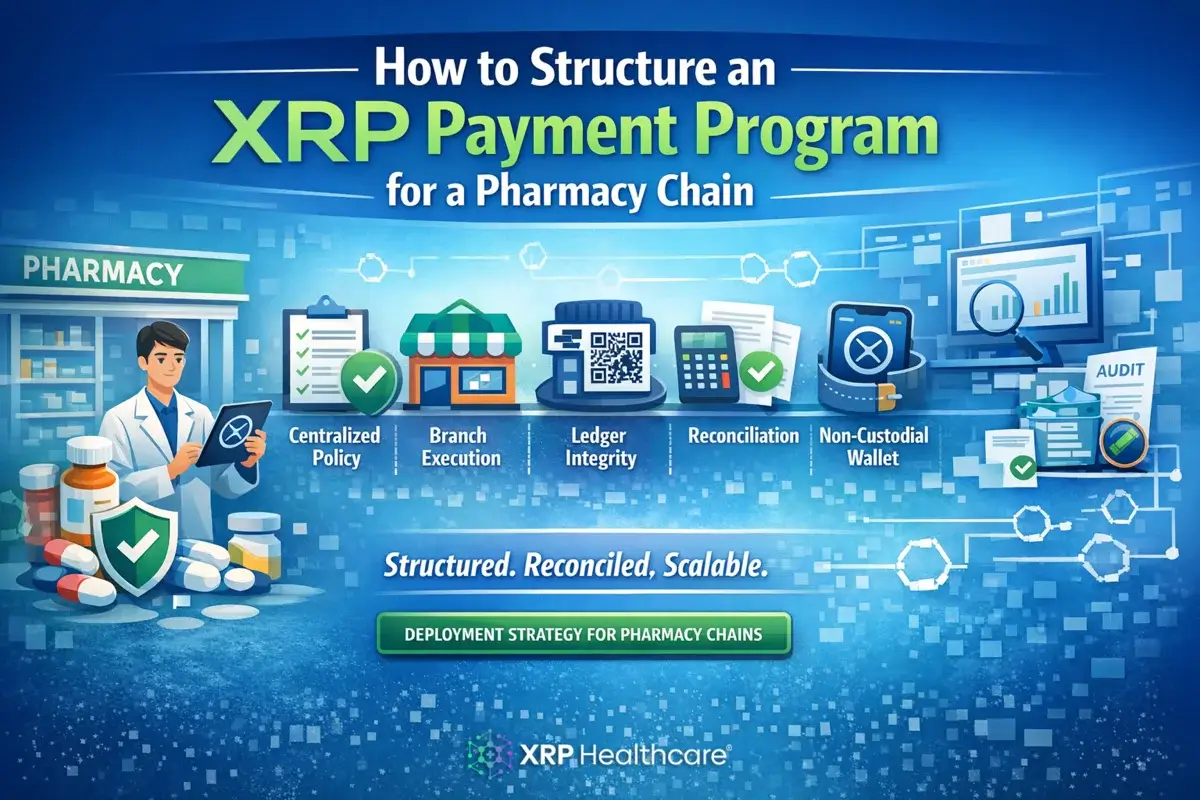
1. Centralised Policy Definition
Before any rollout begins, a pharmacy chain should establish internal policy documentation. This includes:
- Naming standards
- Payment reference format
- Invoice ID mapping structure
- Reporting workflow
- Staff training procedures
When policy is defined centrally, every branch operates under identical framework rules. Governance clarity supports long-term consistency and reduces ambiguity.
2. Branch-Level Payment Execution
Each pharmacy location must operate within defined operational parameters.
This includes:
- Standardised QR invoice generation
- Defined payment reference requirements
- Clear ledger confirmation procedures
An XRP Payment Program should never rely on:
- Manual interpretation
- Informal wallet usage
- Untracked transactions
Institutional deployment requires standardisation at every branch.
3. Ledger Confirmation & Transaction Integrity
Transaction integrity is foundational to structured deployment.
Each payment should include:
- Invoice reference
- XRPL transaction hash
- Timestamp
- Settlement confirmation
This enables:
- Central reconciliation
- Audit trail support
- Dispute resolution capability
Without structured ledger-to-invoice mapping, payment acceptance remains operationally incomplete.
4. Reconciliation & Accounting Integration
For pharmacy chains, reconciliation is not optional, it is mandatory.
Structured implementation should include:
- Exportable transaction logs
- Reference ID matching
- Daily branch reporting
- Central accounting review
Using ledger-native confirmation under the XRP Ledger protocol ensures transactional clarity and traceability.
Accounting integration ensures compliance alignment and operational discipline across the organisation.
5. Non-Custodial Architecture
Institutional deployment does not require custody of funds.
A properly structured XRP Payment Program can operate under a non-custodial model. In such a framework, payment infrastructure functions as:
- Non-custodial XRPL software
- Zero-fee infrastructure layer
- Ledger-native payment interface
- No patient health information storage
This architecture reduces risk exposure while maintaining institutional control.
Avoiding Fragmentation Across Locations
One of the greatest risks in multi-branch rollout is inconsistency.
Common mistakes include:
- Different invoice reference formats per branch
- Informal terminology usage
- Untracked wallet deployments
- Lack of central policy oversight
An XRP Payment Program must operate as a unified framework, not a series of isolated crypto acceptance experiments.
Consistency protects brand clarity, accounting discipline, and operational efficiency.
Governance & Market Clarity
In overlapping commercial sectors, particularly where “XRP,” healthcare, and payments intersect, clarity reduces confusion.
Pharmacy chains should:
- Avoid implied affiliation
- Avoid ambiguous branding
- Maintain descriptive accuracy
- Ensure consistent terminology usage
Structured governance reduces the risk of misinterpretation while supporting legitimate deployment within regulated environments.
Institutional Implementation Model
A properly structured rollout typically follows a defined sequence:
- Policy documentation finalised
- Wallet framework defined
- Branch training conducted
- Invoice reference standard adopted
- Controlled rollout across locations
- Central reporting activated
This phased model ensures scalability while preserving operational discipline.
Why Structured Deployment Matters
In regulated environments such as pharmacy chains:
- Payment ambiguity creates accounting risk
- Terminology ambiguity creates market confusion
- Operational inconsistency creates audit exposure
Structure reduces all three.
An XRP Payment Program is not merely about accepting XRP, it is about implementing a governed, reconciled, scalable infrastructure that aligns with institutional standards.
FAQs
Can a pharmacy chain accept XRP without a formal structure?
Technically yes. However, without reconciliation procedures, governance standards, and documented policy, institutional integrity may be weakened.
Is an XRP Payment Program a standalone brand?
No. It is a descriptive operational framework deployed within a broader infrastructure model.
Does structured deployment require custody of funds?
No. Non-custodial architecture under the XRP Ledger supports institutional deployment without custodial exposure.
Why is reconciliation critical?
Pharmacy chains operate centralised accounting systems. Ledger-to-invoice mapping ensures financial clarity and audit readiness.
What is the first step in deployment?
Policy standardisation before branch rollout.