Open Infrastructure for XRP-Based Healthcare Payments
XRP Healthcare operates as an independent infrastructure provider through XRP Healthcare LLC, the registered trademark owner.
The XRPH Wallet and XRP Payment Program framework form part of the XRP Healthcare infrastructure architecture for healthcare payment deployment using the XRP Ledger (XRPL). The model emphasizes non-custodial design, interoperability, technical transparency, and regulatory clarity.
This infrastructure is open, modular, and structured for integration by pharmacies, healthcare networks, payment facilitators, and enterprise system providers seeking to deploy XRP-based payment rails within their own environments.
XRPH Wallet does not provide custody, brokerage, exchange, financial, or healthcare services. It is non-custodial software infrastructure.
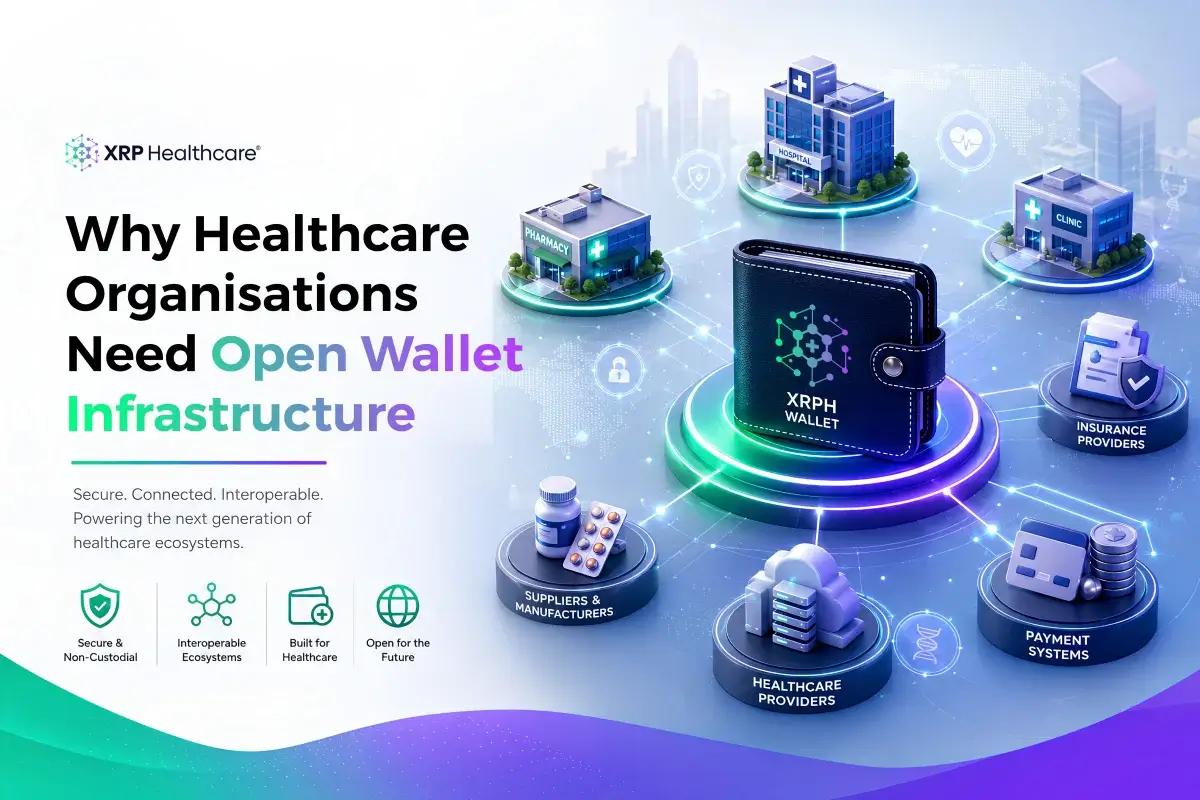
Why Healthcare Organisations Need Open Wallet Infrastructure
Discover why open wallet infrastructure is becoming increasingly important for healthcare organisations, supporting interoperability, secure payments and future digital healthcare ecosystems.
Why Healthcare Organisations Need Open Wallet Infrastructure | XRP Healthcare®
Healthcare is undergoing one of the most significant digital transformations in its history. Artificial intelligence is improving healthcare engagement, electronic health records have become commonplace, telemedicine continues expanding access to care, and digital prescription services are becoming increasingly widespread.
Yet behind each of these innovations lies an often-overlooked requirement: reliable digital infrastructure.
As healthcare organisations adopt new technologies, they also require secure methods of managing digital assets, facilitating payments, and connecting with broader digital ecosystems. This is where open wallet infrastructure is becoming increasingly important.
Rather than viewing wallets simply as tools for storing digital assets, organisations are beginning to recognise them as infrastructure capable of supporting wider healthcare transformation.
Beyond Digital Asset Storage
Many people associate blockchain wallets exclusively with cryptocurrency. However, enterprise wallet infrastructure serves a much broader purpose.
Modern wallet platforms provide secure identity management, payment connectivity, interoperability, and digital asset management within larger technology ecosystems. As healthcare organisations continue adopting digital technologies, wallet infrastructure is becoming another critical component of enterprise architecture.
Its role extends beyond storing digital assets to supporting connected digital services that improve efficiency, transparency, and long-term scalability.
Today's healthcare organisations rarely operate independently. Every healthcare service relies on a network of interconnected participants working together to deliver better patient outcomes.
This ecosystem includes:
Hospitals
Clinics
Pharmacies
Medical suppliers
Insurance providers
Healthcare technology platforms
Patients using digital health applications
Each interaction requires a secure, reliable infrastructure capable of exchanging information and facilitating payments.
Open wallet architecture helps support these interactions by providing flexible digital infrastructure capable of integrating with wider healthcare ecosystems instead of operating in isolation.
Closed technology systems often create limitations as organisations grow.
When infrastructure cannot integrate with new technologies, organisations eventually face expensive upgrades or complete system replacements.
Open wallet infrastructure addresses this challenge by supporting:
Interoperability
Integration
Scalability
Flexibility
Future innovation
Instead of locking organisations into one technology stack, open architecture enables healthcare providers to adopt new services without disrupting existing operations.
This future-ready approach makes digital transformation more sustainable over the long term.
Supporting Enterprise Healthcare
Healthcare organisations require technology that is dependable enough to support mission-critical operations every day.
Enterprise infrastructure must deliver:
High levels of security
Reliable performance
Scalable architecture
Seamless interoperability
Long-term stability
Open wallet infrastructure allows organisations to build solutions aligned with their own operational requirements while remaining connected to broader digital healthcare ecosystems.
This creates a stronger foundation for innovation without sacrificing security or performance.
The XRPH Wallet has been developed as a non-custodial blockchain infrastructure designed to support broader healthcare payment initiatives.
Built on the XRP Ledger (XRPL), it provides users with complete control over supported digital assets while forming part of the wider XRP Healthcare infrastructure strategy.
Unlike traditional custodial solutions, a non-custodial wallet gives users direct ownership of their assets while maintaining secure access to blockchain-powered services.
Alongside the wallet, the XRPH AI App delivers AI-powered healthcare engagement.
Together, these specialised platforms operate within one connected ecosystem, combining secure blockchain infrastructure with intelligent healthcare engagement.
Infrastructure That Can Grow
Healthcare technology continues evolving at an unprecedented pace.
Future developments are expected to include:
More advanced artificial intelligence
Increased adoption of digital healthcare services
Greater interoperability between healthcare systems
Organisations that invest in flexible, open infrastructure today will be far better positioned to integrate tomorrow's innovations without rebuilding their technology foundations.
Wallet infrastructure is becoming one of the core technologies supporting this long-term evolution, helping healthcare organisations remain adaptable in an increasingly digital world.
Enabling Secure Digital Participation
As healthcare organisations continue adopting digital technologies, participation within connected ecosystems becomes increasingly important.
Modern healthcare increasingly depends upon secure digital interactions between healthcare providers, pharmacies, suppliers, payment facilitators, insurers, and patients.
Wallet infrastructure enables these interactions by providing secure access to blockchain-powered services while allowing organisations to retain flexibility over how they participate.
Rather than creating isolated technology environments, open wallet infrastructure supports connected ecosystems where different organisations can collaborate more efficiently, securely, and transparently.
Explore the XRPH Wallet to learn how blockchain infrastructure supports secure healthcare participation.
A Foundation for Healthcare Payment Innovation
Healthcare payment systems are evolving alongside the wider digital transformation of the healthcare industry. Traditional payment methods continue to play an important role while emerging blockchain technologies introduce additional opportunities for efficiency, transparency, and interoperability.
Open wallet infrastructure acts as a secure digital foundation capable of integrating with payment networks, blockchain technologies, and future healthcare services.
Rather than restricting innovation, infrastructure should provide a flexible platform upon which future healthcare payment solutions can continue to evolve.
Healthcare organisations require technology that performs reliably today while remaining capable of supporting tomorrow's growth.
As digital healthcare services continue expanding, infrastructure must accommodate increasing numbers of users, transactions, connected systems, and healthcare providers.
Scalable wallet infrastructure enables organisations to grow without repeatedly redesigning their technology architecture.
This long-term approach reduces operational complexity while supporting sustainable digital transformation. Scalability is therefore not simply a technical advantage-it is a strategic requirement for modern healthcare.
Why Modularity Matters
One of the defining characteristics of modern enterprise technology is modular architecture. Instead of relying on one large application responsible for every task, organisations increasingly deploy specialised platforms that work together seamlessly.
The XRP Healthcare ecosystem follows this same principle.
Each platform performs its own specialised role while contributing to one connected healthcare ecosystem.
This modular architecture enables continuous innovation without disrupting existing infrastructure, allowing organisations to adopt new capabilities as healthcare technology evolves.
The Future of Enterprise Healthcare Infrastructure
Healthcare continues moving toward increasingly connected digital ecosystems. Artificial intelligence is becoming more capable, healthcare platforms are becoming more personalised, and payment systems are becoming more interoperable.
Patients now expect seamless digital healthcare experiences, while providers require infrastructure capable of adapting as technology continues to evolve.
Open wallet infrastructure provides healthcare organisations with a flexible foundation capable of supporting future innovation while maintaining secure digital operations.
The XRP Healthcare ecosystem has been designed around long-term infrastructure rather than short-term technology trends.
Its objective is to build technology that enables healthcare organisations, pharmacies, technology providers, payment facilitators, and future ecosystem participants to interact through secure, interoperable blockchain infrastructure.
The XRPH Wallet forms one part of this strategy, while the XRPH AI App provides AI-powered healthcare engagement.
Together, they create a connected ecosystem where secure infrastructure supports healthcare engagement, and healthcare engagement strengthens ecosystem participation.
This layered approach provides flexibility for future development while maintaining a clear separation of responsibilities across the platform.
Conclusion
Healthcare organisations increasingly require infrastructure that is secure, interoperable, scalable, and adaptable.
Open wallet infrastructure provides a modern foundation capable of supporting connected healthcare ecosystems, blockchain-powered payment initiatives, and future digital healthcare services.
The XRPH Wallet reflects this infrastructure-first philosophy through its non-custodial design, XRP Ledger foundation, and focus on interoperability.
Combined with the XRPH AI App and the broader XRP Healthcare ecosystem, it demonstrates how specialised technologies can work together to support the next generation of digital healthcare.
As healthcare continues evolving, organisations that invest in flexible digital infrastructure today will be better positioned to embrace tomorrow's innovations while delivering more secure, efficient, and connected healthcare experiences.