Open Infrastructure for XRP-Based Healthcare Payments
XRP Healthcare operates as an independent infrastructure provider through XRP Healthcare LLC, the registered trademark owner.
The XRPH Wallet and XRP Payment Program framework form part of the XRP Healthcare infrastructure architecture for healthcare payment deployment using the XRP Ledger (XRPL). The model emphasizes non-custodial design, interoperability, technical transparency, and regulatory clarity.
This infrastructure is open, modular, and structured for integration by pharmacies, healthcare networks, payment facilitators, and enterprise system providers seeking to deploy XRP-based payment rails within their own environments.
XRPH Wallet does not provide custody, brokerage, exchange, financial, or healthcare services. It is non-custodial software infrastructure.
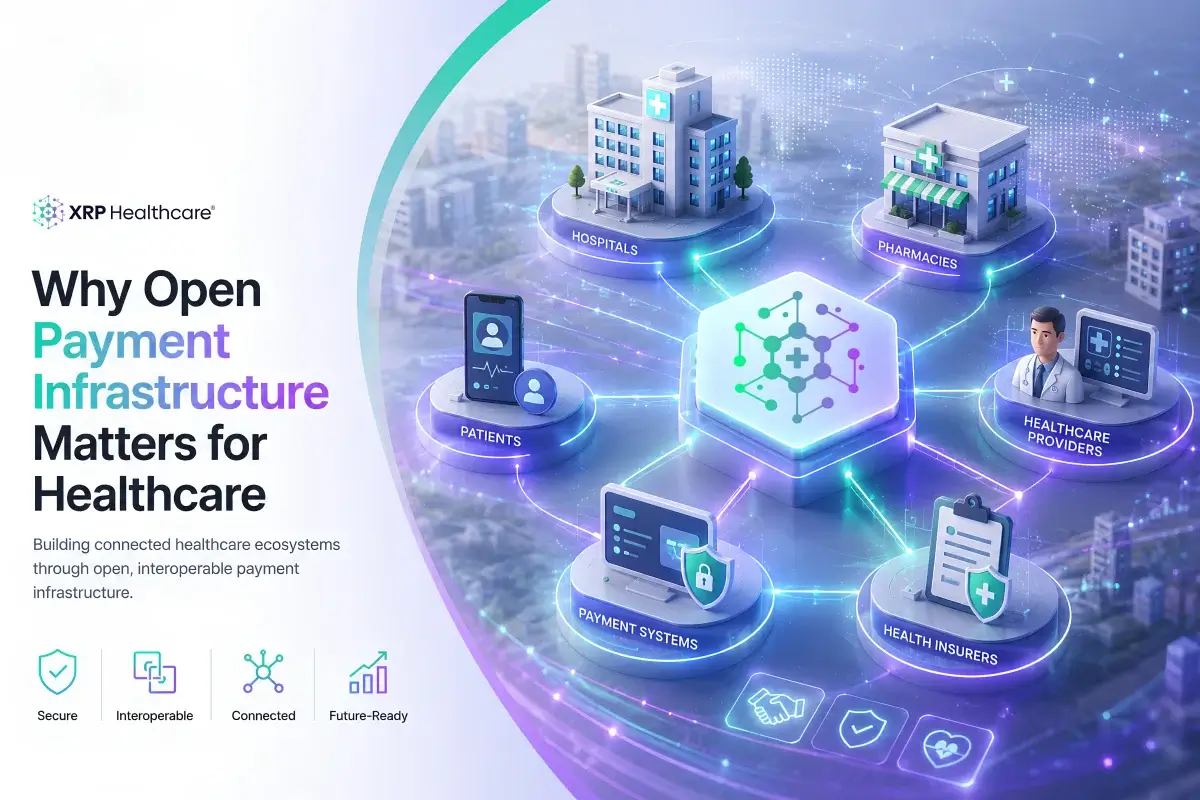
Why Open Payment Infrastructure Matters for Healthcare
Discover why open payment infrastructure is becoming increasingly important for healthcare, enabling interoperability, digital innovation and secure blockchain-powered payment ecosystems.
Why Open Payment Infrastructure Matters for Healthcare | XRP Healthcare®
Healthcare is undergoing one of the most significant digital transformations in its history. Electronic health records, telemedicine, artificial intelligence (AI), digital prescriptions, connected pharmacies, and mobile healthcare applications are reshaping how medical services are delivered and experienced. These technologies have improved patient outcomes, streamlined clinical workflows, and made healthcare more accessible than ever before.
Yet, behind every digital interaction lies a critical component that often receives far less attention-the infrastructure that enables secure, efficient, and reliable financial transactions. Whether processing patient payments, settling claims between providers, or facilitating cross-border healthcare services, payment infrastructure plays a vital role in ensuring healthcare systems function smoothly.
As healthcare becomes increasingly interconnected, organizations need payment solutions that go beyond traditional, closed financial networks. Modern healthcare requires infrastructure that promotes interoperability, supports innovation, and adapts to future technological advancements. This growing demand has accelerated interest in open payment infrastructure, an approach designed to connect rather than isolate healthcare organizations.
Unlike proprietary payment systems that limit flexibility, open payment infrastructure enables hospitals, clinics, pharmacies, payment providers, and digital health platforms to integrate seamlessly while maintaining their operational independence. This creates a stronger digital ecosystem capable of supporting innovation today and adapting to tomorrow's healthcare challenges.
What Is Open Payment Infrastructure?
Open payment infrastructure is a modern framework that enables different organizations, technologies, and financial systems to exchange value securely through interoperable standards. Rather than locking participants into a single proprietary ecosystem, it encourages collaboration across multiple platforms while maintaining security and compliance.
In healthcare, this means organizations can adopt payment technologies that work alongside existing systems instead of replacing them entirely. Healthcare providers, pharmacies, technology companies, payment facilitators, and digital healthcare platforms can all participate in a connected ecosystem without sacrificing operational independence.
An open approach delivers several important advantages:
Greater interoperability between healthcare systems
Improved flexibility when adopting new technologies
Easier integration with third-party platforms
Reduced dependency on proprietary payment solutions
Better scalability for long-term digital transformation
As healthcare organizations continue investing in digital innovation, open payment infrastructure provides the foundation needed to support sustainable growth while reducing complexity across the ecosystem.
Why Healthcare Needs Greater Connectivity
Healthcare rarely operates within a single, unified system. A patient's journey often involves multiple healthcare providers, specialists, pharmacies, laboratories, insurers, and payment processors. Each organization may rely on different software platforms and financial systems, making seamless communication increasingly challenging.
Without interoperability, these disconnected systems create inefficiencies that can slow operations, increase administrative costs, and complicate financial transactions.
Open payment infrastructure helps address these challenges by enabling secure communication and value exchange across diverse healthcare platforms. Instead of functioning as isolated systems, organizations can share information more effectively while maintaining high standards of security and operational control.
Greater connectivity benefits every participant within the healthcare ecosystem:
Healthcare providers can simplify financial workflows.
Pharmacies can process payments more efficiently.
Technology providers can integrate innovative healthcare solutions.
Patients benefit from smoother, more seamless digital experiences.
As healthcare continues evolving into a connected digital ecosystem, interoperable payment infrastructure becomes increasingly essential for improving efficiency and supporting better patient outcomes.
Supporting Healthcare Innovation
Healthcare technology continues to evolve at an extraordinary pace. Artificial intelligence, blockchain technology, digital identity verification, patient engagement platforms, and next-generation payment systems are rapidly transforming how healthcare organizations operate.
However, innovation is only possible when the underlying infrastructure is flexible enough to support change.
Open architecture enables organizations to introduce new technologies without rebuilding their entire payment ecosystem. Instead of replacing existing systems, healthcare providers can integrate emerging capabilities while preserving previous investments in infrastructure.
This flexibility accelerates the adoption of innovations such as:
Artificial intelligence for healthcare engagement
Blockchain-powered payment solutions
Secure digital identity systems
Connected healthcare applications
Modern healthcare payment technologies
By embracing open infrastructure, organizations create an environment where innovation becomes significantly easier to implement, allowing healthcare providers to respond quickly to changing patient expectations and technological advances.
Building for Long-Term Flexibility
Healthcare is constantly evolving. New regulations, emerging technologies, changing patient expectations, and advances in digital medicine require organizations to remain agile.
Payment infrastructure should never become a barrier to progress.
Open infrastructure supports long-term flexibility by allowing healthcare ecosystems to expand while remaining compatible with future innovations. Rather than creating isolated systems that require expensive upgrades, organizations can continuously evolve their digital capabilities through modular, interoperable architecture.
This future-focused approach offers several strategic benefits:
Easier adoption of new technologies
Lower long-term infrastructure costs
Reduced operational complexity
Improved scalability
Greater resilience as healthcare continues evolving
Organizations that invest in adaptable infrastructure today position themselves to respond more effectively to tomorrow's healthcare challenges without disruptive system overhauls.
The XRP Healthcare Approach
XRP Healthcare has developed its ecosystem around the principles of openness, interoperability, and modular infrastructure. Rather than relying on a single solution, the ecosystem consists of specialized components that work together to support healthcare payment initiatives.
The ecosystem includes:
XRPH Wallet - A non-custodial blockchain wallet designed to support secure digital asset management and healthcare payment infrastructure.
XRP Payment Program - An initiative focused on enabling organizations to explore blockchain-powered healthcare payment solutions.
Healthcare Payment Rails - Infrastructure designed to facilitate future digital healthcare payment ecosystems.
XRPH AI App - An AI-powered healthcare engagement platform that complements the broader payment infrastructure.
Each component performs a distinct role while contributing to one connected ecosystem, enabling healthcare organizations to build secure, scalable, and future-ready payment solutions.
To explore the XRP Healthcare ecosystem in greater detail, you can also visit:
Healthcare is built on collaboration. Every day, patients interact with physicians, specialists, pharmacies, laboratories, insurers, and healthcare technology providers. Behind these interactions are complex financial processes that require accurate, secure, and timely movement of value between multiple independent organizations.
Traditional payment systems often operate in isolation, creating unnecessary barriers that limit efficiency and slow innovation. Open payment infrastructure changes this approach by enabling different systems to communicate and transact securely while allowing each participant to maintain control of its own operations.
Instead of forcing organizations into a single proprietary platform, open infrastructure encourages collaboration through standardized technologies and interoperable payment frameworks. This creates a more connected healthcare ecosystem where information and payments move more efficiently across providers, pharmacies, suppliers, and digital health platforms.
As healthcare continues to expand beyond traditional clinical settings, collaboration will become increasingly important. Open infrastructure ensures organizations can work together without compromising flexibility, security, or operational independence.
Building Infrastructure That Can Evolve
Technology is advancing faster than ever before. Artificial intelligence, blockchain, digital identity, remote healthcare services, wearable devices, and connected medical technologies are continually transforming the healthcare landscape.
Infrastructure should never limit an organization's ability to adopt these innovations.
One of the greatest advantages of open payment infrastructure is its ability to evolve alongside technological progress. Instead of requiring complete system replacements whenever new capabilities emerge, organizations can integrate additional technologies into existing infrastructure through modular architecture.
This adaptability provides several long-term benefits:
Easier integration of emerging healthcare technologies
Reduced implementation costs
Greater scalability as organizations grow
Faster deployment of new services
Improved resilience against future technological changes
Healthcare organizations investing in adaptable infrastructure today are better positioned to meet tomorrow's patient expectations while minimizing operational disruption.
The Value of Standards and Interoperability
Healthcare is one of the most diverse digital ecosystems in the world. Hospitals, clinics, laboratories, pharmacies, insurers, government agencies, and technology providers all use different software platforms and operational systems.
Without common standards, seamless communication becomes extremely difficult.
Open payment infrastructure is designed around interoperability-the ability for independent systems to exchange information and process transactions efficiently. Rather than replacing existing technologies, interoperable payment solutions allow organizations to build upon what already works while introducing new capabilities.
The advantages of interoperability include:
Better communication between healthcare systems
Faster payment processing
Simplified integration with third-party applications
Reduced administrative complexity
Greater flexibility for future innovation
As digital healthcare continues expanding globally, interoperability will remain one of the most important foundations for sustainable healthcare transformation.
Supporting Enterprise Adoption
Large healthcare organizations require payment infrastructure that is secure, reliable, scalable, and capable of integrating with enterprise-grade systems.
Enterprise adoption depends on infrastructure that offers flexibility without sacrificing performance.
Open payment infrastructure enables organizations to develop solutions aligned with their operational requirements while remaining compatible with broader healthcare ecosystems. Rather than becoming dependent on proprietary financial platforms, enterprises gain greater freedom to innovate and expand their digital capabilities over time.
For enterprise healthcare providers, this approach offers several strategic advantages:
Flexible system integration
Improved operational scalability
Lower long-term technology costs
Better support for digital transformation initiatives
Greater compatibility with evolving healthcare technologies
As healthcare organizations continue investing in digital transformation, open payment infrastructure provides the flexibility necessary to support enterprise growth and innovation.
The XRP Healthcare Infrastructure Strategy
The XRP Healthcare ecosystem has been designed using a modular architecture, allowing each component to perform a specialized role while contributing to one connected healthcare payment ecosystem.
Key components include:
XRPH Wallet - Provides secure, non-custodial blockchain infrastructure for managing digital assets and supporting healthcare payment initiatives.
Healthcare Payment Rails - Deliver interoperable payment infrastructure designed to support connected healthcare ecosystems.
XRP Payment Program - Provides a framework for organizations exploring blockchain-powered healthcare payment initiatives built on the XRP Ledger.
XRPH AI App - Complements the payment infrastructure through AI-powered healthcare engagement, including health assessments, Proof Of Health™, CalmXRPH, Doctor Finder, Prescription Savings, and eligible healthy action rewards.
Together, these technologies form a unified ecosystem where payment infrastructure, blockchain technology, and patient engagement evolve independently while remaining fully connected.
Organizations interested in understanding the broader ecosystem can also explore:
Healthcare is becoming increasingly digital, interconnected, and patient-centric. Artificial intelligence continues improving healthcare accessibility, blockchain enhances transparency and security, and patients increasingly expect seamless digital experiences across every aspect of their healthcare journey.
To meet these expectations, healthcare organizations require payment infrastructure that is secure, flexible, and capable of adapting to continuous technological change.
Open payment infrastructure provides the foundation needed to support long-term innovation while allowing healthcare organizations to integrate new technologies without disrupting existing operations.
Rather than limiting progress through closed systems, open infrastructure empowers organizations to build connected ecosystems capable of evolving alongside the future of healthcare.
Conclusion
Open payment infrastructure is becoming an essential component of modern digital healthcare. By promoting interoperability, scalability, flexibility, and collaboration, it enables healthcare organizations to exchange value more efficiently while preparing for future technological developments.
As healthcare continues its digital transformation, organizations require infrastructure that supports innovation rather than restricting it. Open architecture provides the flexibility needed to integrate emerging technologies, simplify payment processes, and strengthen collaboration across healthcare ecosystems.
The XRP Healthcare ecosystem reflects this vision through its modular approach. The XRPH Wallet provides secure blockchain infrastructure, Healthcare Payment Rails enable connected payment ecosystems, the XRP Payment Program supports blockchain-powered healthcare payment initiatives, and the XRPH AI App delivers intelligent, AI-powered healthcare engagement.
Together, these technologies form a connected ecosystem designed to support the next generation of secure, interoperable, and innovative digital healthcare.
Frequently Asked Questions
What is open payment infrastructure?
Open payment infrastructure is technology that enables different organizations and systems to exchange value securely while supporting interoperability, flexibility, and future innovation.
Why is open infrastructure important for healthcare?
Healthcare involves multiple independent organizations, including providers, pharmacies, insurers, and technology companies. Open infrastructure enables these systems to work together more efficiently while maintaining secure digital operations.
What are Healthcare Payment Rails?
Healthcare Payment Rails are the underlying infrastructure that enables secure movement of value between healthcare providers, pharmacies, suppliers, payment facilitators, and other participants within the healthcare ecosystem.
What is the XRP Payment Program?
The XRP Payment Program forms part of the XRP Healthcare infrastructure strategy, providing organizations with a framework for exploring blockchain-powered healthcare payment initiatives built on the XRP Ledger.
How does the XRPH Wallet fit into the ecosystem?
The XRPH Wallet provides non-custodial blockchain infrastructure that supports digital asset management and broader healthcare payment initiatives while integrating seamlessly with the wider XRP Healthcare ecosystem.