Introduction
Healthcare payments do not need another closed system.
They need neutral rails that reduce cost, improve settlement speed, and keep participants free to choose their own workflows.
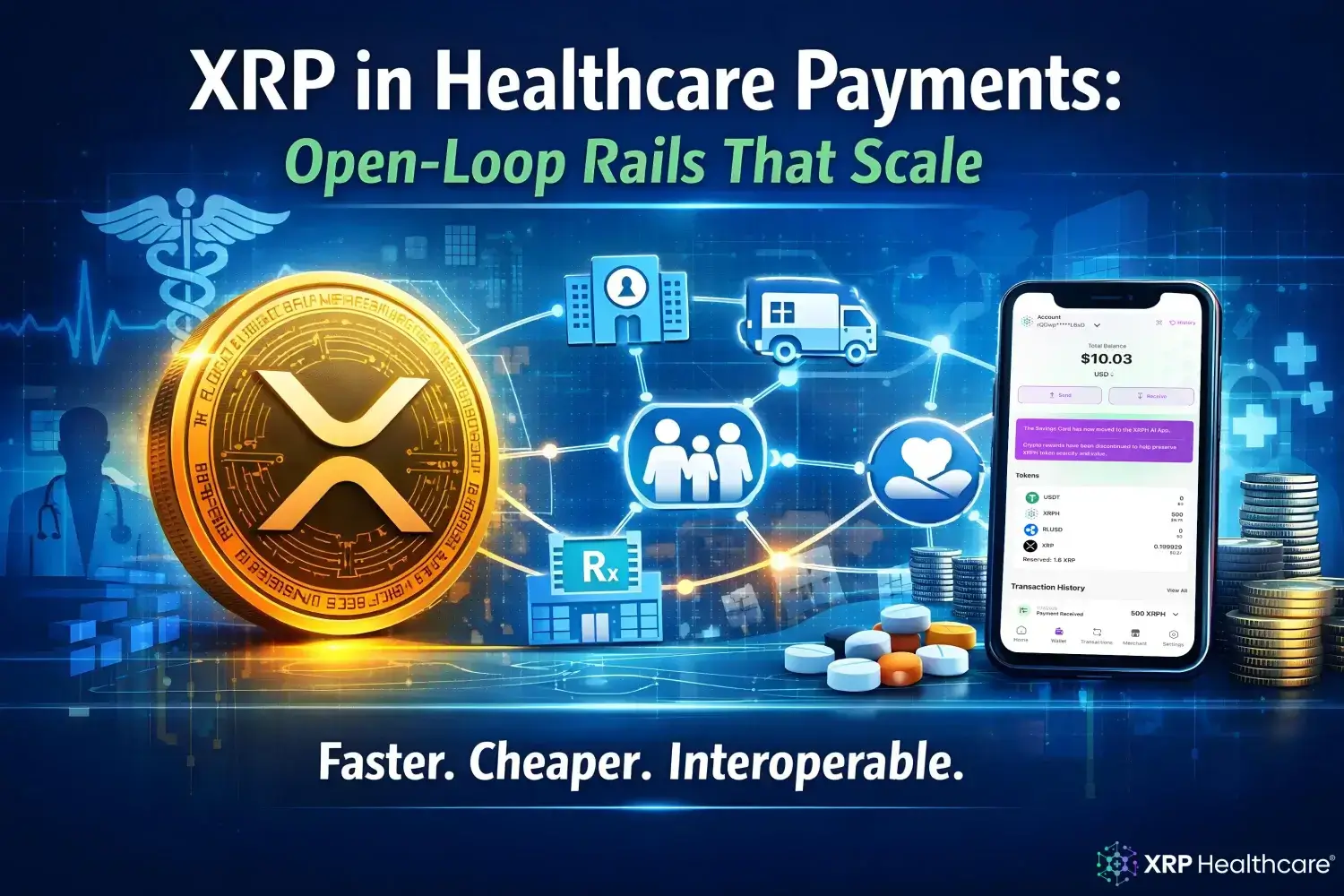
That is the purpose of XRP in healthcare payments: an infrastructure approach built on the XRP Ledger (XRPL) that enables open-loop pharmacy and healthcare settlement without forcing participants into proprietary networks, restrictive contracts, or locked-in platforms.
In this article, we explain:
- How open-loop XRP healthcare payment rails work
- Why this model is structurally superior for pharmacy chains and healthcare networks
- How the XRPH Wallet fits into an infrastructure-first strategy
What “XRP in Healthcare Payments” Really Means
XRP in healthcare payments refers to using XRP Ledger rails to move value between healthcare participants—such as pharmacies, clinics, suppliers, and families—efficiently and transparently.
The infrastructure mindset is simple:
- Own the rails, not the endpoints
- Enable interoperability, not dependency
- Support open standards, not closed networks
For the full mechanism and flow, see our pillar page:
👉 How XRP in Healthcare Works
Open-Loop vs Closed-Loop: The Difference That Matters
Closed-loop payment models
Closed systems create friction through:
- Platform dependency and lock-in
- Mandatory contracts or exclusivity
- Limited interoperability across providers
- Higher settlement and processing overhead
In healthcare, this reduces flexibility and increases the cost of moving money—especially when pharmacies and suppliers operate across regions.
Open-loop payment infrastructure
Open-loop rails are designed to do the opposite:
- No forced exclusivity
- No dependency on one network operator
- Seamless settlement across participants
- Infrastructure that supports many systems, not just one
This is the difference between controlling a system and enabling an ecosystem.
Why XRP Ledger Rails Fit Healthcare and Pharmacy Settlement
The XRP Ledger is built to transfer value efficiently at scale.
Key characteristics for healthcare and pharmacy payments:
- Fast settlement (typically seconds)
- Minimal network fees (measured in drops)
- High throughput suited to frequent transactions
- A design that supports payment flows without the overhead of legacy routing
This matters because pharmacy payments are high-frequency and margin-sensitive. When fees, delays, and reconciliation complexity rise, the entire supply chain feels it.
Where the XRPH Wallet Fits (Infrastructure, Not Control)
The XRPH Wallet is a non-custodial, open-source wallet interface designed to support XRP Ledger payment flows.
It demonstrates how open-loop healthcare settlement can work without taking custody of funds or locking participants into proprietary systems.
Key principles:
- Non-custodial: users control keys and funds
- Open-source: transparent architecture, auditable by third parties
- No PHI: avoids storing or transmitting personal health information
- Open-loop by design: built for interoperability and future integrations
Core idea:
We don’t control healthcare. We enable it.
Why Pharmacies Prefer Open Rails Over Platform Lock-In
Pharmacies and healthcare providers benefit from payment infrastructure that:
- Lowers processing and settlement costs
- Improves cash flow predictability
- Supports multiple payment workflows
- Avoids long-term dependency on a single operator
Open-loop rails can support pharmacy chains across regions, currencies, and operational models—without forcing them to surrender control of their payment relationships.
Infrastructure Ownership: The Long-Term Advantage
In modern markets, infrastructure layers usually outlast and outperform application layers.
Entities that define standards, ensure interoperability, and provide neutral rails tend to win long-term because they enable everyone—without competing with everyone.
That is why the infrastructure narrative matters in XRP in healthcare:
- Open standards
- Neutral rails
- Governance clarity
- Scalable settlement mechanics
For a technical overview of XRP Ledger capabilities, visit:
XRPL.org
Next Step: Read the Full Pillar Explanation
For the complete “how it works” breakdown and infrastructure logic end-to-end:
👉 How XRP in Healthcare Works
FAQs
What is XRP in healthcare payments?
It is the use of XRP Ledger rails to enable open-loop payment settlement for pharmacies, clinics, suppliers, and healthcare participants without closed platform lock-in.
How do pharmacy payments using XRP reduce cost?
XRP Ledger settlement is designed for fast transactions with minimal network fees, reducing payment friction compared to legacy systems.
Do open-loop healthcare payment rails require contracts?
Open-loop rails can be implemented without exclusivity or long-term lock-in. Participants retain choice over integrations and workflows.
Is the XRPH Wallet custodial?
No. The XRPH Wallet is non-custodial. Users control their private keys and funds at all times.
Does the XRPH Wallet store patient medical data?
No. The wallet is designed to avoid storing or transmitting personal health information (PHI).