Introduction
Healthcare payments are often slow, complex, and expensive. Patients, clinics, and pharmacies rely on insurance portals for claims and reimbursements. These portals manage coverage, verification, and billing.
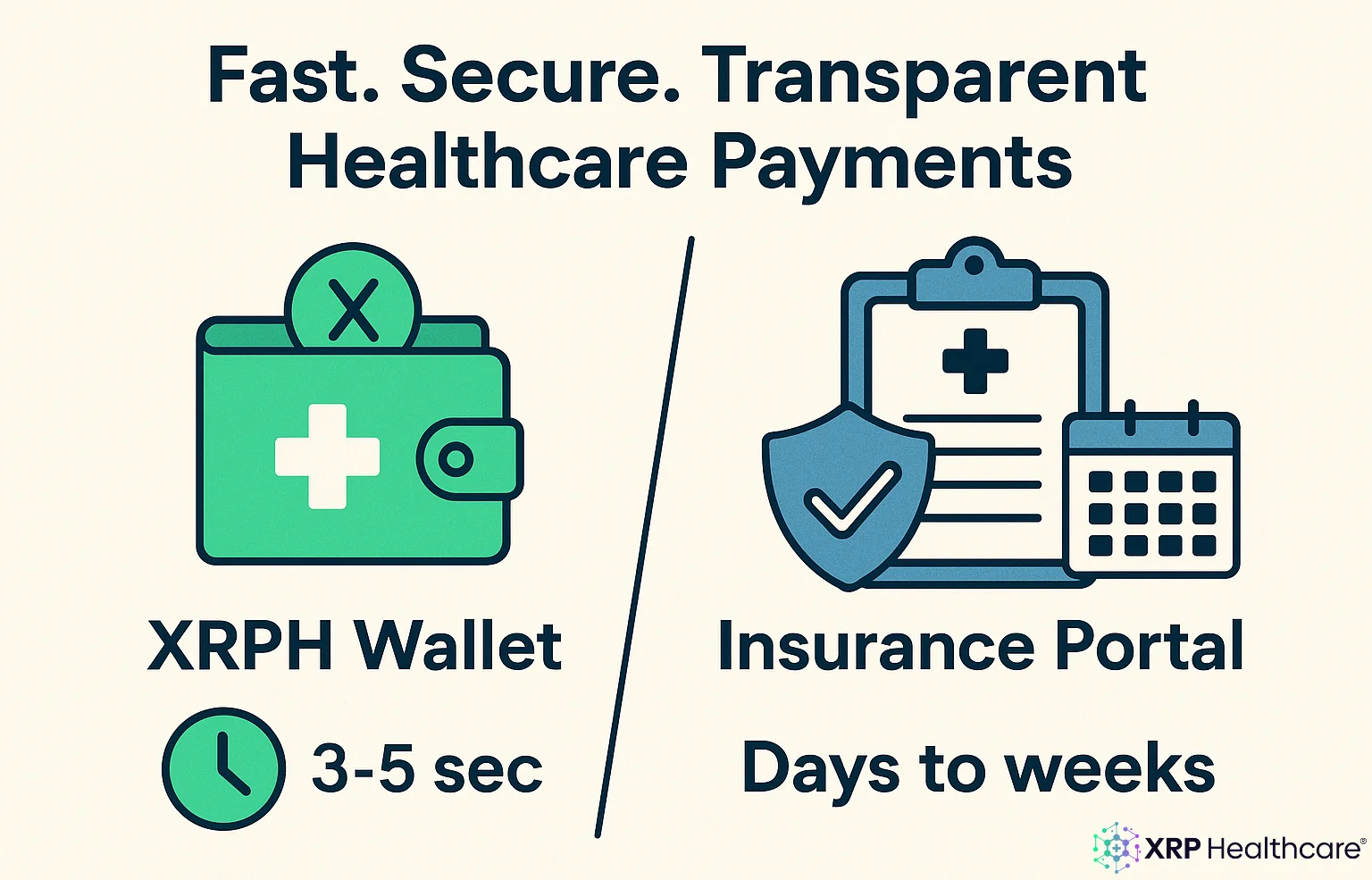
However, insurance-based systems have drawbacks. Payments may take days or weeks. Administrative work is high. Denials and delays are common.
Blockchain-based solutions like XRPH Wallet offer an alternative. XRPH Wallet is built on the XRP Ledger (XRPL). It is fast, low-cost, and secure. Payments settle in seconds, reducing delays and uncertainty.
This article compares XRPH Wallet with insurance portals. We look at how they work, advantages, limitations, and which use cases each suits best.
How Insurance Payment Portals Work
What They Are
Insurance or payer portals are digital platforms. Providers use them to:
- Verify patient coverage
- Submit claims for services or prescriptions
- Track payments and reimbursements
- Manage patient billing accounts (getsolum.com)
These portals integrate with insurer systems. They handle eligibility checks, claims adjudication, and policy management. Patients may pay co-pays or deductibles, but the insurer often covers the bulk of the cost.
Strengths
Insurance portals have several benefits:
- Coverage: For insured patients, costs may be fully or partially covered.
- Compliance: Portals follow regulatory standards for billing and privacy.
- Integration: They connect with multiple insurance providers, allowing providers to handle several payers in one system. (scnsoft.com)
Challenges
Despite these strengths, insurance portals face challenges:
- Delays: Claims may take days or weeks for approval. (gethealthie.com)
- Denials: Errors in documentation, coding, or eligibility can lead to claim denials.
- High Administrative Burden: Providers spend time submitting claims, following up on approvals, and handling resubmissions.
- Cash Flow Issues: Payment depends on insurer processing. Providers may experience delayed revenue.
- Patient Confusion: Patients may not understand coverage, co-pays, or billing statements.
In short, insurance portals are essential for insured patients, but they introduce complexity and delays.
What Is XRPH Wallet?
XRPH Wallet is a blockchain-based healthcare payment solution. Developed by XRP Healthcare LLC, it operates on the XRP Ledger.
Key Features
- Multiple Tokens: Supports XRP, XRPH, and RLUSD (USD-pegged stablecoin). (xrphtoken.com)
- Instant Payments: Settlements occur in 3-5 seconds. (world.einnews.com)
- Low Fees: Transaction cost is negligible - fractions of a cent.
- Non-Custodial: Users control their private keys.
- HIPAA-Grade Privacy: No protected health information (PHI) is stored on servers.
- Global Access: Works across countries with multi-currency support.
How It Works
- Providers create an invoice or QR code.
- Patients pay instantly using XRPH, XRP, or RLUSD.
- Funds settle directly to the provider’s wallet.
- No middlemen, no paperwork, no delays.
XRPH Wallet simplifies everyday healthcare payments. It is ideal for prescriptions, pharmacy refills, diagnostics, and outpatient services.
Advantages of XRPH Wallet
- Fast Payments: Reduces delays in receiving funds.
- Lower Costs: No high fees or administrative overhead.
- Transparency: Transactions are visible on the blockchain.
- Flexibility: Works for insured, uninsured, and international patients.
- Simplicity: Minimal steps for providers and patients.
- Secure: HIPAA-grade privacy without storing PHI.
XRPH Wallet is beneficial for clinics, pharmacies, labs, and small hospitals. It complements traditional insurance by enabling fast, direct payments when insurance claims are unnecessary or unavailable.
Limitations
- XRPH Wallet does not provide insurance coverage. Patients still need insurance for expensive procedures.
- Regulatory compliance varies by country. Legal frameworks may limit adoption.
- For major surgeries or long-term care, insurance portals remain necessary to cover high costs.
- Adoption requires clinics and pharmacies to integrate blockchain payments.
Use Cases
Best suited for:
- Prescription payments
- Outpatient services
- Lab tests and diagnostics
- Cross-border patient payments
- Uninsured patients or those without credit/debit options
Insurance portals remain better for:
- Hospitalization and surgeries
- Complex procedures requiring coverage
- Long-term treatment or ongoing care
- Patients fully covered under an insurance plan
XRPH Wallet for Pharmacies & Providers
Healthcare providers require payment tools that integrate cleanly, operate securely, and reduce friction for staff and patients.
This series examines how the XRPH Wallet supports real-world pharmacy and clinical workflows at scale.
Explore the full series:
Conclusion
XRPH Wallet and insurance portals serve different but complementary purposes.
- XRPH Wallet offers speed, low fees, transparency, and global reach.
- Insurance portals offer coverage, claim management, and regulatory compliance services.
For everyday healthcare payments like prescriptions and outpatient visits, XRPH Wallet is faster and simpler. For large or insurance-dependent treatments, insurance portals remain essential.
XRPH Wallet is shaping the future of healthcare payments. It reduces friction, improves cash flow, and makes transactions predictable. As adoption grows, it may become a standard alternative for modern healthcare payments.