Open Infrastructure for XRP-Based Healthcare Payments
XRP Healthcare operates as an independent infrastructure provider through XRP Healthcare LLC, the registered trademark owner.
The XRPH Wallet and XRP Payment Program framework form part of the XRP Healthcare infrastructure architecture for healthcare payment deployment using the XRP Ledger (XRPL). The model emphasizes non-custodial design, interoperability, technical transparency, and regulatory clarity.
This infrastructure is open, modular, and structured for integration by pharmacies, healthcare networks, payment facilitators, and enterprise system providers seeking to deploy XRP-based payment rails within their own environments.
XRPH Wallet does not provide custody, brokerage, exchange, financial, or healthcare services. It is non-custodial software infrastructure.
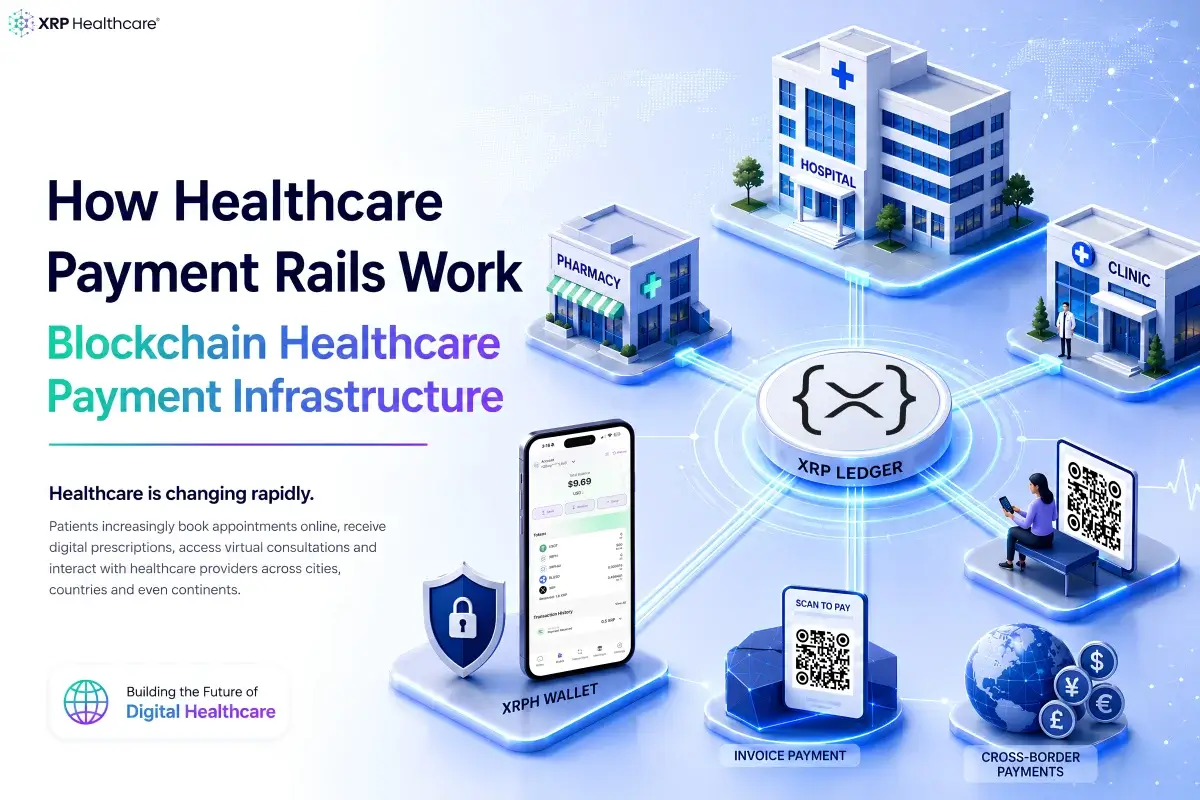
How Healthcare Payment Rails Work: Building the Future of Digital Healthcare Payments
Learn how healthcare payment rails work, why they matter, and how blockchain infrastructure built on the XRP Ledger can help support faster, more transparent healthcare payments.
How Healthcare Payment Rails Work | Blockchain Healthcare Payment Infrastructure | XRP Healthcare®
Healthcare is changing rapidly. Patients increasingly book appointments online, receive digital prescriptions, access virtual consultations, and interact with healthcare providers across cities, countries, and even continents.
Yet while healthcare delivery has become increasingly digital, the financial infrastructure supporting it often remains fragmented. Payments may pass through multiple intermediaries before reaching the final recipient. International healthcare payments can involve additional delays, currency conversions, and administrative costs.
As healthcare continues to evolve into a connected global ecosystem, there is a growing need for payment infrastructure that is faster, more transparent, and capable of supporting digital healthcare services at scale.
This is where Healthcare Payment Rails become important. Rather than referring to a single payment application, payment rails describe the underlying infrastructure that allows value to move securely between participants. Within the XRP Healthcare ecosystem, these payment rails form part of the broader XRP Healthcare Infrastructure, providing a foundation for digital healthcare payments built on the XRP Ledger.
Watch: XRP Healthcare Infrastructure Overview
Before exploring healthcare payment rails in detail, watch this short introduction to see how XRP Healthcare Infrastructure is designed to connect payments, wallets, and digital healthcare services through blockchain technology.
What Are Healthcare Payment Rails?
The term payment rails refers to the network that transfers money from one party to another.
Most people use payment rails every day without realizing it.
Whether someone pays using:
Debit cards
Credit cards
Bank transfers
Mobile banking
Digital wallets
They are using payment rails.
The visible payment method is only the front-end experience.
Behind the scenes, an entire infrastructure validates, processes, and settles each transaction.
Healthcare operates in exactly the same way.
When a patient pays for treatment, a pharmacy receives payment, or healthcare providers exchange value, payment rails move those transactions securely behind the scenes.
Healthcare is unlike many other industries because payments frequently involve multiple participants.
These participants may include:
Patients
Hospitals
Clinics
Pharmacies
Insurance providers
Employers
Payment processors
International banking systems
Each additional participant introduces additional complexity.
Traditional payment systems often involve:
Delayed settlement
Reconciliation challenges
International transfer fees
Multiple financial intermediaries
Different banking standards
Currency conversions
As healthcare expands globally, these challenges become increasingly significant.
Modern healthcare requires infrastructure that supports secure, efficient, and transparent digital payments.
Infrastructure Versus Healthcare Applications
Many healthcare innovations focus on applications.
Examples include:
Patient portals
Appointment booking systems
AI health assistants
Telemedicine platforms
Electronic health records
These applications provide services directly to users.
Payment rails serve a completely different purpose.
They provide the infrastructure beneath those applications.
Just as roads enable transport without being the destination, payment rails enable healthcare payments without being the healthcare service itself.
Strong infrastructure allows many different healthcare applications to operate efficiently without each needing to build its own payment network.
The Evolution of Healthcare Payments
Healthcare payments have evolved significantly over time.
Traditional Cash Payments
Historically, healthcare payments were made in person using physical cash. While simple, this approach offered little automation and limited scalability.
Electronic Banking
Electronic banking introduced faster transfers but often remained dependent on national banking systems and operating hours.
Cross-border payments could still require several intermediaries before funds reached the final destination.
Digital Payment Platforms
The rise of digital payment platforms significantly improved the user experience.
However, many platforms continued relying on traditional financial infrastructure behind the scenes.
Blockchain-Based Payment Infrastructure
Blockchain introduces another major evolution.
Rather than relying entirely on multiple intermediaries, blockchain provides a shared ledger capable of recording and settling transactions transparently and efficiently.
For healthcare payment infrastructure, this creates opportunities to streamline how digital value moves throughout the healthcare ecosystem.
Why Blockchain Changes the Conversation
Blockchain is often discussed in relation to cryptocurrencies. However, one of its most significant applications lies in digital infrastructure.
Instead of focusing solely on digital assets, blockchain can provide a secure, transparent settlement layer beneath healthcare payment systems.
Potential advantages include:
Faster transaction confirmation
Transparent transaction records
Lower operational complexity
Improved traceability
Reduced dependency on multiple intermediaries
Global accessibility
Importantly, blockchain infrastructure is designed to complement existing healthcare systems rather than replace them.
Healthcare providers can continue using familiar software while benefiting from a more efficient payment infrastructure operating underneath.
The Role of the XRP Ledger
XRP Healthcare Infrastructure is built around the XRP Ledger (XRPL).
The XRP Ledger has become widely recognized for supporting fast, reliable, and cost-efficient digital value transfers through an open-source blockchain network.
Its speed, scalability, and low transaction costs make it particularly suitable for infrastructure-focused applications where reliability is essential.
Within the XRP Healthcare ecosystem, the XRP Ledger serves as the settlement layer upon which additional payment services, digital wallets, and healthcare tools can be developed.
Unlike consumer-facing applications, the ledger itself functions as the foundation that powers the ecosystem.
Healthcare Payment Rails as Digital Infrastructure
Rather than thinking of payment rails as software, it is often more helpful to think of them as public infrastructure.
Roads allow vehicles to travel.
Railways allow trains to move.
The internet allows information to flow.
Payment rails allow value to move.
Healthcare payment rails extend this concept into digital healthcare by creating secure pathways through which authorized financial transactions can take place between healthcare participants.
These payment rails are largely invisible to end users, who simply experience fast, seamless, and secure digital payments.
How the XRPH Wallet Connects to Payment Rails
Every payment network requires an interface that allows individuals and organizations to interact with it securely.
Within the XRP Healthcare ecosystem, the XRPH Wallet is designed to provide that interface.
Rather than serving only as a digital asset wallet, it is intended to become a gateway into the broader XRP Healthcare Infrastructure.
As the ecosystem continues to develop, users will be able to access multiple services from one secure application instead of managing numerous disconnected platforms.
Future capabilities may include:
Digital healthcare payments
QR code payments
Supported token management
Payment requests
Healthcare settlement services
AI-powered ecosystem rewards
Healthcare payment programs
The objective is to simplify how users interact with blockchain-powered healthcare infrastructure while maintaining complete control over their digital assets.
QR Code Healthcare Payments
QR codes have become one of the most widely adopted methods of initiating digital payments.
Within healthcare, QR technology simplifies transactions by allowing payment information to be shared quickly, accurately, and securely.
Rather than manually entering payment details, users simply scan a QR code using a compatible wallet.
Potential healthcare use cases include:
Pharmacy payments
Clinic payments
Medical invoices
Healthcare events
Health screening programs
Charitable healthcare donations
Community healthcare initiatives
The payment rail remains almost invisible to the user, creating a payment experience that is both familiar and efficient.
Cross-Border Healthcare Payments
Healthcare increasingly operates on a global scale.
Patients travel internationally for specialist treatment. Medical professionals provide remote consultations across borders. Healthcare organizations collaborate with partners around the world.
Traditional international payments often involve:
Multiple correspondent banks
Foreign exchange delays
High transaction costs
Banking hour limitations
Regional payment restrictions
Modern blockchain infrastructure helps reduce unnecessary friction by providing a shared settlement network capable of operating continuously.
Although healthcare providers must always comply with local regulations and payment requirements, blockchain infrastructure can support faster and more efficient movement of digital value across participating networks.
Understanding Healthcare Settlement
Payment authorization and payment settlement are often confused, but they are two separate stages of a transaction.
Payment Authorization
Authorization confirms that a payment is valid and may proceed.
Payment Settlement
Settlement completes the actual transfer of value between the involved parties.
Settlement is one of the most important functions of payment infrastructure because it represents the point at which a transaction becomes final.
The XRP Ledger is recognized for supporting rapid settlement, making it an excellent foundation for infrastructure-focused healthcare payment systems.
Security Within Healthcare Payment Infrastructure
Healthcare organizations manage sensitive financial transactions and user information. Any payment infrastructure must therefore place security at its core.
Effective payment infrastructure should prioritize:
Cryptographic security
Transaction integrity
Transparent verification
User-controlled wallets
Reliable network operation
Open-source review where appropriate
It is important to distinguish payment infrastructure from medical record systems.
The XRP Healthcare Infrastructure is designed to facilitate digital value transfer and related services. It is not intended to store confidential patient medical records on the blockchain.
This separation allows healthcare applications to maintain appropriate privacy controls while benefiting from efficient payment infrastructure.
Why Open Infrastructure Matters
Open standards encourage innovation by allowing developers to build compatible applications without recreating the underlying payment network.
Future healthcare services that can integrate with open infrastructure include:
Healthcare marketplaces
Pharmacy services
Insurance integrations
Patient engagement platforms
Preventive healthcare programs
Digital wellness services
AI-powered healthcare applications
Infrastructure provides the foundation upon which future healthcare innovation can continue to grow.
Healthcare Payment Rails Within the XRP Healthcare Ecosystem
Healthcare payment rails form one part of a broader infrastructure strategy. Rather than operating independently, ecosystem components are designed to work together as an integrated digital healthcare ecosystem.
Infrastructure
Healthcare Payment Rails
XRP Ledger
Settlement Layer
User Access
XRPH Wallet
QR Payments
Payment Requests
Ecosystem Utility
XRPH Token
XRPHAI Token
AI Rewards
Healthcare Services
Payment Programs
Future Healthcare Applications
Digital Engagement Tools
The Future of Healthcare Payments
Healthcare is expected to become increasingly connected over the coming decade. Patients will expect seamless digital experiences comparable to those found in banking, retail, and other industries.
Future payment infrastructure will need to support:
Instant digital transactions
Cross-border healthcare
Digital identity integration
Mobile-first experiences
AI-assisted healthcare services
Connected healthcare ecosystems
Blockchain-based payment rails offer one approach to supporting these evolving requirements while maintaining transparency and efficiency.
Conclusion
Healthcare payment rails are the unseen infrastructure that allows digital value to move securely throughout modern healthcare systems.
While patients may only experience a simple payment or QR code scan, sophisticated infrastructure operates behind the scenes to validate, process, and settle every transaction.
Within the XRP Healthcare ecosystem, payment rails are designed to work alongside the XRP Ledger, the XRPH Wallet, and future healthcare services to create a scalable foundation for digital healthcare payments.
Rather than replacing existing healthcare systems, this infrastructure complements them by providing efficient payment pathways capable of supporting the next generation of healthcare innovation.
As digital healthcare continues to expand globally, robust payment infrastructure will become an increasingly important component of connected healthcare ecosystems.
Continue Learning
Expand your understanding of the XRP Healthcare ecosystem:
Interested in learning how blockchain infrastructure is helping shape the future of digital healthcare payments?
Explore the XRP Healthcare Infrastructure knowledge hub to discover how payment rails, the XRPH Wallet, AI rewards, and blockchain technology work together to support a connected healthcare ecosystem.
Healthcare payment rails are the underlying infrastructure that enables secure movement of value between participants such as patients, healthcare providers, pharmacies, insurers, and payment networks.
Why are healthcare payment rails important?
They support efficient, transparent, and scalable digital payment systems that help modern healthcare organizations process transactions more effectively.
How does blockchain improve healthcare payments?
Blockchain provides a transparent settlement layer that can reduce operational complexity, improve traceability, and support faster digital transactions while complementing existing healthcare systems.
What role does the XRP Ledger play?
The XRP Ledger serves as the blockchain settlement layer within the XRP Healthcare Infrastructure, enabling fast, secure, and cost-efficient digital value transfers.
Does XRP Healthcare store patient medical records on the blockchain?
No. The XRP Healthcare Infrastructure focuses on payment infrastructure and digital value transfer. It is not designed to store confidential patient medical records on the blockchain.