Introduction
As digital payments become increasingly common, many people are becoming familiar with digital wallets. However, not all wallets operate in the same way. Some wallets place a third party in control of your assets, while others allow you to retain complete ownership. Understanding this difference is one of the most important concepts in blockchain technology.
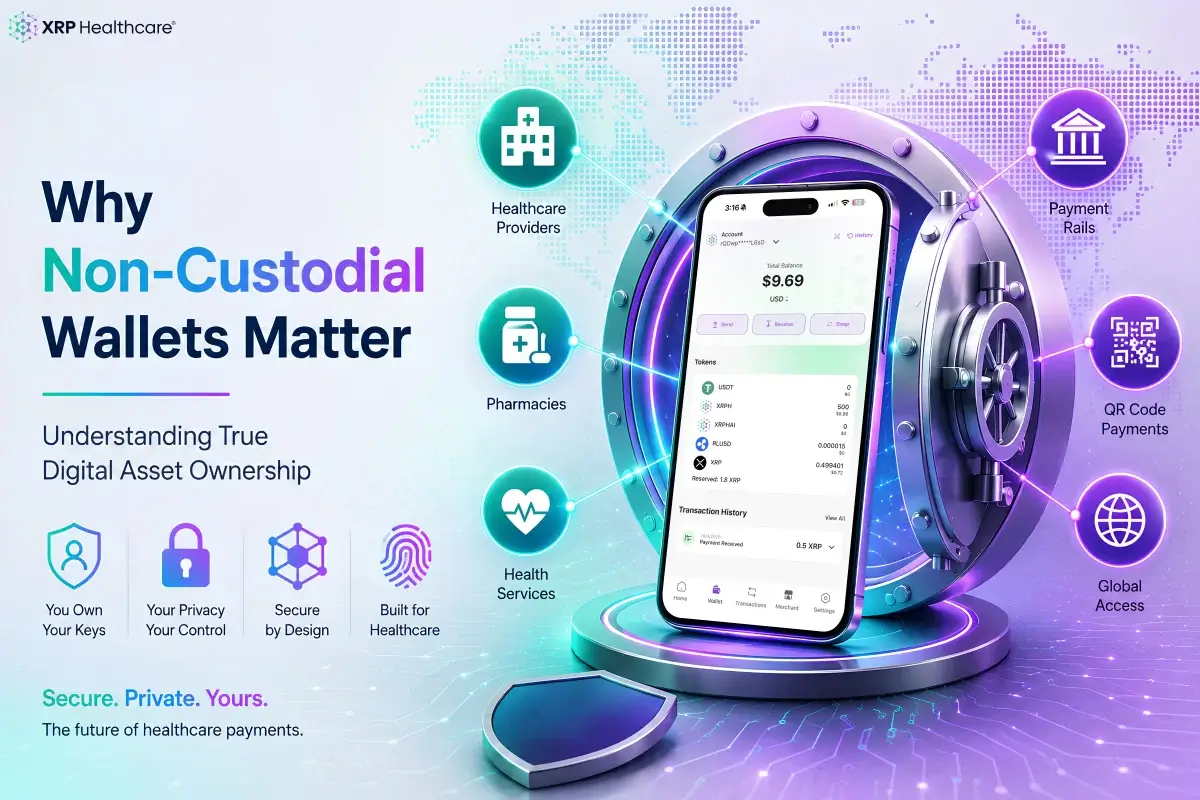
A non-custodial wallet gives you direct control over your digital assets without relying on a bank, exchange, or other intermediary to hold them on your behalf. Within the XRP Healthcare ecosystem, the XRPH Wallet is designed around this principle of self-custody, enabling users to interact with blockchain-powered healthcare infrastructure while remaining in control of their own wallet.
What Does "Non-Custodial" Mean?
The word custody simply means safeguarding or holding something on behalf of someone else. Traditional banks are custodians. When money is deposited into a bank account, the bank safeguards those funds and manages access through its systems. Similarly, many cryptocurrency exchanges act as custodians by holding users' digital assets on their behalf.
A non-custodial wallet works differently. Instead of a company controlling access to the assets, the wallet owner holds the private keys required to access and manage them.
This means the user - not the wallet provider - remains in control.
Understanding Private Keys
Every blockchain wallet is built around cryptographic keys.
Public Address
A public address is similar to an account number. It can be shared with others so they can send digital assets to the wallet.
Private Key
The private key is different. It proves ownership of the wallet and authorises transactions. Whoever controls the private key controls the wallet. For this reason, private keys must never be shared. Most modern wallets generate a recovery phrase, sometimes called a seed phrase, which can restore access if a device is lost or replaced.
Protecting this recovery phrase is one of the most important responsibilities of every wallet owner.
Custodial vs Non-Custodial Wallets
Custodial WalletNon-Custodial Wallet Third party controls accessUser controls access Recovery managed by providerRecovery managed by owner Provider holds private keysUser holds private keys Greater reliance on intermediaryGreater personal responsibility Suitable for convenienceSuitable for direct ownership
Neither approach is inherently right or wrong. Each serves different user needs.
However, blockchain technology was originally designed to allow individuals to hold and transfer value directly, making self-custody a fundamental concept.
Why Self-Custody Matters
True Ownership
Users remain in direct control of their supported digital assets rather than relying on another organisation.
Greater Transparency
Ownership is clearly linked to the wallet itself rather than an intermediary's internal records.
Increased Independence
Users can access compatible blockchain services without needing permission from a central provider.
Portability
A properly secured wallet can often be restored on another compatible device using the recovery phrase.
This reduces dependence on a single application or physical device.
Why This Matters for Healthcare Infrastructure
Healthcare increasingly relies on secure digital systems.
Patients expect greater control over many aspects of their healthcare journey.
The same principle increasingly applies to digital financial interactions.
A non-custodial wallet aligns with this philosophy by allowing users to maintain direct ownership while accessing blockchain-powered healthcare infrastructure.
Rather than creating unnecessary dependence on multiple intermediaries, self-custody supports a more direct relationship between users and compatible digital services.
The XRPH Wallet and Self-Custody
The XRPH Wallet has been designed as a non-custodial wallet. This means users retain control over their wallet credentials and supported digital assets. The wallet provider does not take ownership of user funds.
Instead, the wallet provides the software interface through which users interact with the XRP Ledger and the wider XRP Healthcare ecosystem. This approach combines blockchain security with a familiar user experience designed for both newcomers and experienced users.
Responsibility Comes with Ownership
While self-custody provides greater control, it also increases personal responsibility. There is no customer service department that can recreate a lost recovery phrase. If recovery information is permanently lost, access to the wallet may also be lost.
Users should always:
Write down their recovery phrase.
Store it securely offline.
Never photograph or email it.
Never share it with anyone.
Keep backup copies in secure locations.
Common Misconceptions About Non-Custodial Wallets
Many people assume self-custody is only suitable for technology experts. Modern wallet design has changed considerably. Today's wallets focus on improving usability while maintaining blockchain security.
Another misconception is that non-custodial wallets are less secure because no company controls them. In reality, security depends largely on how well users protect their recovery information and follow good digital security practices.
Protecting Your Wallet
A non-custodial wallet gives you direct control over your digital assets, but that control comes with an important responsibility: protecting your wallet credentials. Unlike traditional online accounts, blockchain wallets generally cannot be recovered by resetting a password or contacting customer support. The recovery phrase generated when a wallet is created is the master key to the wallet. Anyone who gains access to that phrase can potentially access the wallet and its supported digital assets.
Best Practices for Wallet Security
Keep Your Recovery Phrase Offline
Write your recovery phrase down and store it in a secure physical location. Avoid storing it in cloud storage, emails, or messaging applications where it may be exposed.
Never Share Your Recovery Phrase
No legitimate wallet provider, support team, or member of the XRP Healthcare community will ever ask for your recovery phrase.
Use Strong Device Security
Download Only Official Software
Always download the XRPH Wallet from official sources.
Verify Before Confirming
Confirm the recipient address.
Check the payment amount.
Review transaction details carefully.
Understanding Common Threats
Phishing Websites
Fraudsters may create websites that closely resemble legitimate wallet pages to trick users into entering recovery phrases or sensitive information.
Fake Customer Support
Scammers may pretend to represent wallet providers or blockchain projects.
No legitimate support representative will ever request your recovery phrase.
Social Engineering
Social engineering involves manipulating people rather than technology.
Attackers may create urgency or claim there is a problem with your wallet to encourage you to reveal sensitive information.
The Role of Self-Custody in Healthcare Infrastructure
Healthcare is built on trust. Patients expect confidence not only in healthcare providers but also in the digital systems they use. A non-custodial wallet allows users to interact with blockchain-powered healthcare services while retaining direct control over their supported digital assets.
The XRPH Wallet is designed to facilitate payments and ecosystem participation. It is not intended to store confidential patient medical records on the blockchain.
Supporting the XRP Healthcare Ecosystem
The XRPH Wallet is designed to act as the primary access point into the wider XRP Healthcare ecosystem.
Real-World Payment Scenarios
Paying a Healthcare Provider
A clinic generates a QR code for a consultation fee. The patient scans the code using the XRPH Wallet, reviews payment details, and authorises the transaction.
Pharmacy Transactions
A participating pharmacy provides a digital payment request that users can securely review and complete.
International Healthcare Services
Patients receiving treatment abroad can use compatible digital payment infrastructure without relying solely on traditional banking processes.
Why Non-Custodial Wallets Represent the Future
As digital payments continue to evolve, self-custody is expected to play an increasingly important role.
Conclusion
A non-custodial wallet is more than a place to store digital assets. It gives users direct ownership and control while providing secure access to blockchain-powered ecosystems. Within the XRP Healthcare ecosystem, the XRPH Wallet has been designed around these principles, enabling users to interact with healthcare payment infrastructure, QR payments, and future ecosystem services without surrendering control of their supported digital assets.
Continue Learning
Want to learn how blockchain infrastructure is helping shape the future of healthcare payments?
Explore the XRP Healthcare Infrastructure knowledge hub to discover how the XRPH Wallet, payment rails, XRPL, and digital asset technology work together to support a connected healthcare ecosystem.
Explore XRP Healthcare Infrastructure