Introduction
Healthcare is becoming increasingly connected. Patients can now consult doctors remotely, access digital prescriptions, pay for healthcare online, and receive treatment across international borders.
While healthcare services have evolved rapidly, many payment systems continue to rely on infrastructure developed decades ago. This creates challenges such as delayed settlement, fragmented payment networks and increased administrative complexity.
Blockchain technology offers an alternative approach. Rather than relying solely on traditional financial intermediaries, blockchain creates a shared digital ledger capable of recording and settling transactions efficiently and transparently.
The XRP Ledger (XRPL) is one example of this technology. Within the XRP Healthcare ecosystem, it provides the underlying blockchain infrastructure that supports digital healthcare payment services and future financial innovation.
What Is the XRP Ledger?
The XRP Ledger is an open-source blockchain network designed primarily for transferring digital value. Unlike blockchains that focus on complex programmable applications, the XRP Ledger was built with efficiency, reliability and payment infrastructure in mind. It provides a distributed ledger where transactions are verified by independent validators and permanently recorded.
Because the ledger operates continuously, participants can submit transactions without being limited by traditional banking hours. This makes it particularly well suited to payment-focused applications.
Why Healthcare Needs Modern Payment Infrastructure
Healthcare payments often involve more than simply paying a bill.
A single healthcare transaction may involve:
Each participant may use different payment systems.
The result can be additional complexity, reconciliation work, and slower settlement. As healthcare continues to expand internationally, payment infrastructure must become more connected and efficient.
The Difference Between Payments and Settlement
Many people think that a payment is complete as soon as they press "Send." In reality, several processes often occur behind the scenes.
For example:
The payment is authorised.
Payment information is transmitted.
Financial institutions process the request.
Settlement takes place.
Records are updated.
Settlement refers to the final movement of value between participants. This is one of the areas where blockchain technology can offer significant operational improvements. The XRP Ledger is designed to support efficient digital settlement while maintaining a transparent transaction history.
Why the XRP Ledger Is Well Suited to Healthcare
Healthcare infrastructure requires systems that are dependable, scalable, and capable of supporting international activity. The XRP Ledger has several characteristics that make it attractive for payment infrastructure.
Fast Transaction Confirmation
Transactions are confirmed quickly, helping support responsive digital payment experiences.
Low Transaction Costs
Efficient transaction processing can help reduce operational costs associated with digital payments.
Energy-Efficient Consensus
Unlike some blockchain networks that rely on energy-intensive mining, the XRP Ledger uses a consensus protocol designed to validate transactions efficiently.
High Throughput
The network is designed to process a large number of transactions, making it suitable for payment-focused applications.
Mature Ecosystem
Having operated for many years, the XRP Ledger benefits from an established developer community and a broad ecosystem of compatible applications.
Blockchain as Healthcare Payment Infrastructure
One of the biggest misconceptions surrounding blockchain is that it exists solely for cryptocurrencies. In reality, blockchain can serve as infrastructure. Just as roads move vehicles and the internet moves information, blockchain payment infrastructure enables the movement of digital value.
Within healthcare, this infrastructure can support services such as:
The blockchain itself remains largely invisible to end users, who simply experience secure and efficient digital transactions.
How the XRP Ledger Fits into XRP Healthcare Infrastructure
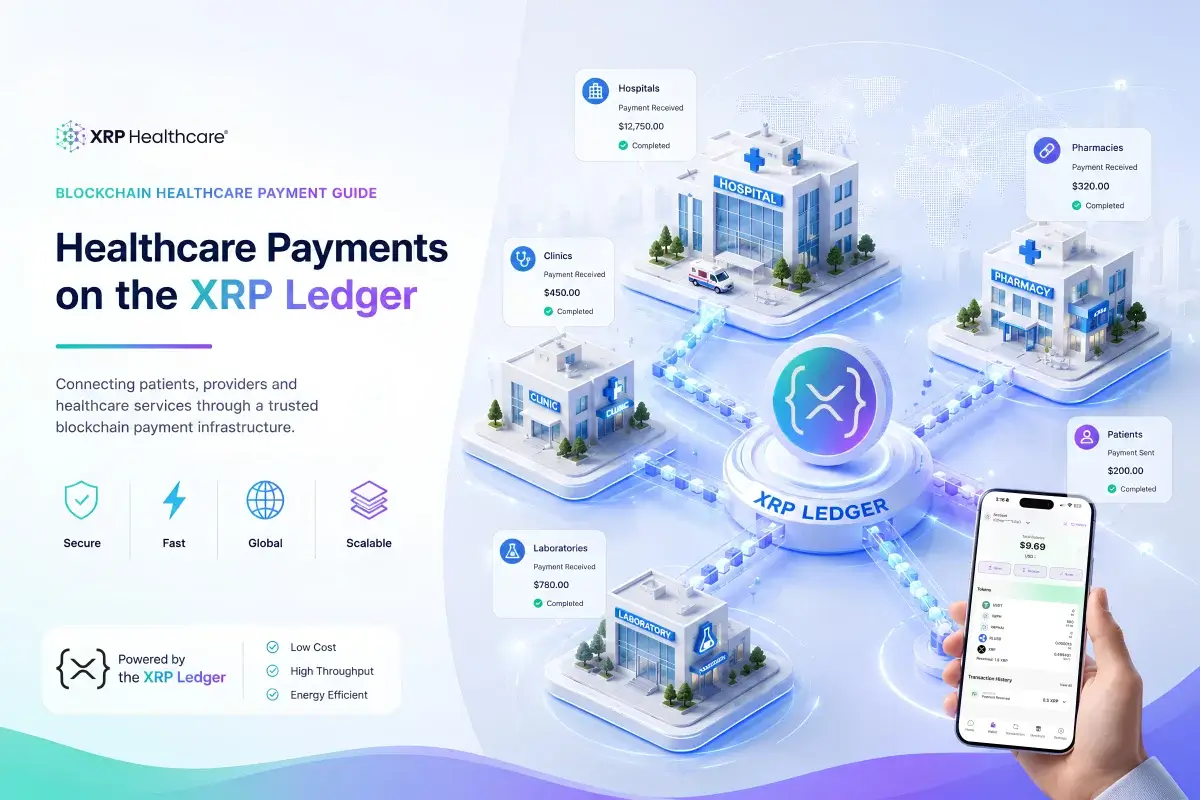
The XRP Healthcare ecosystem is built as a collection of connected infrastructure components. The XRP Ledger provides the settlement layer beneath those components.
Above the ledger sit services such as:
XRPH Wallet
Healthcare Payment Rails
QR Code Payments
XRPH Token
XRPHAI Token
AI Rewards
Future payment services
Each layer performs a different role while working together as an integrated digital ecosystem. Rather than replacing existing healthcare software, this infrastructure is designed to complement it by providing an efficient method of moving digital value.
Supporting Cross-Border Healthcare Payments
Healthcare is no longer confined to national borders. Patients increasingly travel internationally for specialist treatment. Medical professionals provide consultations remotely. Healthcare organisations collaborate across multiple countries.
Traditional international payments can involve:
Blockchain infrastructure offers a different approach by providing a shared digital ledger capable of supporting international value transfer continuously. While compliance with local regulations remains essential, modern payment infrastructure can help simplify how compatible digital payments move across borders.
Transparency and Trust in Healthcare Payments
Transparency is an important characteristic of blockchain infrastructure. Transactions recorded on a blockchain create an auditable history that authorised participants can independently verify. This does not mean confidential patient information should be stored on the blockchain. Within the XRP Healthcare ecosystem, blockchain is intended to support payment infrastructure rather than act as a repository for private medical records.
This distinction helps preserve privacy while allowing payment activity to benefit from transparent settlement technology.
Connecting Healthcare Through the XRPH Wallet
While the XRP Ledger provides the blockchain settlement layer, users require a simple and secure way to interact with that infrastructure. This is where the XRPH Wallet plays an important role.
The wallet is designed to provide access to blockchain-powered healthcare payment services through a familiar mobile interface. Rather than interacting directly with blockchain technology, users can perform everyday actions such as:
Sending supported digital assets
Receiving payments
Scanning QR payment requests
Managing supported ecosystem tokens
Participating in future healthcare payment programmes
Accessing additional XRP Healthcare ecosystem services
The objective is to make blockchain technology accessible without requiring users to understand its technical complexity.
QR Code Payments in Healthcare
QR codes have transformed digital payments around the world. Healthcare is no exception.
Instead of manually entering payment information, users can simply scan a QR code using the XRPH Wallet.
Examples include:
Private medical consultations
Pharmacy purchases
Health screening programmes
Laboratory services
Medical invoices
Community healthcare initiatives
Healthcare charity donations
The payment information is transferred accurately and efficiently, reducing manual entry errors while improving the overall user experience.
Supporting Multiple Digital Assets
The XRP Healthcare ecosystem has been designed with flexibility in mind. Different digital assets may perform different functions within the ecosystem.
XRP
The native digital asset of the XRP Ledger, used to facilitate transactions across the network.
XRPH Token
Designed to support utility within the XRP Healthcare Infrastructure ecosystem and connect compatible services.
XRPHAI Token
Focused on AI-powered engagement and ecosystem rewards, encouraging participation within supported applications.
RLUSD
RLUSD is a US dollar-denominated stablecoin on the XRP Ledger. Stablecoins can help support payment scenarios where users prefer an asset designed to maintain a stable value relative to the US dollar.
As adoption of tokenised financial assets continues to evolve, stablecoins may play an increasingly important role in digital payment infrastructure.
Security and Reliability
Healthcare organisations require payment systems they can trust. Security is therefore a fundamental consideration.
The XRP Ledger incorporates cryptographic techniques that help protect transaction integrity while providing transparent verification of completed transactions.
The broader security of any healthcare payment solution also depends on:
Secure wallet management
Strong authentication
User education
Compliance with applicable regulations
Secure application development
Responsible operational practices
Security is not achieved through technology alone.
It is the combination of infrastructure, software and user awareness that creates resilient payment systems.
Why Interoperability Matters
Healthcare technology rarely exists in isolation. Hospitals, clinics, pharmacies, insurers and healthcare software providers often use different systems. Modern payment infrastructure should therefore support interoperability wherever possible. Rather than requiring every organisation to replace existing software, blockchain infrastructure can act as a settlement layer beneath existing applications.
This allows organisations to continue using familiar healthcare systems while benefiting from more efficient digital payment infrastructure.
Supporting Future Healthcare Innovation
Digital healthcare is expected to continue evolving rapidly.
Future services may include:
AI-assisted healthcare platforms
Preventive healthcare programmes
Connected medical devices
Remote patient monitoring
Digital identity solutions
International healthcare ecosystems
Smart payment automation
Payment infrastructure must be flexible enough to support these innovations without requiring fundamental redesign each time new services are introduced. The XRP Ledger provides a foundation upon which compatible healthcare payment solutions can continue to evolve.
Blockchain Is Infrastructure, Not the Healthcare Service
It is important to understand the distinction between blockchain infrastructure and healthcare delivery. The XRP Ledger is not a healthcare application. It does not diagnose illnesses, provide medical advice, or replace healthcare professionals. Instead, it acts as a secure digital settlement layer capable of supporting the movement of value between participants. Likewise, the XRP Healthcare Infrastructure is designed to complement existing healthcare systems rather than replace them.
Applications deliver healthcare.
Infrastructure enables those applications to operate more efficiently.
The Future of Healthcare Payment Infrastructure
Healthcare is becoming increasingly digital, mobile and international. Patients expect seamless experiences.
Healthcare providers require efficient financial systems. Organisations need infrastructure capable of supporting innovation over many years. Blockchain technology, including the XRP Ledger, represents one approach to modernising payment infrastructure while maintaining transparency, efficiency and scalability.
As digital healthcare continues to mature, payment infrastructure will become an increasingly important part of delivering connected healthcare experiences.
Conclusion
The XRP Ledger provides an efficient blockchain foundation for digital healthcare payment infrastructure. Rather than replacing existing healthcare systems, it supports them by providing a transparent settlement layer capable of moving digital value efficiently between compatible participants. Combined with the XRPH Wallet, healthcare payment rails, QR payments and future ecosystem services, the XRP Ledger helps form part of a broader infrastructure strategy designed to support the next generation of digital healthcare payments.
As healthcare continues to evolve, modern payment infrastructure will play a key role in enabling secure, efficient and globally connected healthcare ecosystems.
Continue Learning: XRP Healthcare Infrastructure
Explore more topics within the XRP Healthcare Infrastructure knowledge hub:
Call to Action
Interested in learning more about blockchain-powered healthcare infrastructure?
Visit the XRP Healthcare Infrastructure pillar page to discover how the XRP Ledger, XRPH Wallet, payment rails and digital assets work together to support the future of healthcare payments.
Explore XRP Healthcare Infrastructure →