Introduction
When people make a payment, they often assume the transaction is complete the moment they press Pay. In reality, several processes usually occur before the payment is fully completed. One of the most important-but least understood-is settlement. Settlement is the point at which money or digital value is finally transferred between participants. Without settlement, a payment is simply an instruction waiting to be completed.
In healthcare, where payments frequently involve patients, clinics, pharmacies, insurers and international organisations, efficient settlement becomes increasingly important. Within the XRP Healthcare Infrastructure, blockchain technology provides a modern settlement layer designed to support faster, more transparent digital healthcare payments.
What Is Settlement?
Settlement is the final stage of a financial transaction. It is the moment when value officially moves from one party to another, and the transaction is considered complete.
Imagine purchasing medication from a pharmacy using a digital payment.
Several things happen behind the scenes:
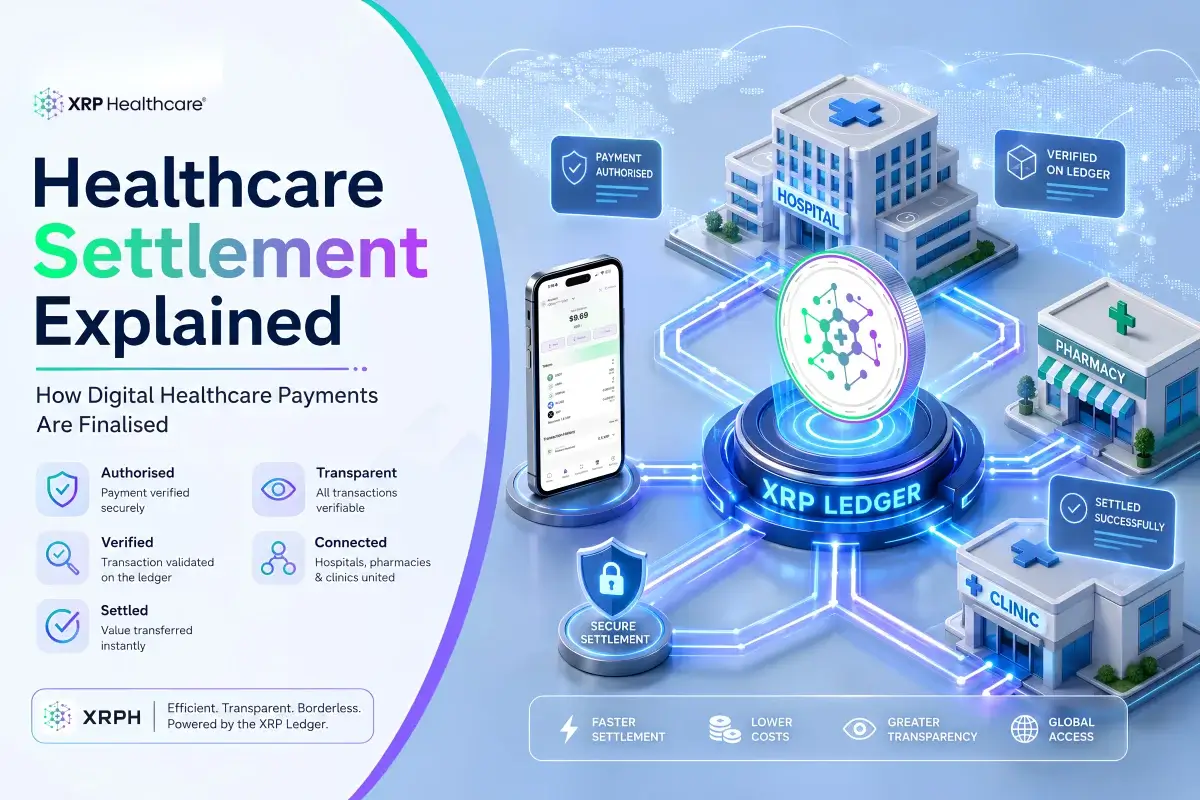
The payment request is created.
The payment is authorised.
The transaction is verified.
Settlement transfers the value.
Financial records are updated.
Only after settlement has taken place has the payment been fully completed.
Settlement vs Payment Authorisation
These two terms are often confused. However, they describe different stages of the payment process.
Payment Authorisation
Authorisation checks whether the payment can proceed.
It verifies information such as:
Authorisation does not necessarily mean the recipient has received the money.
Settlement
Settlement completes the transaction. It transfers the value between participants and finalises the payment. This distinction is important because delays often occur between authorisation and settlement within traditional payment systems.
Why Settlement Matters in Healthcare
Healthcare payments are often more complex than everyday retail purchases. A single transaction may involve multiple parties, including:
Each participant may use different financial systems. This increases the complexity of completing settlement efficiently. The more intermediaries involved, the more opportunities there are for delays, reconciliation issues and administrative costs.
Traditional Settlement Challenges
Conventional payment systems have served healthcare for many years, but they were not originally designed for today's digital-first healthcare environment.
Common challenges include:
Multiple Intermediaries
Payments may pass through several financial institutions before reaching the final recipient.
Delayed Processing
Some settlement systems operate only during business hours or banking days.
International payments may require additional processing time.
Currency Conversion
Cross-border healthcare payments often require foreign exchange services before settlement can occur.
Manual Reconciliation
Healthcare organisations frequently spend significant time matching incoming payments with invoices and patient records.
Limited Transparency
Traditional payment systems may make it difficult to track exactly where a payment is during the settlement process.
How Blockchain Changes Settlement
Blockchain introduces a different approach. Instead of relying on several disconnected systems, participants reference a shared digital ledger. When a transaction is confirmed on the blockchain, it becomes part of a transparent and verifiable transaction history.
This can help support:
Within the XRP Healthcare ecosystem, the XRP Ledger serves as this blockchain settlement layer.
Why the XRP Ledger Is Well Suited to Settlement
The XRP Ledger was designed with efficient value transfer in mind. Several characteristics make it particularly suitable for payment infrastructure.
Fast Transaction Confirmation
Efficient transaction confirmation supports responsive payment experiences.
Low Transaction Costs
Lower network costs can improve operational efficiency for payment-focused applications.
Continuous Availability
Unlike some traditional banking systems, blockchain networks can operate continuously.
Transparent Transaction History
Completed transactions can be independently verified on the ledger while maintaining appropriate privacy regarding sensitive healthcare information.
Scalable Infrastructure
As healthcare payments continue to grow, settlement infrastructure must be capable of supporting increasing transaction volumes.
The XRP Ledger was designed with scalability in mind.
Settlement Within the XRP Healthcare Infrastructure
Settlement is only one component of the broader infrastructure. The XRP Healthcare ecosystem consists of several interconnected layers.
Infrastructure Layer
XRP Ledger
Healthcare Payment Rails
Settlement Network
Access Layer
XRPH Wallet
QR Code Payments
Payment Requests
Ecosystem Layer
Each component performs a different role while contributing to an integrated payment ecosystem.
Why Faster Settlement Benefits Healthcare
Efficient settlement is not simply about speed. It can also improve the experience for healthcare providers and patients.
Potential benefits include:
Faster confirmation of completed payments
Reduced administrative workload
Improved financial visibility
Better cash-flow management
Increased operational efficiency
Enhanced patient payment experiences
As digital healthcare continues to expand internationally, settlement infrastructure will become an increasingly important part of modern healthcare operations.
Cross-Border Healthcare Settlement
Healthcare has become increasingly international. Patients travel overseas for specialist treatment, healthcare professionals provide virtual consultations across borders, and organisations collaborate globally on research, diagnostics and patient care.
While healthcare services have become more connected, payment settlement often remains fragmented.
Traditional cross-border settlement may involve:
Multiple correspondent banks
Currency conversion processes
Settlement delays
Banking hours
Additional processing fees
Manual reconciliation
Modern blockchain infrastructure aims to simplify the movement of digital value by providing a shared settlement network that operates continuously. Although healthcare providers and payment providers must always comply with applicable regulations in every jurisdiction, blockchain technology offers an infrastructure capable of supporting more efficient international payment settlement.
The Role of the XRPH Wallet
Settlement infrastructure works behind the scenes. Users require a simple interface to interact with it. The XRPH Wallet has been designed to provide that interface.
Instead of interacting directly with blockchain protocols, users can perform familiar actions through a modern wallet application, including:
Reviewing payment requests
Sending supported digital assets
Receiving payments
Scanning QR codes
Managing supported ecosystem tokens
Participating in compatible healthcare programmes
The wallet helps abstract much of the underlying technical complexity, allowing users to focus on completing transactions rather than understanding how settlement occurs beneath the surface.
QR Payments and Instant Settlement Requests
QR codes simplify how healthcare payments are initiated. A healthcare provider can generate a QR code containing the payment request.
The patient simply:
Opens the XRPH Wallet.
Scans the QR code.
Reviews the transaction details.
Confirms the payment.
Behind the scenes, the blockchain settlement layer records and processes the transaction.
Potential healthcare scenarios include:
GP consultations
Specialist appointments
Pharmacy collections
Laboratory testing
Diagnostic imaging
Wellness subscriptions
Healthcare conferences
This creates a payment experience that feels familiar while benefiting from modern digital infrastructure.
Transparency Without Sacrificing Privacy
One of blockchain's strengths is transparency. Completed transactions can be independently verified on the ledger. However, transparency should not be confused with exposing confidential healthcare information.
Within the XRP Healthcare ecosystem:
The blockchain is intended to support payment settlement.
It is not designed to store confidential patient medical records.
Sensitive healthcare information should remain protected within appropriate healthcare systems.
This distinction is essential. Blockchain enhances payment transparency while healthcare applications continue managing clinical information using suitable privacy and security controls.
Why Settlement Matters for Healthcare Providers
For healthcare organisations, efficient settlement is about much more than moving money. It influences day-to-day operations. Benefits may include:
Improved Cash Flow
Faster settlement can help healthcare providers gain quicker visibility of completed payments.
Reduced Administrative Work
Efficient digital settlement can reduce time spent reconciling incoming payments.
Better Financial Reporting
Clear settlement records can simplify accounting and financial oversight.
Greater Operational Efficiency
Reducing payment delays can help streamline financial processes across healthcare organisations.
Enhanced Patient Experience
Patients benefit from straightforward payment journeys with clearer confirmation of completed transactions.
Settlement as Part of a Larger Infrastructure
Settlement is only one component of modern healthcare payment infrastructure. The XRP Healthcare ecosystem combines several interconnected technologies. Infrastructure ComponentPurposeXRP LedgerSettlement layerHealthcare Payment Rails Movement of digital valueXRPH WalletUser accessQR PaymentsSimplified payment initiationXRPH TokenEcosystem utilityXRPHAI TokenAI engagement and rewards Future Payment Services Expanded ecosystem capabilities
Each layer contributes to an integrated payment environment designed to support future innovation.
Preparing for the Future of Digital Healthcare
Healthcare continues to evolve towards digital-first experiences. Over the coming years, payment infrastructure is expected to support:
Mobile healthcare services
Remote consultations
International healthcare providers
Preventive healthcare programmes
AI-assisted healthcare
Connected healthcare ecosystems
Digital identity solutions
Smart payment automation
As these technologies mature, efficient settlement infrastructure will become increasingly important. Rather than replacing healthcare systems, blockchain settlement provides a foundation upon which future services can be built.
Conclusion
Settlement is one of the most important components of any payment system. While patients often see only the payment confirmation, settlement is the stage where value is actually transferred, and the transaction becomes final.
Within the XRP Healthcare ecosystem, the XRP Ledger provides a blockchain-based settlement layer designed to support efficient, transparent, and scalable digital healthcare payments. Together with healthcare payment rails, the XRPH Wallet and future ecosystem services, settlement forms part of a modern infrastructure designed to help support the next generation of healthcare payments.
Understanding settlement provides valuable insight into how blockchain technology can strengthen digital payment infrastructure while complementing existing healthcare systems.
Continue Learning
Explore more topics within the XRP Healthcare Infrastructure knowledge hub:
Call to Action
Interested in discovering how blockchain infrastructure is helping shape the future of healthcare payments?
Visit the XRP Healthcare Infrastructure knowledge hub to learn how settlement, payment rails, the XRPH Wallet and the XRP Ledger work together to support secure and efficient digital healthcare transactions.
https://xrphtoken.com/infrastructure