Introduction
Healthcare is no longer limited by geography. Patients regularly travel abroad for specialist treatment. Medical experts provide remote consultations across continents. Healthcare organisations collaborate internationally on research, diagnostics and patient care. As healthcare becomes increasingly global, payment infrastructure must evolve alongside it.
Unfortunately, many international payment systems were developed long before today's digital healthcare economy. International transactions can involve several financial institutions, multiple currencies and varying settlement procedures before reaching their final destination.
This creates unnecessary complexity for organisations that increasingly operate across borders. Modern blockchain infrastructure offers a different approach. Instead of relying solely on multiple intermediaries, blockchain provides a shared digital ledger capable of supporting transparent, efficient and continuously available payment settlement.
Within the XRP Healthcare ecosystem, this infrastructure is built around the XRP Ledger, helping support the future of cross-border healthcare payments.
What Are Cross-Border Healthcare Payments?
Cross-border healthcare payments occur whenever value moves between healthcare participants located in different countries.
Examples include:
A patient travelling overseas for surgery.
An international telemedicine consultation.
A healthcare provider purchasing specialist equipment from another country.
Global research collaborations.
International pharmacy services.
Cross-border healthcare partnerships.
Medical tourism.
International health screening programmes.
Although these activities may appear straightforward to the user, the financial systems supporting them can be remarkably complex.
Why International Healthcare Is Growing
Medical Tourism
Patients increasingly travel internationally to access specialist expertise, reduced waiting times or particular treatment options.
Telemedicine
Healthcare professionals can now consult patients remotely regardless of national borders.
Global Healthcare Providers
Large healthcare organisations often operate facilities across multiple countries.
International Research
Medical research frequently involves universities, laboratories and healthcare providers collaborating globally.
Digital Healthcare
Patients increasingly expect healthcare services that are accessible wherever they are in the world.
These developments require payment infrastructure capable of supporting global healthcare activity.
Challenges Facing Traditional Cross-Border Payments
International payments are often more complicated than domestic transactions.
Several factors contribute to this complexity.
Multiple Financial Institutions
A single payment may pass through several correspondent banks before reaching its final destination. Each intermediary performs a specific role in processing the transaction.
Currency Conversion
Healthcare providers often operate using different national currencies. International payments may require one or more foreign exchange conversions before settlement can occur.
Settlement Delays
Traditional international payment systems may require additional processing time due to differing banking systems and settlement procedures.
Banking Hours
Many traditional financial systems operate during standard business hours. Healthcare, however, operates around the clock.
Administrative Complexity
International healthcare payments frequently involve additional reconciliation, compliance and reporting requirements.
Why Payment Infrastructure Matters
Patients usually focus on receiving care. Healthcare providers focus on delivering treatment. Payment infrastructure quietly operates in the background. When infrastructure works well, users rarely notice it.
Strong payment infrastructure helps support:
Reliable payment processing
Transparent settlement
Efficient movement of value
Improved financial visibility
Better operational workflows
Scalable international healthcare services
Rather than being the healthcare service itself, payment infrastructure enables healthcare organisations to exchange value efficiently.
Blockchain Changes the Payment Journey
Traditional payment systems often rely on multiple independent organisations exchanging payment instructions. Blockchain introduces a shared ledger that records completed transactions transparently. Instead of each institution maintaining isolated records, authorised participants reference the same settlement history.
Potential advantages include:
Faster settlement
Reduced operational complexity
Transparent transaction verification
Continuous network availability
Improved interoperability
Blockchain is therefore best viewed as infrastructure rather than simply a payment application.
The Role of the XRP Ledger
Within the XRP Healthcare ecosystem, the XRP Ledger provides the settlement layer supporting compatible digital payment services.
The ledger has become recognised for characteristics including:
Fast transaction confirmation
Low transaction costs
High throughput
Energy-efficient consensus
Mature blockchain ecosystem
Open-source development
These characteristics make it well suited to payment-focused infrastructure capable of supporting healthcare innovation.
Cross-Border Payments Within XRP Healthcare Infrastructure
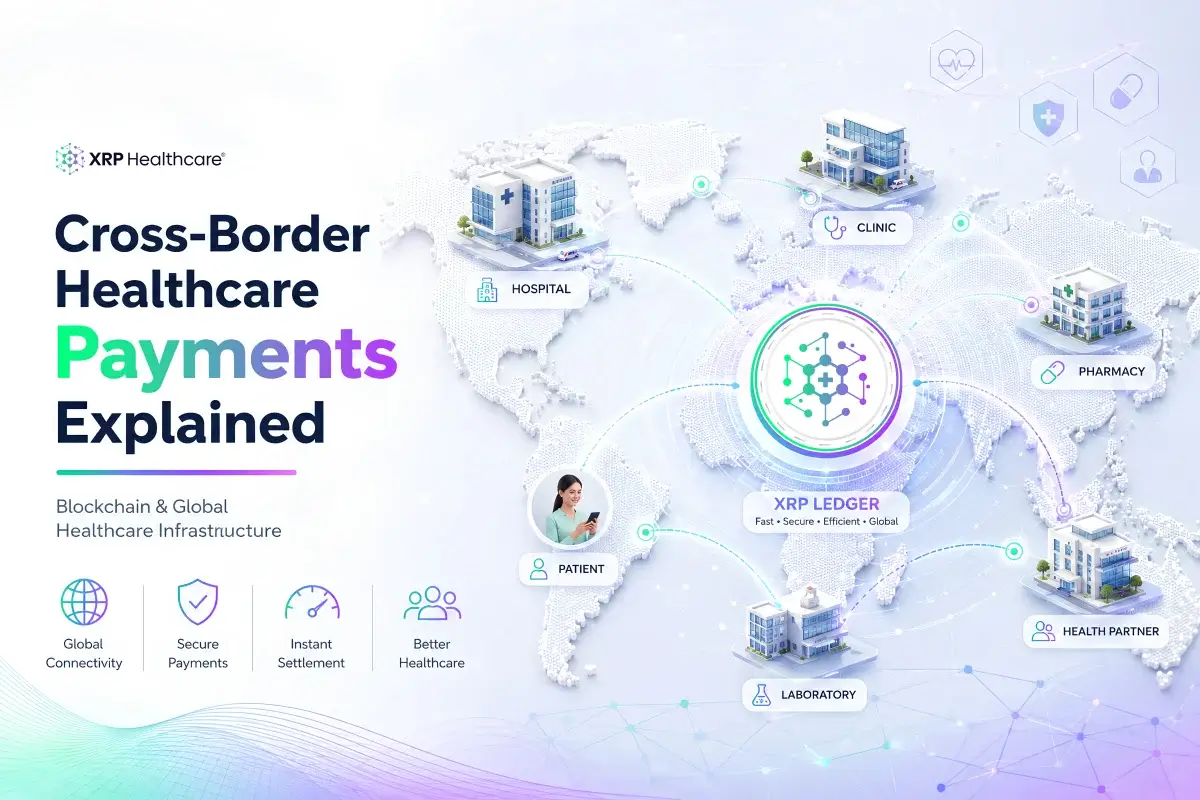
The XRP Healthcare ecosystem combines several connected infrastructure components. Each performs a different role.
Settlement Layer
Payment Infrastructure
Healthcare Payment Rails
Cross-Border Settlement
User Access
XRPH Wallet
QR Payments
Payment Requests
Ecosystem Services
Together, these layers create an integrated ecosystem capable of supporting the future of global healthcare payments while complementing existing healthcare systems.
Why This Matters for the Future of Healthcare
Healthcare is expected to become even more international over the coming decade.
Patients increasingly expect healthcare services that are:
Digital
Mobile
International
Connected
Secure
Convenient
Supporting these expectations requires infrastructure capable of moving value efficiently across borders. Blockchain settlement provides one approach to helping meet these changing requirements while maintaining transparency and operational efficiency.
The Role of the XRPH Wallet
While the XRP Ledger provides the settlement infrastructure, users need a simple way to access it. The XRPH Wallet acts as the user-facing gateway into the XRP Healthcare Infrastructure. Rather than interacting directly with blockchain technology, users can perform familiar actions through an intuitive interface, including:
Sending supported digital assets
Receiving international payments
Scanning QR payment requests
Viewing transaction history
Managing supported ecosystem tokens
Accessing future healthcare payment services
The objective is to make global digital payments feel as straightforward as domestic transactions while the underlying blockchain infrastructure manages settlement behind the scenes.
QR Payments Across Borders
QR code technology has become one of the world's most widely adopted payment methods. Within healthcare, QR payments can simplify international transactions by allowing patients to scan a payment request instead of manually entering payment information.
Potential use cases include:
Overseas medical consultations
International private hospitals
Pharmacy purchases
Diagnostic laboratories
Medical tourism providers
Healthcare conferences
International charity healthcare programmes
Using QR codes helps reduce typing errors while creating a quicker and more consistent payment experience.
Supporting Multiple Digital Assets
Modern healthcare payment ecosystems may involve different types of digital assets depending on the specific use case. Within the XRP Healthcare ecosystem, these include:
XRP
The native digital asset of the XRP Ledger, supporting value transfer across the network.
XRPH Token
Designed to provide utility across the XRP Healthcare Infrastructure ecosystem and connect compatible services.
XRPHAI Token
Supports AI engagement and ecosystem rewards within participating healthcare applications.
RLUSD
RLUSD is a US dollar-denominated stablecoin issued on the XRP Ledger.
Stablecoins may be useful where users or organisations prefer a digital asset designed to maintain a stable value relative to a traditional currency.
As tokenised financial infrastructure continues to evolve, stablecoins are expected to become an increasingly important component of global digital payment ecosystems.
Compliance Remains Essential
Technology alone does not determine whether a payment is appropriate. Healthcare organisations operating internationally must continue to comply with all applicable:
Financial regulations
Anti-money laundering (AML) requirements
Know Your Customer (KYC) obligations
Healthcare regulations
Data protection laws
Local licensing requirements
Blockchain infrastructure can support payment processing, but organisations remain responsible for operating within the legal and regulatory frameworks of the countries in which they provide services.
Security in International Payments
International healthcare payments require a high level of trust. Blockchain infrastructure contributes to payment security through cryptographic verification and transparent transaction records.
However, secure payments also depend on:
Strong wallet security
Secure authentication
Responsible key management
User education
Secure application development
Appropriate organisational controls
Technology provides the foundation, while good operational practices help ensure the overall security of the payment ecosystem.
Interoperability Is Critical
Healthcare organisations use many different software platforms. Hospitals, insurers, pharmacies and clinics are unlikely to replace all of their existing systems simply because a new payment technology becomes available.
For this reason, interoperability is essential. Rather than replacing healthcare software, blockchain settlement infrastructure can operate beneath existing applications, enabling organisations to continue using familiar systems while benefiting from modern digital payment capabilities.
This layered approach allows innovation without requiring wholesale replacement of existing healthcare technology.
Preparing for a More Connected Healthcare Economy
Healthcare is moving towards a future that is:
More international
More digital
More mobile
More personalised
More AI-assisted
More interconnected
Payment infrastructure must evolve alongside these changes.
Future developments may include:
International telehealth platforms
AI-powered healthcare services
Digital identity solutions
Connected wearable devices
Global health programmes
Preventive healthcare initiatives
Smart payment automation
Modern settlement infrastructure provides a foundation capable of supporting these evolving healthcare ecosystems.
Blockchain Supports Healthcare Infrastructure
It is important to distinguish infrastructure from healthcare delivery. The XRP Ledger does not provide medical treatment or clinical advice. Instead, it provides a settlement layer capable of supporting the movement of digital value between compatible participants.
Similarly, the XRP Healthcare Infrastructure is designed to complement healthcare providers, insurers and payment systems by offering modern payment infrastructure-not by replacing clinical systems or healthcare professionals.
Looking Ahead
Cross-border healthcare is expected to continue expanding as technology makes medical expertise increasingly accessible worldwide. Patients will expect seamless digital experiences regardless of location.
Healthcare providers will require payment systems capable of supporting international operations with greater efficiency and transparency. Blockchain infrastructure, including the XRP Ledger, offers one approach to supporting these changing expectations through modern settlement technology.
Conclusion
Cross-border healthcare payments are becoming an increasingly important part of modern healthcare. As patients, providers and organisations operate internationally, payment infrastructure must evolve to support secure, efficient and transparent movement of value.
Within the XRP Healthcare ecosystem, the XRP Ledger provides the settlement foundation, while the XRPH Wallet, healthcare payment rails and future ecosystem services work together to simplify international digital payments. Rather than replacing existing healthcare systems, this infrastructure is designed to strengthen them by supporting the next generation of globally connected healthcare services.
Continue Learning
Explore more topics within the XRP Healthcare Infrastructure knowledge hub:
Call to Action
Want to learn how blockchain infrastructure is helping connect healthcare across borders?
Visit the XRP Healthcare Infrastructure pillar page to explore how the XRP Ledger, the XRPH Wallet, healthcare payment rails and digital assets work together to support the future of international healthcare payments.
Explore the XRP Healthcare Infrastructure Knowledge Hub →