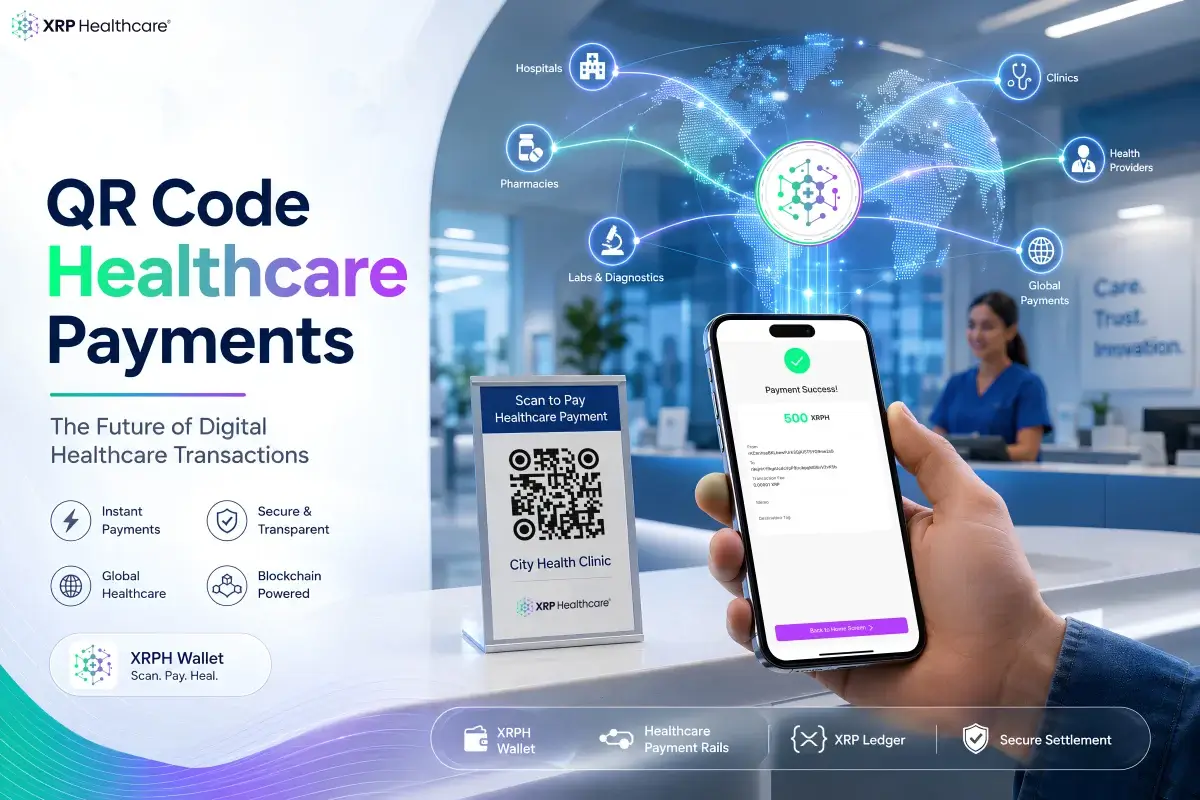
Digital payments have become part of everyday life. People routinely scan QR codes to pay for meals, transport, shopping, and online services. Healthcare is beginning to adopt the same approach.
Rather than manually entering payment information, patients can simply scan a QR code using a compatible wallet application and confirm the transaction.
The experience is faster, easier, and less prone to human error. Behind the scenes, however, a sophisticated payment infrastructure processes the transaction. Within the XRP Healthcare Infrastructure, QR code payments work alongside the XRPH Wallet, Healthcare Payment Rails and the XRP Ledger, creating a connected ecosystem designed to support modern digital healthcare payments.
What Is a QR Code Payment?
A QR (Quick Response) code is a two-dimensional barcode capable of storing digital information. When scanned by a smartphone, it can instantly transfer payment information without requiring manual entry.
In a healthcare setting, a QR code might contain:
The patient simply scans the code, reviews the information, and authorises the payment.
Why QR Payments Are Growing
Simplicity
Scanning a QR code is usually quicker than entering account details manually.
Accuracy
Reducing manual typing helps minimise payment errors.
Familiar User Experience
Millions of people already use QR payments in retail, hospitality and transport.
Applying the same technology to healthcare creates a familiar payment journey.
Mobile First
Most patients already carry smartphones, making QR technology widely accessible.
Digital Integration
QR payments integrate naturally with mobile wallets and digital healthcare applications.
How QR Payments Work
Although scanning a QR code appears simple, several processes occur in the background.
A typical payment journey looks like this:
A healthcare provider generates a payment request.
A QR code is displayed.
The patient scans the QR code using the XRPH Wallet.
Payment information is reviewed.
The patient authorises the transaction.
Payment is submitted.
Settlement occurs through the underlying payment infrastructure.
Both parties receive confirmation.
The entire experience can take only a few moments while remaining secure and transparent.
QR Payments in Healthcare
Healthcare providers can potentially use QR payments in many different scenarios.
Examples include:
The technology is flexible because the payment process remains consistent regardless of the healthcare service being provided.
Benefits for Patients
Patients increasingly expect digital experiences that are simple and convenient. QR code payments can help improve the payment experience by offering:
Faster Checkout
Patients spend less time entering payment information.
Reduced Errors
Scanning removes many of the mistakes associated with manual data entry.
Greater Convenience
Payments can be completed using a smartphone in a familiar way.
Improved Transparency
Users can review payment details before confirming the transaction.
Contactless Experience
QR payments support modern contactless payment journeys without requiring physical payment terminals.
Benefits for Healthcare Providers
Healthcare organisations may also benefit from QR payment technology.
Potential advantages include:
Simplified payment collection
Faster payment confirmation
Improved operational efficiency
Reduced administrative workload
Easier invoice reconciliation
Better patient experience
As healthcare organisations continue their digital transformation, QR technology provides a practical bridge between physical healthcare services and digital payment infrastructure.
The Role of the XRPH Wallet
Within the XRP Healthcare ecosystem, QR payments are designed to work through the XRPH Wallet.
The wallet provides users with an intuitive interface for:
Scanning QR codes
Reviewing payment requests
Sending supported digital assets
Receiving payments
Viewing transaction history
Managing ecosystem participation
The wallet abstracts much of the underlying blockchain complexity, allowing users to focus on completing payments rather than understanding the technical infrastructure beneath them.
Powered by the XRP Ledger
Although patients primarily interact with the wallet, the underlying payment settlement infrastructure is provided by the XRP Ledger. The ledger supports characteristics important for payment systems, including:
Fast transaction confirmation
Low transaction costs
Transparent settlement
High transaction throughput
Energy-efficient consensus
The blockchain remains largely invisible to users while helping support secure digital payment processing.
QR Payments as Part of a Larger Infrastructure
QR codes are only one layer of the XRP Healthcare Infrastructure.
They work alongside:
Settlement Layer
Payment Infrastructure
Healthcare Payment Rails
Healthcare Settlement
User Layer
Ecosystem Layer
Together, these components form an integrated payment ecosystem designed to support the future of digital healthcare.
International Healthcare Payments Made Simple
QR payment technology is particularly valuable in international healthcare settings.
Patients travelling abroad for treatment may not be familiar with local banking systems or payment methods.
Instead of entering lengthy payment information, they can simply scan a QR code using a compatible wallet and review the payment before confirming it.
Potential international use cases include:
Medical tourism
Overseas specialist consultations
International private hospitals
Global pharmacy networks
Cross-border diagnostic services
International healthcare conferences
Charity and humanitarian healthcare programmes
As healthcare becomes increasingly global, simple payment experiences become more important for both patients and providers.
Supporting Multiple Digital Assets
The XRP Healthcare ecosystem is designed to support different digital assets, each serving distinct purposes.
XRP
The native digital asset of the XRP Ledger, facilitating the transfer of value across the network.
XRPH Token
Designed to provide utility throughout the XRP Healthcare Infrastructure ecosystem and connect compatible services.
XRPHAI Token
Supports AI-powered engagement and ecosystem reward programmes within participating applications.
RLUSD
RLUSD is a US dollar-denominated stablecoin issued on the XRP Ledger.
For some payment scenarios, stablecoins may offer the advantage of using a digital asset that is designed to maintain a value aligned with a traditional fiat currency.
As digital payment infrastructure evolves, stablecoins are expected to become an increasingly important component of international payment ecosystems.
Security Comes First
Healthcare payments involve financial trust.
QR code technology must therefore be supported by strong security practices.
Within the XRP Healthcare ecosystem, payment security depends upon several layers working together:
Cryptographic transaction verification
Secure wallet authentication
Responsible private key management
User confirmation before payment
Secure application development
Ongoing user education
Scanning a QR code should never automatically authorise a payment.
Users should always have the opportunity to review payment details before confirming a transaction.
Transparency Without Compromising Privacy
Blockchain provides transparent payment settlement. Healthcare requires confidential patient information.
These are two separate responsibilities. Within the XRP Healthcare Infrastructure:
Payment activity can be recorded through blockchain settlement.
Confidential patient medical records are not intended to be stored on the blockchain.
Clinical information should remain protected within appropriate healthcare systems that comply with applicable privacy and data protection requirements.
This separation helps organisations benefit from transparent payment infrastructure while maintaining appropriate patient confidentiality.
Interoperability With Existing Healthcare Systems
Healthcare providers have invested heavily in clinical software, patient management systems and financial platforms. Modern payment infrastructure should integrate with these systems rather than require organisations to replace them. QR payment technology can act as an additional payment channel while existing healthcare systems continue to manage:
Patient records
Clinical workflows
Appointment scheduling
Billing systems
Insurance administration
Financial reporting
This layered approach supports innovation without disrupting day-to-day healthcare operations.
Preparing for the Future of Healthcare Payments
Digital healthcare continues to evolve rapidly. QR payment technology is expected to play an increasingly important role as healthcare services become more connected.
Potential future applications include:
AI-assisted healthcare platforms
Digital prescription services
Preventive healthcare subscriptions
Remote patient monitoring
Community healthcare programmes
Connected wearable devices
International healthcare marketplaces
Smart payment automation
The simplicity of QR technology makes it well suited to future healthcare services that prioritise accessibility and user experience.
QR Codes Are Part of the Infrastructure
QR codes are sometimes viewed simply as a payment convenience. In reality, they are one component of a much larger payment ecosystem. Within the XRP Healthcare Infrastructure:
The XRP Ledger provides settlement.
Healthcare Payment Rails enable the movement of digital value.
The XRPH Wallet provides user access.
QR codes simplify payment initiation.
Each layer performs a specific role while working together to deliver a seamless payment experience.
Looking Ahead
Healthcare payments are becoming increasingly digital, mobile, and international. Patients expect secure payment experiences that are as simple as scanning a code. Healthcare providers require infrastructure capable of supporting efficient payment processing without increasing administrative complexity.
QR payment technology, supported by blockchain settlement infrastructure, offers a practical solution that aligns with these changing expectations.
Conclusion
QR code healthcare payments simplify how patients and providers initiate digital transactions. Combined with the XRPH Wallet, Healthcare Payment Rails and the XRP Ledger, QR technology forms part of a broader payment infrastructure designed to support secure, transparent and efficient healthcare payments. Rather than replacing existing healthcare systems, QR payments complement them by making digital healthcare transactions faster, easier and more accessible for users around the world.
Continue Learning
Explore more topics within the XRP Healthcare Infrastructure knowledge hub:
Call to Action
Want to explore how modern payment infrastructure is transforming healthcare?
Visit the XRP Healthcare Infrastructure pillar page to discover how QR payments, the XRPH Wallet, Healthcare Payment Rails and the XRP Ledger work together to support the future of digital healthcare payments.