Open Infrastructure for XRP-Based Healthcare Payments
XRP Healthcare operates as an independent infrastructure provider through XRP Healthcare LLC, the registered trademark owner.
The XRPH Wallet and XRP Payment Program framework form part of the XRP Healthcare infrastructure architecture for healthcare payment deployment using the XRP Ledger (XRPL). The model emphasizes non-custodial design, interoperability, technical transparency, and regulatory clarity.
This infrastructure is open, modular, and structured for integration by pharmacies, healthcare networks, payment facilitators, and enterprise system providers seeking to deploy XRP-based payment rails within their own environments.
XRPH Wallet does not provide custody, brokerage, exchange, financial, or healthcare services. It is non-custodial software infrastructure.
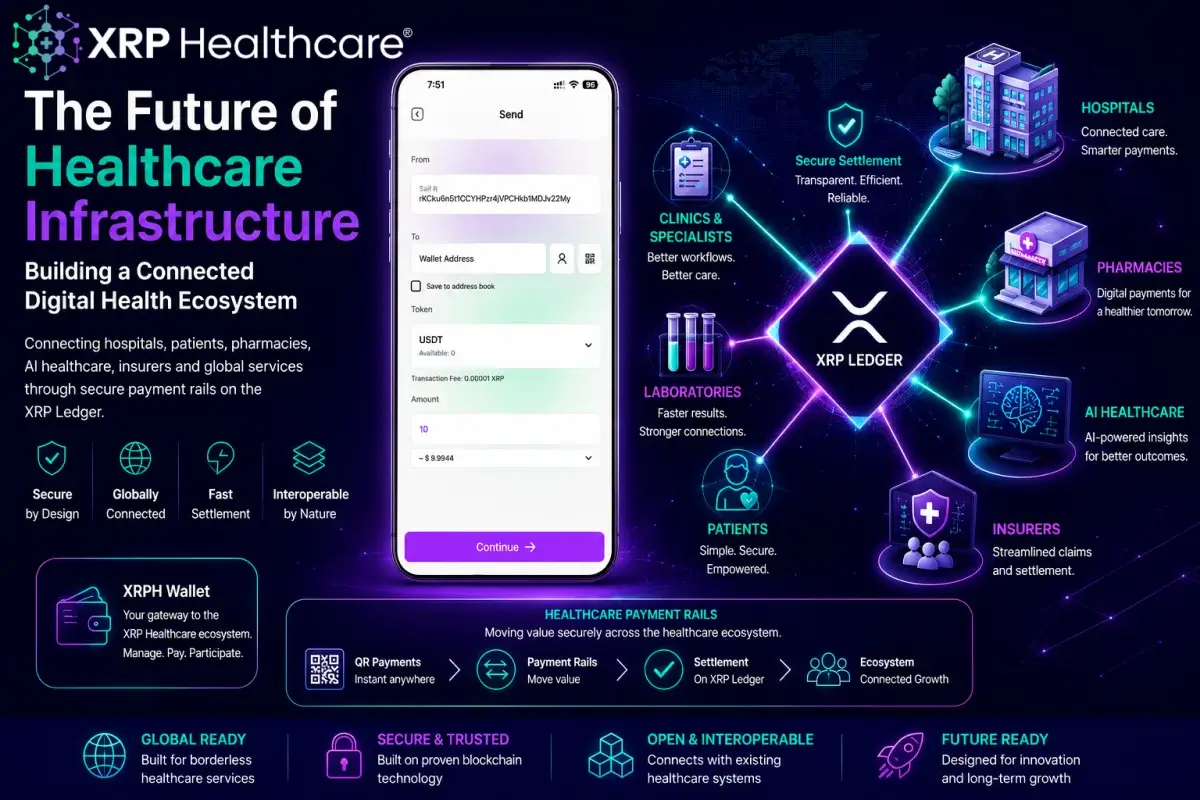
The Future of Healthcare Infrastructure: Building a Connected Digital Health Ecosystem
Explore the future of healthcare infrastructure and how blockchain, digital wallets, payment rails and interoperability can support connected digital health ecosystems.
The Future of Healthcare Infrastructure | XRP Healthcare | XRP Healthcare®
Introduction
Healthcare is entering a new infrastructure era. For decades, healthcare technology developed as a collection of separate systems. Hospitals implemented electronic records. Pharmacies adopted specialist dispensing software.
Insurers created their own payment platforms. Digital health companies introduced mobile applications.
More recently, artificial intelligence has added another layer of technology. The challenge now is not simply creating more healthcare software. It is connecting these systems into infrastructure that can support healthcare across organisations, countries and technologies.
The future of healthcare infrastructure will therefore depend on interoperability, secure digital identity, intelligent applications, modern payment systems and infrastructure capable of supporting global healthcare services. Within the XRP Healthcare Infrastructure, these concepts come together through technologies including the XRP Ledger, XRPH Wallet, Healthcare Payment Rails, blockchain settlement and supported digital assets.
Rather than replacing existing healthcare systems, this infrastructure is designed to provide additional layers that help connect the digital healthcare ecosystem.
What Is Healthcare Infrastructure?
Healthcare infrastructure includes the systems and technologies required for healthcare organisations to operate effectively.
This extends beyond hospitals and medical equipment.
Modern healthcare infrastructure may include:
Clinical information systems
Electronic health records
Pharmacy systems
Appointment platforms
Payment networks
Digital wallets
Cybersecurity systems
AI healthcare platforms
Communication networks
Digital identity
Financial settlement infrastructure
Each system performs a specialised function.
The future challenge is enabling these technologies to work together efficiently.
From Individual Systems to Connected Ecosystems
Healthcare technology has historically been fragmented. Different organisations often operate different systems that were never designed to communicate with one another.
This creates operational challenges.
For example, a healthcare journey might involve:
A patient books an appointment.
A clinic manages the appointment through its scheduling platform.
A doctor records information in a clinical system.
A pharmacy processes a prescription through another platform.
Payment occurs through a separate financial network.
Insurance may involve another system entirely.
Each stage may operate independently. Future healthcare infrastructure aims to make these interactions more connected.
Why Interoperability Will Be Critical
Interoperability means different systems can exchange information or services in a structured way. Healthcare organisations are unlikely to replace every existing platform simply because new technology becomes available.
Modern infrastructure must therefore work alongside:
Electronic Health Records
Hospital Information Systems
Pharmacy Management Systems
Laboratory Information Systems
Billing platforms
Accounting systems
Digital healthcare applications
Interoperability allows organisations to modernise gradually rather than rebuilding their technology environment from the ground up.
Payment Infrastructure Is Part of Healthcare Infrastructure
Payments are often overlooked when discussing digital healthcare. However, healthcare organisations cannot operate without reliable financial infrastructure.
Payment systems support:
Patient billing
Pharmacy transactions
Healthcare memberships
Telemedicine payments
Laboratory services
Cross-border healthcare
Corporate healthcare programmes
Modern healthcare payment infrastructure must therefore be capable of supporting increasingly digital and international healthcare services.
The Role of Blockchain Infrastructure
Blockchain provides another infrastructure layer. It can support the movement and settlement of digital value through a shared distributed ledger.
Within healthcare payment systems, blockchain may support:
Transparent settlement
Efficient digital payments
Cross-border transactions
Wallet connectivity
Digital asset management
Verifiable transaction records
Blockchain is most useful when viewed as infrastructure rather than as a replacement for healthcare software.
The XRP Ledger as a Settlement Layer
Within the XRP Healthcare ecosystem, the XRP Ledger provides blockchain settlement infrastructure. Its payment-focused architecture supports:
Fast transaction confirmation
Low transaction costs
High throughput
Energy-efficient consensus
Transparent transaction records
Open-source development
These characteristics make it suitable for infrastructure designed around digital value transfer.
The XRPH Wallet as the Access Layer
Infrastructure becomes useful only when people can access it easily. The XRPH Wallet provides the user-facing layer within the XRP Healthcare ecosystem.
Potential wallet capabilities include:
Managing supported digital assets
Sending payments
Receiving payments
QR code transactions
Supported token swaps
Viewing transaction history
Accessing future ecosystem services
The wallet simplifies interaction with blockchain infrastructure while users retain control of their supported digital assets through a non-custodial architecture.
Healthcare Payment Rails
The Healthcare Payment Rails connect the wallet and settlement infrastructure. They support the movement of compatible digital value across the ecosystem.
Potential scenarios include:
Healthcare provider payments
Pharmacy transactions
International healthcare services
QR payments
Digital healthcare memberships
Future ecosystem services
Payment rails provide the connectivity between user-facing applications and settlement infrastructure.
Security Must Be Built Into the Architecture
Future healthcare infrastructure must be secure by design. Security requires multiple complementary layers.
Cryptographic verification
Secure wallet architecture
Authentication
Secure software development
Infrastructure monitoring
Operational governance
User education
No single technology provides complete protection.
The strongest infrastructure combines technical security with responsible operational practices.
Digital Assets as Infrastructure Components
Different digital assets can support different functions within a connected ecosystem. Within XRP Healthcare, these include:
Digital AssetExample RoleXRPNative asset of the XRP LedgerXRPHEcosystem utilityXRPHAIAI-powered engagement and participation RLUSD Stable digital payment option
The purpose of a multi-asset infrastructure is not to make every asset perform the same function.
It is to allow specialised components to support different parts of the ecosystem.
AI and Infrastructure Will Become Increasingly Connected
Artificial intelligence is becoming an increasingly important part of digital healthcare.
AI applications may support:
Healthcare navigation
Patient education
Administrative workflows
Wellness programmes
Health journey support
Payment assistance
Digital engagement
The infrastructure beneath these applications must be capable of supporting secure payments, digital identity and connected services. This is where the relationship between xrphealthcare.ai and XRPHToken.com becomes important. The AI healthcare layer focuses on user-facing health experiences.
The infrastructure layer focuses on the blockchain, wallet and payment systems supporting the broader ecosystem.
Enterprise Healthcare Will Require Scalable Infrastructure
Large healthcare organisations operate across complex environments. Future infrastructure must support:
Hospitals
Pharmacy networks
Laboratory groups
Telemedicine providers
Insurance platforms
Healthcare marketplaces
International healthcare organisations
These enterprises need infrastructure capable of scaling without introducing unnecessary complexity. Blockchain can form one component of this architecture while existing enterprise systems continue handling clinical and operational functions.
Cross-Border Healthcare Will Increase Infrastructure Demand
Healthcare is becoming more international. Patients travel for treatment. Specialists consult remotely.
Modern infrastructure must be designed with these international workflows in mind.
Infrastructure Should Remain Invisible to Users
The best infrastructure is often invisible. Most people using the internet do not think about routing protocols or data centres. They simply expect services to work. Healthcare payment infrastructure should operate in the same way.
Patients should be able to:
Open a wallet.
Review a payment.
Scan a QR code.
Confirm a transaction.
The underlying blockchain infrastructure handles the technical complexity.
A Layered Healthcare Infrastructure Model
The XRP Healthcare ecosystem can be understood through several interconnected layers.
Settlement Layer
XRP Ledger
Payment Layer
Healthcare Payment Rails
Healthcare Settlement
User Access Layer
XRPH Wallet
QR Code Payments
Digital Asset Layer
XRP
XRPH
XRPHAI
RLUSD
Engagement Layer
XRPH AI Rewards
XRP Payment Programme
Application Layer
AI-powered healthcare services
Digital healthcare applications
Future ecosystem integrations
Each layer contributes to a broader connected healthcare architecture.
The Future Is Interconnected
Healthcare technology is moving away from isolated applications towards connected ecosystems.
The future will increasingly involve systems that can:
Exchange information securely
Move digital value efficiently
Support international healthcare
Integrate with enterprise systems
Connect patients with digital services
Adapt as new technologies emerge
Infrastructure will determine how effectively these technologies work together.
Conclusion
The future of healthcare infrastructure is not defined by a single technology. It is defined by how technologies connect. Blockchain, digital wallets, payment rails, enterprise systems, AI applications and healthcare providers all have different roles.
Within the XRP Healthcare ecosystem, the XRP Ledger, XRPH Wallet, Healthcare Payment Rails, digital assets and AI-powered services form part of a layered architecture designed to support connected digital healthcare.
As healthcare becomes increasingly digital and international, infrastructure capable of supporting secure, scalable and interoperable services will become more important.
The next generation of healthcare will depend not simply on better applications, but on better infrastructure connecting them.
Continue Learning About XRP Healthcare Infrastructure
RLUSD in Healthcare - explore the potential role of stable-value digital assets in healthcare payments.
Frequently Asked Questions
What is healthcare infrastructure?
Healthcare infrastructure includes the physical and digital systems required to deliver and support healthcare, including clinical platforms, payment systems, digital applications, security infrastructure and financial settlement technologies.
What is the future of healthcare infrastructure?
Future healthcare infrastructure is expected to become increasingly digital, connected and interoperable, allowing healthcare applications, payment systems, enterprise platforms and emerging technologies to work together more effectively.
How can blockchain support healthcare infrastructure?
Blockchain can provide infrastructure for transparent digital transactions and settlement. It should be viewed as an additional technology layer rather than a replacement for clinical healthcare systems.
What role does the XRP Ledger play in XRP Healthcare Infrastructure?
The XRP Ledger provides the blockchain settlement layer supporting compatible digital transactions within the XRP Healthcare infrastructure architecture.
What is the XRPH Wallet?
The XRPH Wallet is the wallet layer within the XRP Healthcare ecosystem, providing users with access to supported digital assets and blockchain transaction functionality.
Why are healthcare payment rails important?
Healthcare payment rails provide infrastructure for moving value between participants and services within a healthcare ecosystem.
Why does interoperability matter in healthcare?
Healthcare organisations use many different clinical, financial and administrative systems. Interoperability allows new infrastructure to connect with these systems without requiring every existing platform to be replaced.
Will blockchain replace existing healthcare systems?
No. Blockchain is better understood as an additional infrastructure layer that can support payments, settlement and digital asset functionality alongside existing healthcare systems.
Explore XRP Healthcare Infrastructure
Discover the blockchain, wallet, payment and settlement infrastructure supporting the XRP Healthcare ecosystem.