Introduction
Digital payments are becoming an increasingly important part of modern healthcare. Patients can now pay for consultations, pharmacy services, laboratory testing, subscriptions, and other healthcare services through digital channels.
Alongside traditional digital payment methods and cryptocurrencies such as XRP, stablecoins are emerging as another type of digital payment asset.
Stablecoins are designed to maintain a relatively stable value by referencing an external asset, such as a national currency. One example is RLUSD, a US dollar-denominated stablecoin issued on the XRP Ledger.
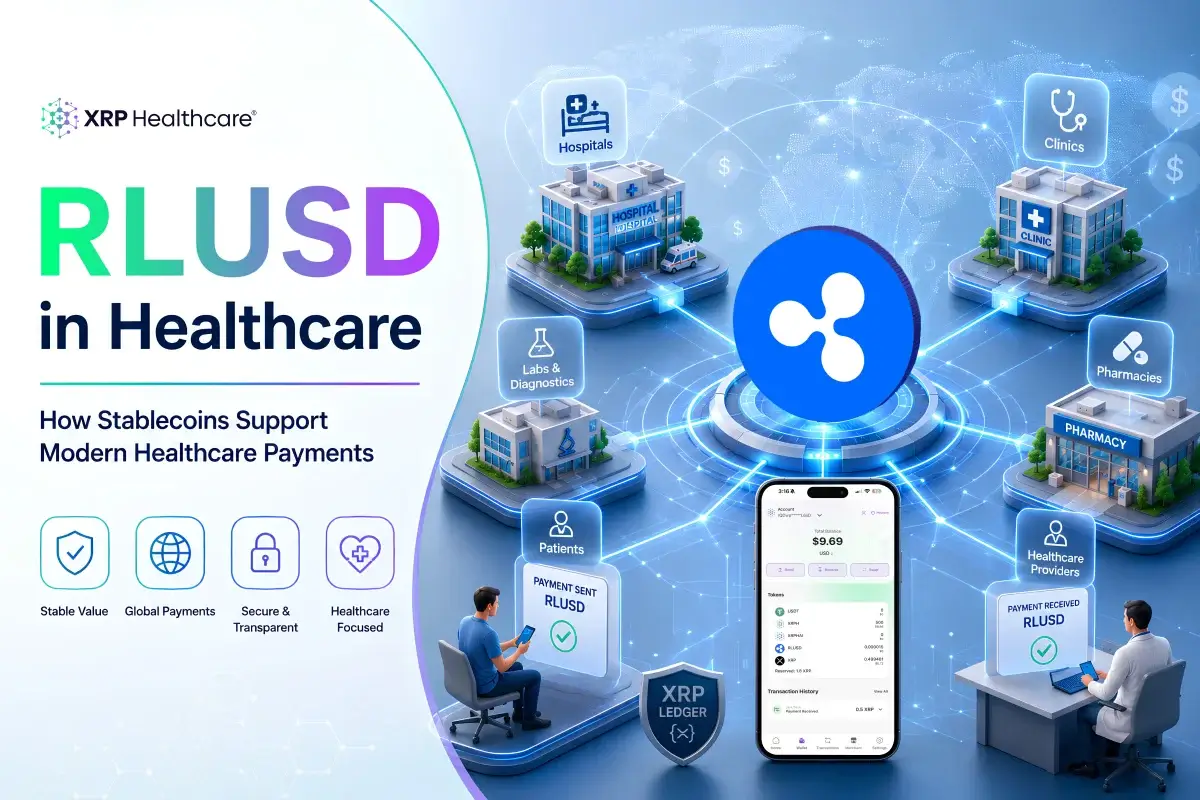
While stablecoins are used across many industries, they may also have applications within healthcare payment infrastructure. By combining a digital representation of US dollar value with blockchain-based settlement, RLUSD may support payment scenarios where predictability and digital efficiency are important.
Within the broader XRP Healthcare Infrastructure, RLUSD can complement other components such as the XRP Ledger, XRPH Wallet, Healthcare Payment Rails, and supported digital assets.
What Is RLUSD?
RLUSD is a digital stablecoin issued on the XRP Ledger and designed to maintain a value closely aligned with the US dollar. Unlike many digital assets whose market values can fluctuate significantly, stablecoins are designed to provide greater price consistency.
This characteristic can make stablecoins useful for transactions where users prefer to know the approximate value of the digital asset being transferred.
However, RLUSD remains a digital asset and is subject to applicable regulatory, operational, issuer, and market considerations.
What Is a Stablecoin?
A stablecoin is a type of digital asset designed to maintain a relatively stable value by referencing another asset. Many stablecoins are linked to national currencies such as:
The purpose is generally to combine the advantages of blockchain-based transactions with the familiarity of traditional currency values. Rather than replacing traditional currencies, stablecoins can provide another way to represent, transfer, and settle value digitally.
Why Does Stability Matter in Healthcare Payments?
Healthcare payments often involve essential services, which means payment predictability can be particularly important. Patients and healthcare providers generally want to understand the value of a transaction before it is completed.
Potential healthcare payment scenarios include:
If a digital payment asset experiences significant price fluctuations, the value received by a provider may differ substantially from the amount expected when the payment was initiated. A stablecoin designed to maintain a value linked to a fiat currency may reduce this particular source of volatility.
Stablecoins vs Traditional Cryptocurrencies
Stablecoins and traditional cryptocurrencies both use blockchain technology, but they can serve different purposes.
Traditional Cryptocurrencies
Assets such as XRP can support value transfer and blockchain ecosystems. Their market values can fluctuate based on market conditions, supply and demand, liquidity, and other factors.
Stablecoins
Stablecoins are designed to reduce price volatility by referencing another asset, such as the US dollar. This can make them suitable for certain transactional scenarios where predictable value is important. Both categories of digital assets can therefore play different roles within a broader blockchain ecosystem.
Why Could Healthcare Benefit From Stable Digital Assets?
Healthcare organisations manage a wide range of financial transactions. As healthcare becomes increasingly digital and international, payment infrastructure must also evolve. Stable digital assets may provide several potential advantages.
Predictable Payment Values
A healthcare payment denominated in a stable digital asset may provide users with greater predictability compared with highly volatile digital assets.
Simplified Financial Planning
More predictable digital payment values may help organisations manage certain financial operations and forecast payment-related activity more effectively, subject to applicable accounting and financial requirements.
International Payments
Stablecoins may support certain cross-border payment scenarios by providing a digital representation of a recognised fiat currency.
This can be relevant to healthcare organisations, patients, and service providers involved in international healthcare transactions.
Digital Payment Efficiency
Stablecoins combine blockchain-based payment infrastructure with a digital representation of a familiar currency value. This may allow organisations to explore digitally integrated payment workflows while maintaining a familiar unit of account.
RLUSD and the XRP Ledger
RLUSD operates on the XRP Ledger, which provides the underlying blockchain infrastructure. The XRP Ledger is known for characteristics including:
Fast transaction confirmation
Low transaction costs
High transaction throughput
Energy-efficient consensus
Payment-focused blockchain architecture
Together, RLUSD and the XRP Ledger combine blockchain payment infrastructure with a stable digital asset designed for transactional use.
The Role of RLUSD Within the XRP Healthcare Infrastructure
Within the XRP Healthcare ecosystem, different digital assets can serve different intended purposes.
XRP: Native digital asset supporting value transfer on the XRP Ledger.
XRPH: Ecosystem utility within XRP Healthcare Infrastructure.
XRPHAI: AI engagement and ecosystem rewards.
RLUSD: Stable digital payment option linked to the US dollar.
Rather than serving identical functions, these assets can support different payment and ecosystem scenarios.
Using RLUSD Through the XRPH Wallet
The XRPH Wallet is designed to provide users with access to supported digital assets through a simple interface.
Potential wallet functions may include:
Holding supported assets
Sending payments
Receiving payments
Scanning QR payment requests
Viewing transaction history
Accessing future ecosystem services
By presenting multiple supported assets within one application, users can select the payment option that is appropriate for their particular transaction.
Stablecoins as Part of Modern Healthcare Payment Infrastructure
Stablecoins represent only one component of digital healthcare infrastructure. Within the XRP Healthcare ecosystem, stable digital assets can work alongside other infrastructure components.
Settlement Layer
The XRP Ledger provides the underlying blockchain settlement infrastructure.
Payment Infrastructure
Components such as Healthcare Payment Rails and Healthcare Settlement can support payment processing and settlement workflows.
User Layer
The XRPH Wallet and QR Payments provide user-facing access to digital payment functionality.
Digital Assets
The ecosystem may include digital assets such as:
Together, these components can form a flexible digital payment ecosystem capable of supporting a variety of healthcare payment scenarios.
RLUSD and Cross-Border Healthcare Payments
Healthcare increasingly operates across national borders. Patients may travel internationally for specialist care, healthcare professionals may provide remote consultations, and healthcare organisations may collaborate globally on research, diagnostics, and treatment.
Cross-border payments can involve:
Multiple financial institutions
Currency conversion
Settlement delays
Additional administrative processes
Different financial and regulatory requirements
A US dollar-denominated stablecoin such as RLUSD may help simplify certain payment workflows by providing a digital asset designed to maintain a value aligned with the US dollar while using blockchain settlement infrastructure.
Healthcare organisations must still comply with applicable financial, healthcare, tax, and regulatory requirements. Blockchain infrastructure does not remove those obligations.
Supporting Predictable Healthcare Pricing
One challenge with digital payments is ensuring that both parties clearly understand the value being transferred. Because RLUSD is designed to closely track the US dollar, it may be suitable for payment scenarios where price consistency is important.
Potential examples include:
Predictable pricing may help patients and healthcare providers better understand payment obligations before a transaction is completed.
Security and Trust in Healthcare Payments
Healthcare payment infrastructure must inspire confidence among patients, providers, and organisations. RLUSD transactions on the XRP Ledger benefit from blockchain-based transaction verification and settlement. However, secure digital payments depend on much more than the underlying blockchain.
Important considerations include:
Secure wallet authentication
Responsible private key management
Strong application security
User education
Compliance with applicable regulations
Robust operational controls
Blockchain technology can provide an infrastructure foundation, while appropriate governance, security practices, and user protections remain essential to the overall payment ecosystem.
Interoperability With Existing Financial Systems
Healthcare providers already rely on established financial and administrative systems for:
Billing
Accounting
Insurance processing
Patient administration
Financial reporting
Stablecoins are not intended to replace these systems overnight.
Instead, they can potentially complement existing infrastructure by providing an additional digital payment option where appropriate. This layered approach may allow organisations to explore new payment technologies while continuing to use familiar financial and healthcare software.
Stablecoins and the Future of Healthcare
Healthcare continues to undergo significant digital transformation.
Future healthcare ecosystems may include:
AI-assisted healthcare services
Digital prescription platforms
Remote patient monitoring
International telehealth
Preventive healthcare subscriptions
Connected wearable devices
Smart healthcare payments
Digital identity services
Stable digital assets such as RLUSD may contribute to these ecosystems by providing a predictable payment mechanism alongside other supported digital assets. Their usefulness will depend on factors such as regulation, infrastructure adoption, interoperability, security, and real-world demand.
RLUSD Is One Part of a Larger Ecosystem
Within the XRP Healthcare Infrastructure, RLUSD is not intended to replace every other supported digital asset.
Each asset can serve a different intended role.
XRP: Native asset supporting value transfer on the XRP Ledger.
XRPH: Utility within the XRP Healthcare Infrastructure ecosystem.
XRPHAI: AI engagement and ecosystem rewards.
RLUSD: Stable digital payment option linked to the US dollar.
This multi-asset approach can allow an ecosystem to support different payment preferences and use cases.
Blockchain Supports the Infrastructure
It is important to distinguish healthcare delivery from healthcare payment infrastructure. RLUSD functions as a digital payment asset. The XRP Ledger provides blockchain settlement infrastructure. The XRPH Wallet provides users with access to supported digital assets and payment functionality. Healthcare providers continue to deliver clinical care through qualified healthcare professionals and organisations. Together, these layers can support an integrated payment infrastructure while keeping healthcare delivery separate from the underlying financial technology.
Looking Ahead
The digital payments landscape continues to evolve. Stablecoins are becoming an increasingly recognised component of blockchain payment infrastructure across multiple industries.
Within healthcare, stable digital assets may help support payment consistency, operational efficiency, and international digital transactions when used within appropriate regulatory and operational frameworks.
As blockchain adoption develops, payment infrastructure built around stable digital assets may become an increasingly important component of connected healthcare ecosystems.
Conclusion
RLUSD introduces a stable digital payment option to the XRP Ledger ecosystem. By combining blockchain settlement infrastructure with a digital asset designed to closely follow the US dollar, RLUSD may support healthcare payment scenarios where consistency and predictability are important.
Working alongside the XRP Ledger, XRPH Wallet, Healthcare Payment Rails, XRPH, and XRPHAI, RLUSD can form part of a broader digital payment infrastructure designed to support evolving healthcare payment needs.
Rather than immediately replacing existing financial systems, stablecoins can complement established infrastructure by providing another digital payment option within an increasingly connected healthcare ecosystem.
Frequently Asked Questions
What is RLUSD?
RLUSD is a US dollar-denominated stablecoin issued on the XRP Ledger and designed to maintain a value closely aligned with the US dollar.
Why could RLUSD be useful for healthcare payments?
A stable digital asset may help provide more predictable payment values for healthcare transactions while benefiting from blockchain-based settlement infrastructure.
Does RLUSD replace XRP or XRPH?
No. RLUSD, XRP, XRPH, and XRPHAI can have different intended roles within the broader XRP Healthcare ecosystem rather than serving identical purposes.
Can RLUSD support international healthcare payments?
RLUSD may support certain cross-border healthcare payment scenarios by providing a digital asset designed to maintain a value aligned with the US dollar, subject to applicable financial and regulatory requirements.
Does RLUSD store patient medical information?
No. RLUSD is a digital payment asset and is not intended to store confidential patient medical records.
Continue Learning
Explore more topics within the XRP Healthcare Infrastructure knowledge hub:
Final Thoughts
The evolution of healthcare payments requires infrastructure that can support digital transactions while maintaining usability, security, and predictable value.
RLUSD represents one potential component of that infrastructure. When combined with blockchain settlement through the XRP Ledger, user-facing tools such as the XRPH Wallet, and healthcare-focused payment infrastructure, stable digital assets may contribute to the development of more connected healthcare payment ecosystems.