Open Infrastructure for XRP-Based Healthcare Payments
XRP Healthcare operates as an independent infrastructure provider through XRP Healthcare LLC, the registered trademark owner.
The XRPH Wallet and XRP Payment Program framework form part of the XRP Healthcare infrastructure architecture for healthcare payment deployment using the XRP Ledger (XRPL). The model emphasizes non-custodial design, interoperability, technical transparency, and regulatory clarity.
This infrastructure is open, modular, and structured for integration by pharmacies, healthcare networks, payment facilitators, and enterprise system providers seeking to deploy XRP-based payment rails within their own environments.
XRPH Wallet does not provide custody, brokerage, exchange, financial, or healthcare services. It is non-custodial software infrastructure.
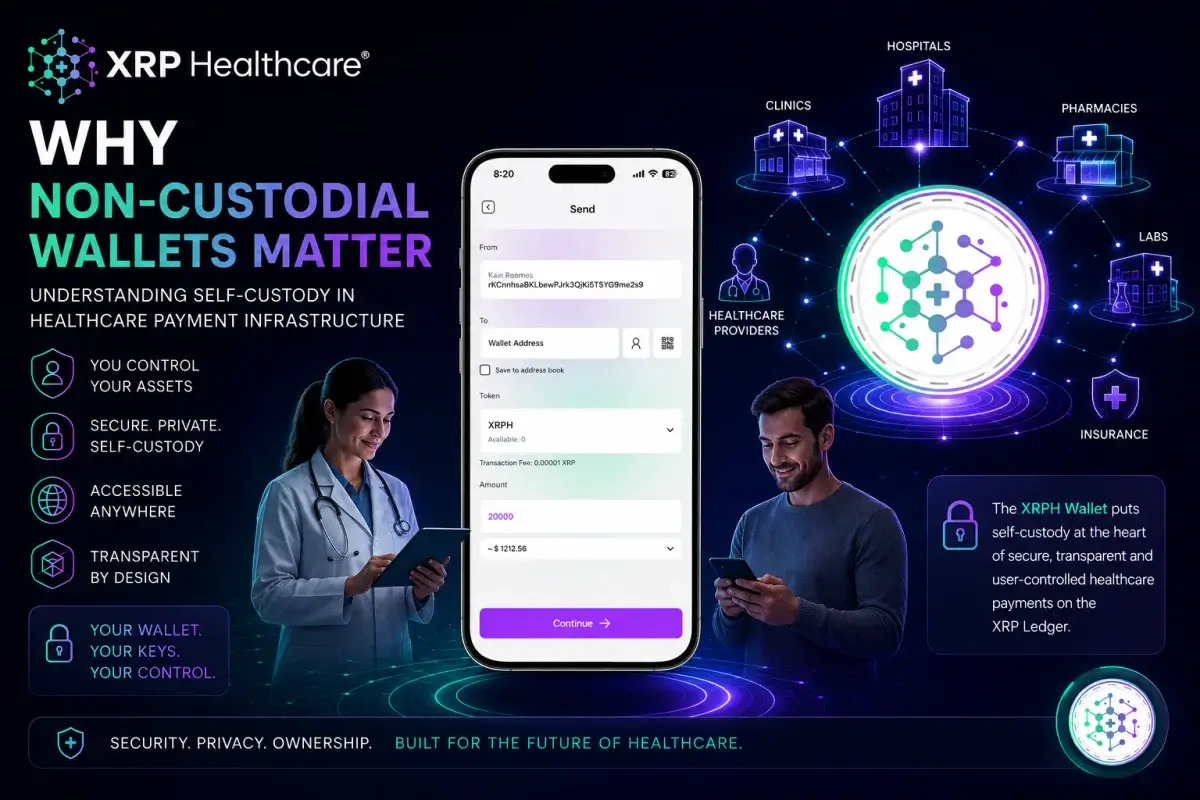
Why Non-Custodial Wallets Matter: Understanding Self-Custody in Healthcare Payment Infrastructure
Learn why non-custodial wallets are important, how self-custody works and how the XRPH Wallet supports secure blockchain-powered healthcare payment infrastructure.
As digital payments become more common, the way people store and manage their digital assets is becoming increasingly important. In traditional banking, financial institutions hold and manage customer funds.
Blockchain technology introduces another approach. Instead of relying entirely on an institution to safeguard digital assets, users can choose to control them directly through a non-custodial wallet.
This concept is known as self-custody. While self-custody provides greater control, it also introduces greater responsibility. Understanding how non-custodial wallets work is essential for anyone using blockchain-powered payment infrastructure.
Within the XRP Healthcare Infrastructure, the XRPH Wallet has been designed as a non-custodial wallet, allowing users to interact directly with supported digital assets while remaining in control of their own wallet credentials.
XRP Healthcare Wallet Overview
What Is a Non-Custodial Wallet?
A non-custodial wallet is a digital wallet where the user-not a third party-controls the private cryptographic credentials required to access their digital assets.
This means:
The user controls access to their wallet.
The user authorises transactions.
The user is responsible for securely protecting their recovery information.
The wallet provider does not control the user's digital assets.
Unlike traditional financial accounts, there is no central organisation capable of simply resetting access if recovery information is lost.
This makes understanding self-custody especially important.
What Does Self-Custody Mean?
Self-custody refers to personally maintaining control over the credentials that provide access to digital assets.
In practical terms, this means the wallet owner is responsible for:
Securing recovery phrases
Protecting private credentials
Verifying transactions before approval
Maintaining device security
Preventing unauthorised access
Rather than depending on a third party, users take direct responsibility for managing access to their blockchain wallet.
Custodial vs Non-Custodial Wallets
Understanding the difference between custodial and non-custodial wallets helps explain why self-custody has become an important concept in blockchain technology.
Custodial Wallet Non-Custodial Wallet Provider controls wallet credentials User controls wallet credentials Password recovery may be available User is responsible for recovery information Assets are managed by the provider Assets remain under user control Greater reliance on third parties Greater personal responsibility
Neither model is inherently right or wrong.
Each offers different advantages depending on user requirements and risk preferences.
Why Self-Custody Is Important
Self-custody is one of the defining characteristics of blockchain technology.
Rather than requiring permission from a central intermediary to access digital assets, users maintain direct control over their wallets.
Potential advantages include:
Greater Control
Users decide when and how they authorise transactions.
Direct Ownership
Digital assets remain under the user's control rather than being held by an intermediary.
Global Accessibility
Users can access compatible blockchain wallets wherever they have secure access to their credentials.
Transparency
Blockchain transactions remain independently verifiable through the underlying ledger.
Greater Responsibility Comes With Greater Control
Self-custody also introduces important responsibilities.
Users should understand that safeguarding access credentials is critical.
Good practices include:
Securely storing recovery phrases offline.
Never sharing private credentials.
Using trusted devices.
Enabling available security protections.
Carefully reviewing transactions before confirmation.
Blockchain transactions are generally designed to be irreversible once confirmed, making careful transaction review essential.
How the XRPH Wallet Uses Self-Custody
Within the XRP Healthcare ecosystem, the XRPH Wallet is designed as a non-custodial wallet.
This means users remain responsible for controlling access to their supported digital assets.
Potential wallet capabilities include:
Holding supported ecosystem assets.
Sending digital payments.
Receiving payments.
Scanning QR payment requests.
Viewing transaction history.
Accessing future ecosystem services.
The wallet provides a user-friendly interface while allowing users to retain control of their wallet credentials.
Why Healthcare Benefits From User-Controlled Wallets
Healthcare increasingly involves digital interactions.
Patients may access:
Telemedicine services
Pharmacy payments
Healthcare memberships
Wellness programmes
International healthcare services
Digital healthcare ecosystems
Giving users direct control over their digital payment wallet aligns with the broader movement towards patient empowerment and digital participation.
While clinical information remains protected within appropriate healthcare systems, payment infrastructure benefits from secure user-controlled access.
Non-Custodial Wallets Within the XRP Healthcare Infrastructure
The XRPH Wallet forms one component of a larger payment ecosystem.
Settlement Layer
XRP Ledger
Payment Infrastructure
Healthcare Payment Rails
Healthcare Settlement
User Layer
XRPH Wallet (Non-Custodial)
QR Code Payments
Digital Assets
XRP
XRPH
XRPHAI
RLUSD
Participation Layer
XRP Payment Programme
Future ecosystem services
Each layer performs a distinct function while supporting a connected blockchain-powered healthcare payment ecosystem.
Building Trust Through Ownership
One of the reasons blockchain technology has attracted significant interest is its emphasis on user ownership.
Rather than relying exclusively on central intermediaries, non-custodial wallets allow individuals to participate directly within digital ecosystems.
For healthcare payment infrastructure, this creates opportunities for users to manage supported digital assets with greater independence while maintaining responsibility for protecting their own wallet credentials.
Why Non-Custodial Wallets Matter
Protecting Your Recovery Phrase
One of the most important responsibilities of using a non-custodial wallet is protecting your recovery phrase (sometimes called a seed phrase).
This recovery phrase is designed to restore access to your wallet if your device is lost, damaged or replaced.
Because it provides access to your wallet, it should be treated with the highest level of security.
Good practices include:
Store it securely offline.
Never share it with anyone.
Never send it by email or messaging apps.
Avoid storing it in unsecured cloud storage.
Keep a secure backup in a protected location.
If someone else gains access to your recovery phrase, they may be able to access the associated wallet.
Understanding Private Keys
Behind every blockchain wallet are cryptographic private keys.
These keys are used to authorise transactions and prove ownership of digital assets.
In most modern wallets, users do not interact directly with these keys.
Instead, the wallet securely manages the technical processes while allowing users to approve transactions through a simple interface.
The recovery phrase provides a way to regenerate these private keys if access to the original device is lost.
Common Misconceptions About Self-Custody
As blockchain technology has become more widely adopted, several misconceptions have emerged.
"A non-custodial wallet is anonymous."
Not necessarily.
Wallet ownership and blockchain transactions may still be subject to applicable laws, regulations and compliance requirements depending on how the wallet is used.
"Self-custody means there are no security risks."
Incorrect.
Self-custody reduces reliance on third parties but increases the user's responsibility for protecting access credentials.
"The wallet provider can recover my recovery phrase."
No.
With a true non-custodial wallet, the provider does not retain control of the user's recovery phrase.
This is one of the defining characteristics of self-custody.
"Blockchain replaces personal responsibility."
In reality, blockchain increases personal responsibility because users directly control access to their digital assets.
The Relationship Between the XRPH Wallet and the XRP Ledger
The XRPH Wallet and the XRP Ledger perform different but complementary roles.
Component Role XRPH Wallet User interface for managing supported digital assets XRP Ledger Blockchain settlement and transaction infrastructure
The wallet provides the user experience.
The blockchain records and settles transactions.
Understanding this distinction helps users appreciate how different parts of the infrastructure work together.
Non-Custodial Wallets and Healthcare Payments
Healthcare payment infrastructure increasingly relies on secure digital interactions.
A non-custodial wallet allows users to:
Manage supported digital assets.
Approve healthcare-related payments.
Scan QR payment requests.
Participate in compatible ecosystem services.
Access future healthcare payment capabilities.
Importantly, the wallet is designed for payment infrastructure.
It is not intended to store confidential patient medical records.
Clinical information remains within appropriate healthcare systems that comply with applicable privacy and regulatory requirements.
Security Is a Shared Responsibility
Strong blockchain infrastructure is only one part of a secure ecosystem.
Security also depends upon:
Responsible user behaviour
Secure application development
Device protection
Software updates
Compliance with applicable regulations
Ongoing cybersecurity practices
Every participant contributes to maintaining the security of the overall ecosystem.
Looking Ahead
Non-custodial wallets are expected to become increasingly important as digital healthcare continues to evolve.
Future capabilities may include:
Healthcare membership management
Digital identity integration
International healthcare payments
AI-assisted healthcare services
Connected wearable devices
Preventive healthcare programmes
Smart payment automation
Secure ecosystem participation
The underlying principle remains the same: users retain control over their own digital assets while interacting with a broader blockchain-powered healthcare ecosystem.
Self-Custody Supports Digital Independence
One of the defining principles of blockchain technology is enabling individuals to control their own digital assets.
Within the XRP Healthcare ecosystem:
The XRP Ledger provides settlement infrastructure.
The XRPH Wallet provides non-custodial access.
Healthcare Payment Rails move digital value.
Healthcare providers continue delivering medical care.
This layered approach separates payment infrastructure from healthcare delivery while allowing users to participate directly in the ecosystem.
Conclusion
Non-custodial wallets represent an important development in modern digital payment infrastructure.
By allowing users to maintain direct control over their wallet credentials, self-custody supports greater independence while placing responsibility for security firmly in the hands of the wallet owner.
Within the XRP Healthcare ecosystem, the XRPH Wallet combines this non-custodial approach with blockchain infrastructure provided by the XRP Ledger, creating a secure gateway to healthcare payment services, QR payments, supported digital assets and future ecosystem participation.
Understanding self-custody is an essential step towards using blockchain-powered healthcare payment infrastructure responsibly and confidently.
Continue Learning
Explore more topics within the XRP Healthcare Infrastructure knowledge hub:
Want to learn more about secure blockchain-powered healthcare payments?
Visit the XRP Healthcare Infrastructure pillar page to discover how the XRPH Wallet, Healthcare Payment Rails, the XRP Ledger and self-custody work together to support the future of digital healthcare payments.