Open Infrastructure for XRP-Based Healthcare Payments
XRP Healthcare operates as an independent infrastructure provider through XRP Healthcare LLC, the registered trademark owner.
The XRPH Wallet and XRP Payment Program framework form part of the XRP Healthcare infrastructure architecture for healthcare payment deployment using the XRP Ledger (XRPL). The model emphasizes non-custodial design, interoperability, technical transparency, and regulatory clarity.
This infrastructure is open, modular, and structured for integration by pharmacies, healthcare networks, payment facilitators, and enterprise system providers seeking to deploy XRP-based payment rails within their own environments.
XRPH Wallet does not provide custody, brokerage, exchange, financial, or healthcare services. It is non-custodial software infrastructure.
Healthcare Payment Orchestration: How Intelligent Routing Can Simplify Digital Healthcare Transactions
Learn how healthcare payment orchestration coordinates wallets, payment rails, APIs and settlement systems across modern digital healthcare infrastructure.
Healthcare Payment Orchestration | Digital Payment Infrastructure | XRP Healthcare®
Healthcare payments are becoming more complex. A modern healthcare organisation may accept cards, bank transfers, mobile payments, digital wallets, stable-value digital assets and blockchain-based transactions. Each payment method can depend on different technologies, providers and settlement systems.
As more payment options are introduced, healthcare organisations face an important infrastructure challenge: how can these different payment systems be coordinated efficiently?
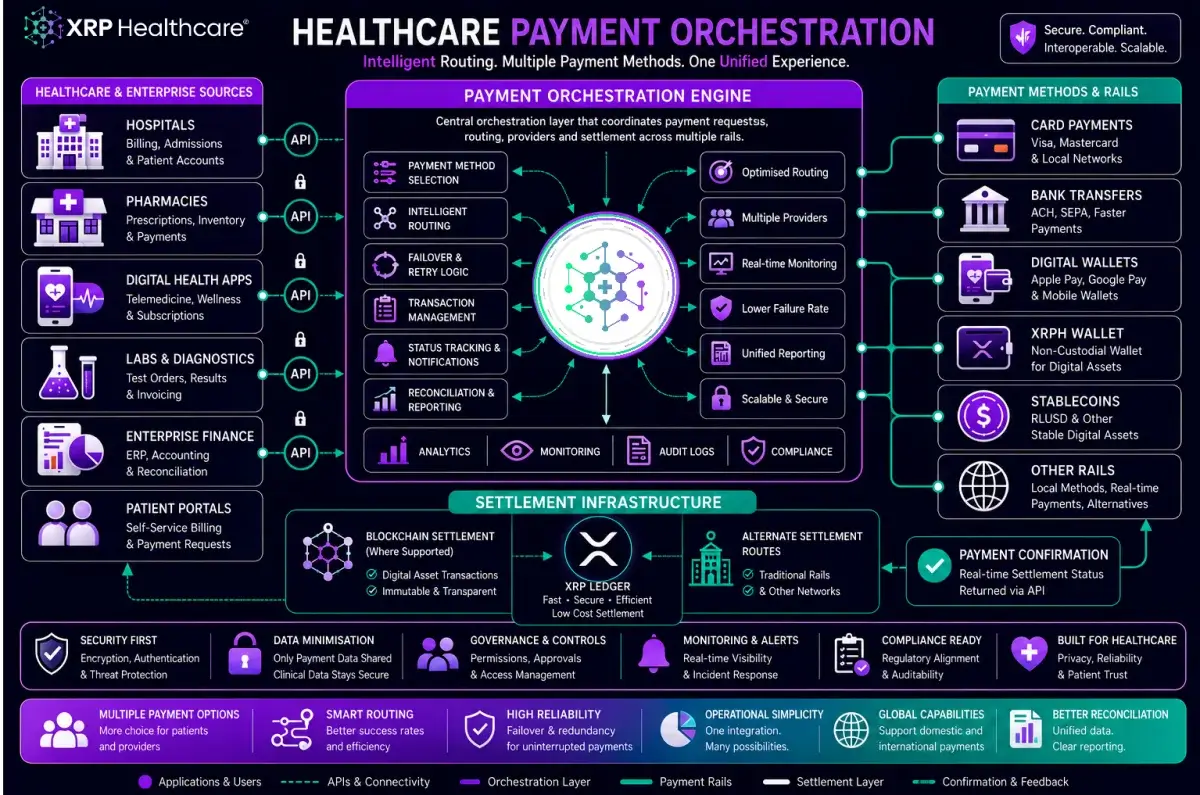
This is where healthcare payment orchestration becomes important. Payment orchestration is an infrastructure approach that coordinates multiple payment systems through a unified layer. Instead of requiring every healthcare application to connect separately to every payment provider, an orchestration layer can help manage how transactions are requested, routed, processed, and confirmed.
Within the broader XRP Healthcare Infrastructure, orchestration could potentially connect healthcare applications, payment APIs, the XRPH Wallet, Healthcare Payment Rails, settlement infrastructure and supported digital assets into more streamlined payment workflows.
What Is Healthcare Payment Orchestration?
Healthcare payment orchestration is the coordination of multiple payment technologies through a common infrastructure layer. The orchestration layer can sit between healthcare applications and payment providers, helping coordinate the movement of a payment request through the appropriate systems.
Depending on the architecture, an orchestration layer may be responsible for:
Receiving payment requests
Determining available payment methods
Routing transactions
Tracking payment status
Handling failed transactions
Returning settlement confirmation
Supporting reconciliation
The primary objective is to reduce complexity while providing healthcare applications with a consistent payment workflow.
Why Healthcare Payments Need Orchestration
Healthcare organisations increasingly operate across multiple payment environments. A hospital may need to support domestic card payments, international cards, bank transfers, digital wallets, subscription payments and cross-border healthcare payments.
A digital healthcare platform may have even more requirements. Without orchestration, each payment method may require a separate integration, which can create:
Complex software architecture
Duplicate development work
Multiple reconciliation processes
Fragmented reporting
Operational overhead
An orchestration layer can provide a central coordination point for supported payment routes and infrastructure components.
Payment Orchestration Versus a Payment Gateway
A payment gateway typically helps connect transactions to a particular payment processor or network. Payment orchestration is broader because it can potentially coordinate multiple gateways, payment rails, wallets, processors, settlement systems, and payment methods.
InfrastructurePrimary RolePayment GatewayConnects transactions to a payment processor or networkPayment APIAllows software systems to communicatePayment RailMoves valuePayment OrchestrationCoordinates multiple payment routes and systemsSettlement InfrastructureConfirms and finalises transactions
These components can work together as parts of a broader healthcare payment infrastructure architecture.
A Simple Healthcare Payment Orchestration Workflow
Imagine a patient needs to pay for a healthcare service. A supported payment workflow could operate as follows:
The healthcare system creates a payment request.
The orchestration layer receives the request.
Available payment options are identified.
The patient selects a supported payment method.
The transaction is routed to the appropriate infrastructure.
The payment is processed.
Settlement status is confirmed.
Confirmation is returned to the healthcare system.
Billing or accounting records are updated.
The patient sees a relatively simple payment experience while the infrastructure coordinates the complexity behind it.
The Importance of Payment Choice
Healthcare users have different payment preferences. Some may prefer traditional cards or bank payments, while others may use mobile wallets, stablecoins or other supported digital assets.
A multi-rail payment environment can allow organisations to provide greater flexibility. Payment orchestration can help coordinate these different options through a consistent workflow without requiring the user to understand the underlying infrastructure.
Orchestration and Healthcare Payment Rails
Healthcare Payment Rails represent the infrastructure through which compatible digital value can move. Payment orchestration sits above individual rails and may determine which supported route is appropriate for a particular transaction.
The orchestration layer coordinates the workflow, while the payment rail performs the relevant value-transfer function.
Orchestration and Healthcare Payment APIs
Payment orchestration depends heavily on APIs. APIs allow an orchestration system to communicate with healthcare applications, billing platforms, payment providers, wallets, and settlement infrastructure.
Without reliable interfaces, coordinating multiple systems becomes significantly more difficult. This makes Healthcare Payment APIs an important technical foundation for payment orchestration.
Orchestration and Healthcare Payment Interoperability
Payment orchestration also depends on Healthcare Payment Interoperability. Interoperability allows different systems to communicate and work together, while orchestration coordinates how those connected systems and payment routes are used.
The relationship can be understood as:
Interoperability allows systems to communicate.
APIs provide technical interfaces.
Orchestration coordinates how those connected systems are used.
This creates a logical infrastructure progression from connectivity to coordinated payment execution.
What Is Healthcare Payment Orchestration?
Healthcare payment orchestration is the coordination of multiple payment methods, wallets, gateways, rails and settlement systems through a common infrastructure layer.
How Is Payment Orchestration Different From a Payment Gateway?
A payment gateway usually connects transactions to a particular processor or network. Payment orchestration is broader and can coordinate multiple payment providers, rails, wallets and settlement paths.
Why Does Healthcare Payment Orchestration Matter?
Healthcare organisations may need to support cards, bank payments, digital wallets, stablecoins and blockchain transactions. Orchestration can reduce integration complexity by coordinating these payment routes through one infrastructure layer.
How Does Orchestration Fit Within XRP Healthcare Infrastructure?
Within XRP Healthcare Infrastructure, an orchestration layer could potentially sit above APIs, the XRPH Wallet, Healthcare Payment Rails and compatible settlement infrastructure such as the XRP Ledger.
Important: Orchestration capabilities should only be described as live where they have been officially verified. This article explains the architectural role payment orchestration can play within future or compatible healthcare payment infrastructure.
The XRPH Wallet in an Orchestrated Payment Environment
The XRPH Wallet can represent a user-facing payment interface within a broader orchestration architecture.
For a supported transaction, a potential workflow could be:
A healthcare platform creates the payment request.
The orchestration layer identifies the compatible payment option.
The XRPH Wallet displays the transaction.
The user reviews and approves it.
The payment infrastructure processes the transaction.
Settlement status is returned to the originating healthcare system.
The wallet provides the user experience, while the orchestration infrastructure coordinates the underlying workflow.
Orchestration and the XRP Ledger
The XRP Ledger can provide a blockchain settlement layer for compatible transactions. In an orchestrated payment environment, XRPL could represent one settlement path where the relevant asset and transaction are supported.
The orchestration layer should not assume that every healthcare payment must use blockchain. Instead, it can potentially coordinate different supported rails according to the payment scenario.
This approach can provide greater architectural flexibility while allowing blockchain settlement to be used where appropriate.
Multi-Rail Healthcare Payments
Modern healthcare payments are increasingly multi-rail. A multi-rail environment may include:
Card networks
Bank payment systems
Digital wallets
Blockchain settlement
Stablecoins
Mobile payments
The role of orchestration is to help coordinate these options. It does not require one payment rail to replace every other payment method.
Stablecoins and Payment Orchestration
Stablecoins can provide another payment option within a multi-rail environment where supported. For example, a user may prefer a stable-value digital asset for an international healthcare transaction.
The orchestration layer may help coordinate the payment request, supported asset, wallet interaction, transaction routing and settlement confirmation.
The stablecoin remains the payment asset. The orchestration layer manages the surrounding workflow.
Cross-Border Healthcare Payment Routing
Cross-border healthcare transactions can involve additional complexity. A patient may be located in one country while the healthcare provider operates in another. Different payment options may have different fees, settlement times, currency requirements, availability and compliance considerations.
Payment orchestration can potentially help coordinate available routes. However, routing should not be described as automatically optimised unless that functionality has genuinely been implemented and verified.
Intelligent Payment Routing
Some payment orchestration architectures can use rules to select between supported payment routes. Potential criteria may include:
Payment method
Geography
Currency
Availability
Transaction amount
Provider rules
Risk controls
Future systems may use more sophisticated decision-making. Within XRP Healthcare content, such functionality should remain clearly described as architectural or future-facing unless officially confirmed as live.
Payment Failover
One potential benefit of orchestration is the ability to manage payment failures more effectively. For example, if one supported payment route becomes unavailable, an orchestration system may be able to offer another available option.
This can improve resilience. However, failover must be designed carefully so that a user is never accidentally charged twice.
Preventing Duplicate Payments
Orchestrated payment systems require strong transaction controls. Every transaction should have a unique identifier to help prevent duplicate processing, conflicting payment states, repeated billing and reconciliation errors.
If a payment request is retried, the infrastructure should determine whether the request represents a new transaction or an attempt to continue an existing transaction.
Transaction safety: Payment retries and failover mechanisms must be designed to prevent accidental duplicate charges. Unique transaction references and clear payment states are essential.
Payment Status Must Remain Clear
A payment may move through several states, including:
Created
Awaiting approval
Processing
Confirmed
Failed
Cancelled
Healthcare applications need accurate status information. A transaction should not be marked as paid merely because payment initiation has started.
The provider system should rely on confirmed status from the relevant settlement infrastructure.
Settlement principle: A transaction should not be treated as completed simply because payment initiation succeeded. Healthcare systems should rely on confirmed payment or settlement status from the relevant infrastructure.
Orchestration and Settlement
Payment orchestration and settlement perform different roles. Orchestration coordinates the transaction journey.
Settlement finalises the supported payment. Both functions can be important for a complete payment workflow. The orchestration layer must understand the status of each payment route so that it can provide accurate information back to healthcare applications.
Reconciliation Across Multiple Payment Methods
Supporting many payment methods can make accounting more complicated. An orchestration layer can help standardise transaction information across providers.
For example, an organisation may receive common transaction fields such as:
Transaction ID
Amount
Payment method
Settlement status
Timestamp
Reference
Standardised information can simplify reporting, reconciliation and financial operations.
Enterprise Healthcare Payment Orchestration
Large healthcare organisations may operate multiple hospitals, hundreds of clinics, pharmacy networks, telemedicine services, subscription products and international operations.
Managing payment integrations individually across every business unit can become difficult. A central orchestration layer can provide a more consistent payment architecture across the organisation.
Orchestration and Vendor Flexibility
Payment orchestration can support modular infrastructure. If payment providers connect through defined interfaces, organisations may be able to add new payment methods, replace providers, introduce new digital assets, expand internationally and upgrade individual components without rebuilding every application.
This can help reduce dependency on a single payment provider or infrastructure component.
Security Across Payment Routes
More payment routes also mean more infrastructure to secure. Security controls should include:
API authentication
Access control
Transaction validation
Wallet security
Monitoring
Encryption
Credential management
Audit logging
The orchestration layer becomes particularly security-sensitive because it coordinates multiple payment systems.
Governance and Payment Routing
Healthcare organisations should establish clear rules around:
Which payment methods are approved
Which providers may be used
Which digital assets are supported
Who can change routing rules
How transactions are monitored
How incidents are escalated
Routing logic should not become an uncontrolled black box. Governance should define how payment routes are selected, monitored and changed.
Compliance Across Multiple Rails
Different payment routes can create different compliance requirements. Organisations may need to consider jurisdiction, payment method, digital asset, provider, transaction type and customer location.
Payment orchestration can coordinate infrastructure, but it does not remove the need for appropriate legal, regulatory and compliance review.
Data Minimisation
The orchestration layer should process only the information required for payment workflows. It should avoid unnecessary access to diagnoses, medical histories, clinical notes and treatment records.
A payment system should not become a clinical data repository. Separating payment responsibilities from clinical data can improve security and privacy.
Orchestration and Healthcare Privacy
Healthcare payment infrastructure should minimise the use of sensitive medical information in transaction references.
For example, a payment system may need an invoice reference, amount and payment status. It generally does not need a detailed diagnosis.
Separating payment and clinical responsibilities is an important principle for responsible healthcare infrastructure.
Payment Orchestration and the XRP Healthcare Infrastructure Stack
A future orchestration layer could potentially sit within the broader architecture as follows:
Application Layer
Hospitals, pharmacies, healthcare applications, and enterprise systems.
↓
API and Interoperability Layer
Structured interfaces between systems.
↓
Payment Orchestration Layer
Coordinates supported payment routes.
↓
User Access
XRPH Wallet and compatible payment interfaces.
↓
Payment Rails
Healthcare Payment Rails and other supported payment rails.
↓
Settlement
XRP Ledger or other supported settlement infrastructure, depending on the payment route.
↓
Confirmation and Reconciliation
Transaction status is returned to enterprise systems.
Security, governance, monitoring and compliance operate across all layers.
Important: This architecture describes a potential infrastructure model. It should not be interpreted as confirmation that XRP Healthcare currently operates every component or orchestration function described above.
Orchestration Should Remain Invisible to the Patient
The patient should not need to understand payment architecture. Ideally, the user should simply be able to:
See the amount due.
Choose an available payment method.
Review the transaction.
Confirm payment.
Receive confirmation.
The orchestration layer handles the complexity behind the scenes.
Good infrastructure makes complicated systems feel simple.
The Future of Healthcare Payment Orchestration
As digital healthcare becomes increasingly global and multi-rail, payment orchestration may become more important.
Future infrastructure could support:
More payment methods
Multi-asset digital payments
More sophisticated routing
Automated reconciliation
Enterprise payment rules
Improved failure handling
Greater international connectivity
Any XRP Healthcare-specific orchestration capabilities should be described as live only when officially implemented and verified.
Building on APIs and Interoperability
Healthcare payment orchestration represents a logical layer above other infrastructure concepts.
Interoperability allows systems to work together.
APIs allow them to communicate.
Payment orchestration coordinates how those systems and payment routes are used.
This creates a progressively deeper infrastructure architecture.
Orchestration Principle
Orchestration principle: The purpose of payment orchestration is not to force every transaction through one payment method. It is to coordinate multiple supported routes while maintaining a consistent experience for healthcare applications and users.
Healthcare Payment Orchestration Within XRP Healthcare Infrastructure
Within a broader XRP Healthcare Infrastructure architecture, payment orchestration could potentially connect healthcare applications with payment APIs, the XRPH Wallet, Healthcare Payment Rails and compatible settlement infrastructure.
The critical semantic relationship can be represented as:
This progression shows how connected healthcare systems can evolve from basic interoperability toward coordinated multi-rail payment infrastructure.
Conclusion
Healthcare payment orchestration can help simplify an increasingly complex payment environment.
As healthcare organisations support more wallets, payment methods, digital assets and settlement systems, coordinating every connection individually can become difficult. An orchestration layer can provide a central point for managing payment requests, routing transactions, tracking status and returning confirmation to healthcare systems.
Within the XRP Healthcare Infrastructure, orchestration could potentially sit above Healthcare Payment APIs, Healthcare Payment Rails, the XRPH Wallet and compatible settlement infrastructure such as the XRP Ledger.
The objective is not to force every payment through one technology. Instead, the goal is to create flexible infrastructure capable of coordinating multiple supported payment methods while maintaining security, governance and a simple user experience.
Frequently Asked Questions
What is healthcare payment orchestration?
Healthcare payment orchestration is the coordination of multiple payment methods, providers, wallets, rails and settlement systems through a common infrastructure layer.
How is payment orchestration different from a payment gateway?
A payment gateway typically connects a transaction with a payment processor or network. Payment orchestration can coordinate multiple gateways, payment methods, rails and settlement routes.
Why is payment orchestration useful in healthcare?
Healthcare organisations may need to support multiple payment methods across hospitals, pharmacies, digital services and international operations. Orchestration can reduce integration complexity by coordinating these options through one layer.
How do payment APIs relate to orchestration?
APIs allow software systems to communicate. Payment orchestration uses these interfaces to coordinate requests, routing, payment status and settlement across connected systems.
How does interoperability relate to payment orchestration?
Interoperability allows independent systems to work together. Orchestration builds on that connectivity by coordinating how the available payment systems and routes are used.
What role could the XRPH Wallet play?
The XRPH Wallet can serve as a user-facing payment interface within supported workflows, while payment rails and settlement infrastructure operate beneath the wallet layer.
Could the XRP Ledger be used within an orchestrated healthcare payment environment?
Potentially, yes, for compatible transactions where the relevant asset and payment route support XRP Ledger settlement. Not every orchestrated payment would necessarily use blockchain.
Can payment orchestration prevent payment failures?
Orchestration can potentially provide alternative payment routes or failure-handling logic, but no system can guarantee every payment succeeds. Duplicate-payment prevention and accurate transaction-state management remain essential.
Does XRP Healthcare currently operate an intelligent payment orchestration platform?
Only officially confirmed live capabilities should be described as current. This article explains how payment orchestration can fit within modern XRP Healthcare infrastructure architecture and should not be interpreted as confirmation of unannounced functionality.
Continue Learning About Healthcare Payment Infrastructure