Open Infrastructure for XRP-Based Healthcare Payments
XRP Healthcare operates as an independent infrastructure provider through XRP Healthcare LLC, the registered trademark owner.
The XRPH Wallet and XRP Payment Program framework form part of the XRP Healthcare infrastructure architecture for healthcare payment deployment using the XRP Ledger (XRPL). The model emphasizes non-custodial design, interoperability, technical transparency, and regulatory clarity.
This infrastructure is open, modular, and structured for integration by pharmacies, healthcare networks, payment facilitators, and enterprise system providers seeking to deploy XRP-based payment rails within their own environments.
XRPH Wallet does not provide custody, brokerage, exchange, financial, or healthcare services. It is non-custodial software infrastructure.
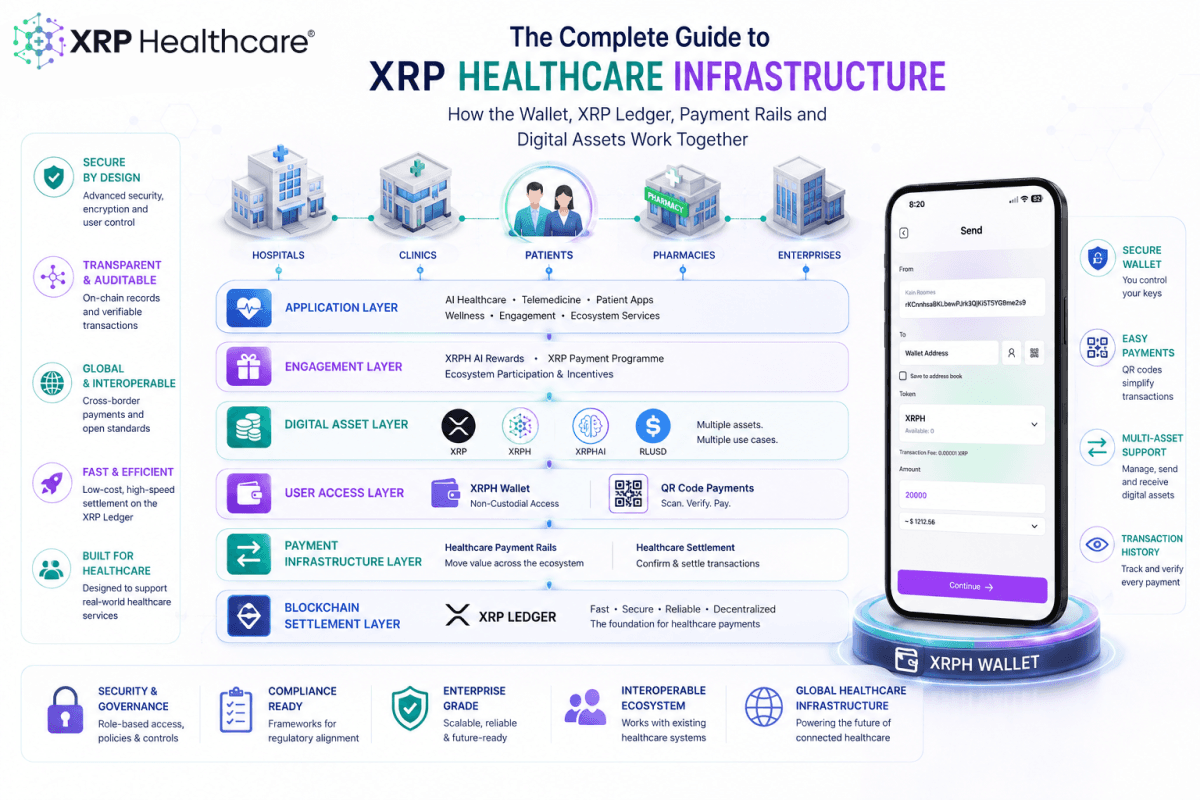
The Complete Guide to XRP Healthcare Infrastructure: How the Wallet, XRP Ledger, Payment Rails and Digital Assets Work Together
Explore the complete XRP Healthcare Infrastructure and learn how the XRPH Wallet, XRP Ledger, payment rails, digital assets and settlement layers work together.
Healthcare technology is becoming increasingly connected. Patients now use mobile applications, digital payments, telemedicine, AI-powered healthcare tools and online pharmacy services as part of everyday healthcare. Behind those experiences sits another layer that users may rarely see: infrastructure.
Infrastructure determines how digital services connect, how payments move, how transactions settle, how users access supported assets and how enterprise systems interact with emerging technologies.
The XRP Healthcare Infrastructure has been designed around this layered approach.
Rather than relying on a single application or blockchain feature, the ecosystem combines several specialised components, including:
The XRP Ledger
Healthcare Payment Rails
Healthcare Settlement
The XRPH Wallet
QR Code Payments
XRP
XRPH
XRPHAI
RLUSD
AI-powered engagement
Enterprise infrastructure
Security and governance
Each component performs a different role. Together, they form a broader infrastructure framework supporting the XRP Healthcare ecosystem.
XRP Healthcare Infrastructure refers to the underlying blockchain, wallet, payment, and digital asset architecture that supports the XRP Healthcare ecosystem. It provides the technology foundation upon which compatible healthcare payment and ecosystem services can operate.
The infrastructure can be understood through several interconnected layers.
Blockchain Settlement
The XRP Ledger provides the underlying distributed ledger and blockchain settlement foundation.
Payment Connectivity
Healthcare Payment Rails support the movement of compatible digital value between participants.
Healthcare Settlement
Healthcare Settlement supports the confirmation and recording of compatible payment activity.
User Access
The XRPH Wallet provides a user-facing interface for supported blockchain functionality and digital assets.
Payment Initiation
QR Code Payments can simplify initiating supported digital transactions.
Digital Assets
XRP, XRPH, XRPHAI and RLUSD can serve different functions within the wider ecosystem, depending on supported functionality.
Engagement
XRPH AI Rewards and the XRP Payment Programme represent additional participation and engagement components.
Why Healthcare Needs Better Infrastructure
Healthcare is one of the world's most complex industries. A single patient journey may involve hospitals, doctors, pharmacies, laboratories, insurers, payment processors, digital applications and specialist providers.
Each organisation may operate different technology systems.
This fragmentation creates challenges around:
Payments
Settlement
Interoperability
User experience
Cross-border healthcare
Security
Enterprise integration
Modern healthcare infrastructure needs to connect these environments without requiring every organisation to replace its existing systems.
The XRP Ledger: The Settlement Foundation
At the base of the XRP Healthcare Infrastructure is the XRP Ledger. The XRP Ledger is a blockchain designed around digital value transfer and settlement.
Its characteristics include:
Fast transaction confirmation
Low transaction costs
High throughput
Energy-efficient consensus
Open-source architecture
Transparent transaction records
Within XRP Healthcare Infrastructure, the XRP Ledger acts as the blockchain settlement layer.
Users do not necessarily need to interact directly with the ledger. Applications and wallets can provide the interface while the underlying blockchain handles compatible transaction processing. For deeper information, link this section to Healthcare Payments on the XRP Ledger, Healthcare Settlement Explained and Blockchain Healthcare Payments Explained.
Healthcare Payment Rails
The next layer is Healthcare Payment Rails. Payment rails are the infrastructure used to move digital value between participants. Within healthcare, this may involve:
Patients
Healthcare providers
Pharmacies
Digital healthcare platforms
Enterprise organisations
International healthcare services
Healthcare Payment Rails connect user-facing systems with underlying settlement infrastructure.
This separation makes the architecture more modular and allows different components to perform specialised functions. Continue learning through Healthcare Payment Rails, Instant Healthcare Payments and Cross-Border Healthcare Payments.
Healthcare Settlement
Payment initiation and payment settlement are not exactly the same thing. A user may initiate a transaction through a wallet or QR code. Settlement refers to the point at which the transaction is confirmed through the relevant infrastructure.
Within the XRP Healthcare ecosystem, blockchain settlement can support:
Transparent transaction records
Efficient confirmation
Verifiable payment history
Digital value transfer
Settlement is therefore one of the core building blocks of modern payment infrastructure.
The XRPH Wallet
The XRPH Wallet is the user-facing gateway into the blockchain infrastructure. Instead of requiring users to understand blockchain protocols directly, a wallet can provide a familiar interface for interacting with supported digital assets and transaction functionality.
Potential wallet capabilities include:
Sending supported digital assets
Receiving supported digital assets
Viewing transaction history
QR Code Payments
Supported token swaps
Managing ecosystem assets
Accessing supported ecosystem services
The wallet simplifies interaction while blockchain infrastructure operates behind the scenes.
Link this section to the confirmed live article What Is the XRPH Wallet?.
Non-Custodial Wallet Architecture
The XRPH Wallet follows a non-custodial model. This means users remain responsible for controlling access to their supported digital assets and wallet credentials.
Open-source wallet development can support transparency. Where source code is publicly available, developers and security researchers can examine how software operates.
Potential benefits include:
Independent review
Community scrutiny
Security analysis
Technical transparency
Continuous improvement
Open source does not automatically guarantee security. Instead, it provides an additional layer of visibility that can support technical review.
QR payments can simplify blockchain payment initiation. Instead of manually entering transaction information, users can scan a supported QR code.
A typical process might involve:
Scan the QR code.
Review the destination.
Confirm the amount.
Confirm the digital asset.
Approve the transaction.
The wallet handles the user interface while the underlying blockchain manages compatible settlement.
QR codes therefore provide a bridge between real-world healthcare experiences and digital payment infrastructure.
XRP: The Native Asset of the XRP Ledger
XRP is the native digital asset of the XRP Ledger. Its role within the wider infrastructure relates to blockchain value transfer and network functionality. XRP should be distinguished from other ecosystem assets because each asset can serve a different purpose.
XRPH: Ecosystem Utility
XRPH serves an ecosystem utility role within XRP Healthcare Infrastructure. Utility can relate to supported infrastructure and ecosystem functionality. The exact use of a digital asset should always be described according to confirmed live functionality rather than speculative future possibilities.
XRPHAI: AI Ecosystem Participation
XRPHAI connects the infrastructure layer with AI-powered ecosystem participation. Its role relates to supported engagement across the wider XRP Healthcare ecosystem. This creates an important connection between XRPHToken.com, which focuses on infrastructure, and XRPHealthcare.ai, which focuses on AI healthcare applications and user-facing digital health services. These websites should complement one another without duplicating the same search intent.
RLUSD and Stable Digital Payments
Stable-value digital assets can be useful where predictable value is important. RLUSD provides one example of a US dollar-denominated digital asset that may support compatible payment scenarios. Within a healthcare payment environment, stable-value assets can potentially complement:
XRP
XRPH
XRPHAI
Traditional payment methods
The appropriate asset depends on the payment scenario, supported functionality and applicable requirements.
XRPH AI Rewards
The ecosystem also includes an engagement layer. XRPH AI Rewards are designed around digital participation within compatible healthcare experiences. Rewards and payment infrastructure should be understood separately.
Payments move value. Rewards encourage supported participation. Both can operate within the same digital ecosystem.
The XRP Payment Programme
The XRP Payment Programme forms another participation and payment-related component. It demonstrates how payment infrastructure can extend beyond basic transfers and support broader ecosystem engagement.
Programme rules, eligibility and functionality should always reflect the current live platform rather than assumed future features.
Token Swaps and XRPHAI
Supported token swaps allow users to exchange compatible digital assets. Within the XRPH Wallet, a supported swap experience may enable users to move between assets according to available functionality. This creates a practical bridge between wallet access and ecosystem participation.
Modern healthcare increasingly operates in real time.
Patients may:
Book appointments instantly.
Access telemedicine rapidly.
Use digital prescriptions.
Purchase healthcare services online.
Payment infrastructure must keep pace.
Blockchain settlement can support payment experiences where confirmation occurs efficiently while maintaining transparent transaction records. This is one reason payment-focused blockchain infrastructure is relevant to healthcare.
Cross-Border Healthcare Payments
Healthcare is becoming increasingly international. Patients travel, specialists consult remotely, and healthcare companies operate across multiple countries. Cross-border healthcare payments may involve:
Currency conversion
Payment delays
International settlement
Different financial systems
Regulatory requirements
Blockchain infrastructure can provide another settlement option within these workflows. It does not eliminate jurisdictional obligations.
Digital Healthcare Payments
Digital healthcare payments extend beyond cryptocurrency. The broader trend includes:
Digital wallets
Mobile payments
Online billing
Subscription healthcare
QR payments
Blockchain settlement
Stable-value assets
XRP Healthcare Infrastructure exists within this wider evolution of digital payments.
Blockchain healthcare payments use distributed ledger infrastructure to record and settle compatible digital transactions. The value proposition is not simply that blockchain exists. It is that the technology can support:
Transparency
Settlement
Digital value transfer
Global infrastructure
Programmable integrations
Blockchain should therefore be viewed as one component of the payment architecture.
Interoperability allows new infrastructure to complement existing systems.
The Complete XRP Healthcare Infrastructure Stack
Layer 1 - Blockchain Settlement
XRP Ledger
Provides blockchain settlement infrastructure.
Layer 2 - Payment Infrastructure
Healthcare Payment Rails
Supports movement of compatible digital value.
Healthcare Settlement
Supports transaction confirmation and settlement.
Layer 3 - User Access
XRPH Wallet
Provides non-custodial user access.
QR Code Payments
Simplifies transaction initiation.
Layer 4 - Digital Assets
XRP - Native XRPL digital asset.
XRPH - Ecosystem utility.
XRPHAI - AI ecosystem participation.
RLUSD - Stable-value digital payment option.
Layer 5 - Participation
XRPH AI Rewards
Supports eligible engagement.
XRP Payment Programme
Supports compatible ecosystem participation.
Layer 6 - Applications
AI healthcare and digital health applications provide user-facing services above the infrastructure.
Layer 7 - Enterprise Controls
Security, compliance, governance and interoperability support responsible infrastructure deployment.
Why the Layered Model Matters
No single component is expected to perform every function.
The wallet should not become a hospital system.
The blockchain should not become a medical record.
A digital asset should not be expected to perform every payment function.
Specialisation creates a more scalable architecture.
Each component performs the role it is designed for.
Infrastructure and AI Healthcare Work Together
XRP Healthcare's wider ecosystem operates across two complementary digital layers.
XRPHToken.com
Infrastructure
Wallet
Payments
Settlement
Blockchain
Digital assets
Security
Governance
XRPHealthcare.ai
AI healthcare
Patient education
AI health guidance
Doctor Finder
Medicine Guidance
Preventive healthcare
Health journeys
Digital engagement
The infrastructure supports the ecosystem.
The applications provide the user experience.
This distinction strengthens both platforms.
Building a Healthcare Infrastructure Knowledge Graph
The XRP Healthcare Infrastructure cluster is designed to explain each component individually while connecting every article back to the central infrastructure pillar.
This creates a clear knowledge structure around:
Blockchain settlement
Wallet architecture
Healthcare payment rails
Digital assets
Security
Governance
Enterprise infrastructure
AI integration
For users, this makes complex infrastructure easier to understand.
For search engines and AI retrieval systems, it creates clear semantic relationships between the major entities in the XRP Healthcare ecosystem.
Conclusion
XRP Healthcare Infrastructure is not a single wallet, blockchain, or token. It is a layered architecture. The XRP Ledger provides blockchain settlement. Healthcare Payment Rails support the movement of digital value.
Healthcare Settlement supports transaction confirmation. The XRPH Wallet provides user access. XRP, XRPH, XRPHAI and RLUSD support different functions. Security, interoperability, governance and enterprise controls help make the infrastructure more resilient.
Together, these components provide the foundation for a connected healthcare ecosystem designed to evolve alongside digital health.
Understanding the complete infrastructure makes it easier to understand how each XRP Healthcare technology fits into the wider system.
XRP Healthcare Infrastructure is the blockchain, wallet, payment, digital asset, security, and governance architecture that supports compatible services across the XRP Healthcare ecosystem.
What blockchain does XRP Healthcare use for its infrastructure?
The XRP Healthcare Infrastructure uses the XRP Ledger as its blockchain settlement layer for compatible digital transactions.
What is the XRPH Wallet?
The XRPH Wallet is the user-facing wallet layer within the XRP Healthcare ecosystem, providing non-custodial access to supported digital assets and blockchain functionality.
What are Healthcare Payment Rails?
Healthcare Payment Rails are the infrastructure supporting the movement of compatible digital value across participating healthcare services and ecosystem applications.
What is healthcare settlement?
Healthcare settlement refers to the confirmation and finalisation of compatible payment transactions through the underlying payment and blockchain infrastructure.
What digital assets form part of the XRP Healthcare ecosystem?
The ecosystem includes XRP, XRPH, XRPHAI and RLUSD, with different assets serving different functions depending on supported platform functionality.
Is the XRPH Wallet non-custodial?
The XRPH Wallet is designed around a non-custodial model in which users retain responsibility for controlling their wallet credentials and supported digital assets.
Does the XRP Ledger store medical records?
XRP Healthcare's infrastructure use of the XRP Ledger focuses on digital transactions, settlement and related blockchain functionality. It should not be presented as a replacement for confidential clinical record systems.
How does XRPHealthcare.ai relate to XRPHToken.com?
XRPHealthcare.ai focuses on the AI healthcare application and patient-facing experience, while XRPHToken.com focuses on the blockchain, wallet, payment and digital asset infrastructure supporting the wider ecosystem.
What is the main XRP Healthcare Infrastructure page?
The central infrastructure authority page is https://xrphtoken.com/infrastructure, which connects the major infrastructure components and supporting educational resources.