Introduction
Healthcare payments depend on predictability. A hospital invoice may need to be settled for a specific amount. A patient purchasing medicine needs to understand exactly what they are paying. A healthcare organisation operating internationally needs reliable ways to account for revenue and expenses.
This requirement for predictable value creates an important challenge when using digital assets whose market prices can fluctuate significantly. Stablecoins provide another approach.
A stablecoin is a digital asset designed to maintain a value linked to another asset or reference, commonly a national currency such as the US dollar. This makes stablecoins potentially useful within blockchain-powered payment environments where users want the benefits of digital settlement without the same degree of short-term price volatility associated with some other digital assets.
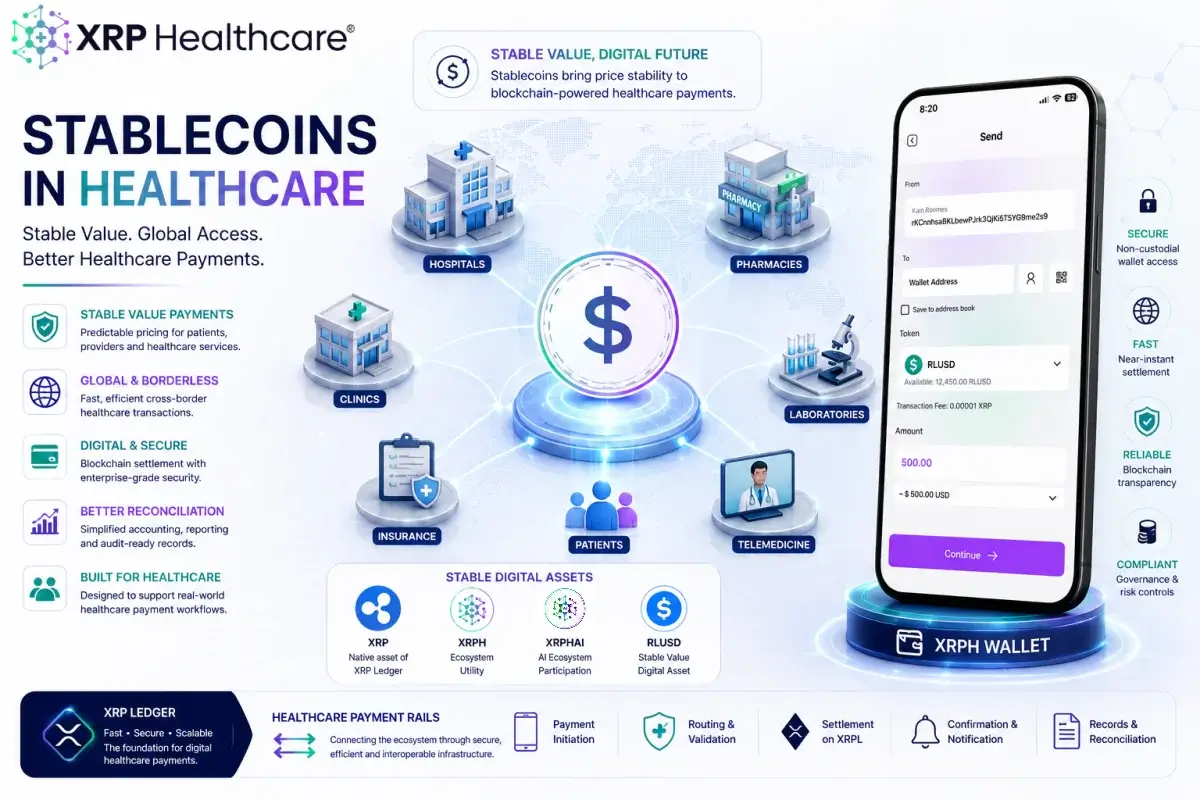
Within the broader XRP Healthcare Infrastructure, stable-value digital assets can complement the XRP Ledger, XRPH Wallet, healthcare payment rails, healthcare settlement, and other supported payment technologies.
What Are Stablecoins in Healthcare?
Stablecoins in healthcare are stable-value digital assets used or considered within compatible healthcare payment infrastructure. They can provide blockchain-based payment functionality while aiming to maintain a more predictable reference value than many other digital assets.
A stablecoin is a blockchain-based digital asset designed to maintain a relatively stable reference value. Many stablecoins are structured around fiat currencies. For example, a US dollar-denominated stablecoin is generally designed so that one unit aims to represent approximately one US dollar according to the relevant issuer's structure and terms.
Stablecoins differ from digital assets whose value is determined primarily by open market supply and demand. Their primary objective is usually value stability.
Why Stable Value Matters in Healthcare
Healthcare organisations typically operate with clearly defined prices. Examples include:
If the payment asset changes significantly in value between invoicing and settlement, accounting becomes more complicated.
Stablecoins can potentially address part of this challenge by providing a digital asset designed around a predictable reference value. This can be useful when prices are denominated in fiat currency, organisations require predictable accounting, patients want clear payment amounts, or healthcare services operate internationally.
Stablecoins and Digital Healthcare Payments
Stablecoins can potentially support several healthcare payment scenarios, including patient-to-provider payments, pharmacy payments, telemedicine services, healthcare memberships and enterprise settlement.
Patient-to-Provider Payments
Patients may use supported digital assets to pay healthcare providers where the relevant payment infrastructure and provider acceptance are available.
Pharmacy Payments
Stable-value digital payments may provide another option for purchasing medicines and healthcare products through compatible payment systems.
Telemedicine
International digital healthcare services may benefit from payment methods designed for online and cross-border use.
Healthcare Memberships
Subscription-based healthcare services may benefit from predictable digital payment values where supported.
Enterprise Settlement
Healthcare organisations may use stable-value digital assets in compatible settlement workflows. The appropriate use depends on the participating systems, jurisdiction, and applicable requirements.
Stablecoins Versus Other Digital Assets
Different digital assets are designed for different purposes. A simplified comparison is:
Asset TypeGeneral CharacteristicStablecoinDesigned around a relatively stable reference value XRP Native digital asset of the XRP Ledger XRP HXRP Healthcare ecosystem utilityXRPHAIAI-related ecosystem participation
These assets should not be treated as interchangeable simply because they all use blockchain infrastructure. Each performs a different role.
Stablecoins and Payment Predictability
Imagine a healthcare provider issues an invoice for $500. If the payment asset fluctuates significantly before settlement, the final economic value received could differ from the original invoice.
Stable-value digital assets are designed to reduce this problem. This may make them useful when:
Prices are denominated in fiat currency.
Organisations require predictable accounting.
Patients want clear payment amounts.
Healthcare services operate internationally.
Stability can therefore improve the practical usability of blockchain payments.
Stablecoins and the XRP Ledger
The XRP Ledger supports issued digital assets in addition to its native XRP asset. This allows compatible digital assets to operate across XRPL infrastructure according to their specific design and issuer arrangements.
Within healthcare infrastructure, the ledger can provide settlement capabilities while user-facing applications handle payment interaction.
The distinction is important:
Stablecoin: Provides the digital representation of stable value.
XRP Ledger: Provides blockchain transaction and settlement infrastructure where the asset is supported.
The Role of RLUSD
Within the wider XRP ecosystem, RLUSD provides an example of a US dollar-denominated stable digital asset. Within XRP Healthcare Infrastructure, RLUSD may be relevant to supported payment scenarios where users or organisations prefer a stable-value digital asset.
Its role should be distinguished from:
Each asset has different functionality and characteristics. Any use of RLUSD within specific XRP Healthcare products should always be described according to confirmed live functionality.
Stablecoins and the XRPH Wallet
A digital wallet provides the interface users need to interact with supported assets. Within the XRP Healthcare ecosystem, the XRPH Wallet can serve as the user-facing gateway to compatible digital assets and payment functionality.
Where a supported stablecoin is available, the wallet experience may allow users to:
View balances
Receive supported assets
Send supported assets
Review transaction history
Initiate compatible payments
Interact with supported payment services
The wallet simplifies the experience while the underlying blockchain handles settlement.
Stablecoins and Healthcare Payment Rails
Healthcare Payment Rails represent the infrastructure used to move compatible digital value between participants.
A simplified architecture might look like:
Patient or Organisation
↓
XRPH Wallet or Compatible Interface
↓
Healthcare Payment Rails
↓
XRP Ledger Settlement
↓
Healthcare Provider
The stablecoin represents the digital value moving through the infrastructure. XRPL settlement applies only where the relevant asset and payment implementation support it.
Stablecoins and Cross-Border Healthcare
Healthcare is increasingly international. Patients may travel abroad for surgery, specialist treatment, diagnostics, dental care, wellness services and medical tourism. Others may purchase healthcare services remotely.
Traditional cross-border payment systems can involve:
Stablecoins can provide another digital payment option within compatible infrastructure. They do not eliminate regulatory, tax, or compliance responsibilities.
Compliance note: Blockchain settlement does not remove legal, tax, financial or regulatory responsibilities. Requirements vary according to jurisdiction, organisation, asset and payment use case.
Supporting Medical Tourism
Medical tourism is one area where predictable digital payments may be useful.
A patient travelling internationally may need to pay:
A stable-value digital asset could potentially simplify payment expectations by keeping the payment denomination closer to a familiar fiat value. Implementation still depends on provider acceptance and applicable regulations.
Stablecoins and Healthcare Pricing
Healthcare organisations often publish prices in national currencies such as USD, GBP, EUR, AED and UGX.
A stablecoin linked to a widely used currency can potentially provide a bridge between conventional pricing and blockchain settlement. This allows the healthcare service to remain priced in familiar terms while using blockchain infrastructure for the transaction.
Why Stablecoins Do Not Replace XRP
It is important to distinguish stablecoins from XRP.
XRP is the native digital asset of the XRP Ledger. A stablecoin is an issued digital asset designed around a reference value. They serve different purposes.
A blockchain ecosystem can support multiple digital assets without requiring one to replace another. This multi-asset architecture provides flexibility.
Why Stablecoins Do Not Replace XRPH or XRPHAI
The same principle applies within XRP Healthcare.
XRPH supports ecosystem utility, while XRPHAI supports AI-related ecosystem participation.
A stablecoin focuses primarily on maintaining a stable reference value for compatible payment scenarios.
These are different functions. A well-designed ecosystem can use specialised assets for specialised purposes.
Stablecoins and Healthcare Settlement
Settlement is the process through which a transaction becomes confirmed through the relevant payment infrastructure.
When stablecoins operate on blockchain infrastructure, settlement can provide:
This can support healthcare organisations that require clear payment records.
Accounting and Reconciliation
Enterprise healthcare organisations need reliable accounting. Stable-value digital assets may simplify certain aspects of reconciliation because their reference value is designed to remain more predictable than highly volatile assets.
However, organisations may still need to consider:
Accounting standards
Transaction records
Treasury policies
Local tax rules
Asset classification
Conversion procedures
Blockchain payment infrastructure does not remove normal financial governance requirements.
Stablecoins and Enterprise Healthcare
Large healthcare organisations may require predictable pricing, clear settlement records, high transaction availability, international payment support, security, governance and financial reporting.
Stablecoins can potentially provide one component within this wider payment architecture. They are not a complete enterprise healthcare payment system by themselves; they operate within broader infrastructure.
Security Remains Essential
Stable value does not mean risk-free.
Users and organisations should still consider:
Wallet security
Credential protection
Transaction verification
Issuer risk
Operational risk
Cybersecurity
Regulatory requirements
Important: Stablecoins are designed to maintain a reference value, but they are not risk-free. Users and organisations should consider issuer structure, supported networks, wallet security, liquidity, redemption arrangements and applicable regulatory requirements.
Understanding Issuer Risk
Unlike the native asset of a blockchain, many stablecoins depend on an issuing organisation or legal structure.
Users and enterprises should understand:
Who issues the asset
How it is designed
Applicable terms
Supported networks
Redemption arrangements
Relevant jurisdictions
Stablecoins should therefore be evaluated as both technical and financial infrastructure components.
Compliance and Governance
Healthcare organisations considering stablecoin payments should maintain appropriate governance. This may include:
Approved asset policies
Wallet controls
Transaction limits
Accounting procedures
Compliance review
Risk management
Audit records
Cross-border policies
Blockchain settlement does not remove these responsibilities.
Stablecoins and Healthcare Privacy
A blockchain payment should not unnecessarily contain confidential clinical information.
Healthcare privacy: Payment infrastructure should not unnecessarily place confidential medical information on public blockchain networks. Clinical records and sensitive patient information should remain within appropriately designed healthcare information systems.
Payment data and healthcare data should remain appropriately separated. Blockchain payment infrastructure should not be treated as a replacement for electronic health records, clinical databases, prescription records or patient medical histories.
Stablecoins Within XRP Healthcare Infrastructure
The relationship can be summarised through several infrastructure layers.
Blockchain Settlement Layer
XRP Ledger provides compatible blockchain settlement.
Payment Infrastructure
Healthcare Payment Rails move compatible digital value.
User Access
XRPH Wallet provides access to supported assets.
Stable-Value Payment Layer
RLUSD or other supported stable digital assets may provide predictable digital payment value where supported.
Healthcare Services
Hospitals, pharmacies, healthcare platforms and other providers deliver the actual healthcare service.
Each layer performs a specialised function.
Stablecoins and the Future of Healthcare Payments
As digital payments continue evolving, healthcare organisations are likely to require greater flexibility.
The future payment environment may combine:
Rather than one payment technology replacing every other system, healthcare infrastructure is likely to become increasingly multi-rail. Users and organisations can then choose the most appropriate payment method for each situation.
A Multi-Asset Healthcare Infrastructure
Asset Primary Infrastructure Role XRP Native XRPL digital asset XRP Healthcare ecosystem utility XRPHAIAI ecosystem participationRLUSDStable-value digital payment option where supported
This specialised structure allows payment and utility functions to remain distinct.
Stablecoins Are Infrastructure, Not an Investment Thesis
When discussing stablecoins in healthcare, the primary focus should remain on payment functionality.
The relevant questions are:
Can the asset support predictable payments?
Is the infrastructure secure?
Is settlement efficient?
Is the asset supported?
Does the payment workflow comply with applicable requirements?
Is it useful to patients and healthcare providers?
The purpose of healthcare payment infrastructure is operational utility.
Continue Learning About Digital Healthcare Payments
Continue exploring the wider XRP Healthcare payment infrastructure through:
Frequently Asked Questions
What is a stablecoin?
A stablecoin is a digital asset designed to maintain a relatively stable value relative to a reference asset, commonly a national currency such as the US dollar.
Why could stablecoins be useful in healthcare?
Healthcare services usually require predictable pricing. Stablecoins can potentially combine a stable-value payment denomination with digital wallet and blockchain settlement capabilities.
Can stablecoins be used for cross-border healthcare payments?
Stablecoins can provide another payment option within compatible cross-border healthcare infrastructure. Their use remains subject to provider acceptance, supported infrastructure, and applicable regulatory requirements.
What is RLUSD?
RLUSD is Ripple's US dollar-denominated stablecoin. Within XRP Healthcare infrastructure content, it is relevant to compatible stable-value payment scenarios where supported.
Is RLUSD the same as XRP?
No. XRP is the native digital asset of the XRP Ledger, while RLUSD is a US dollar-denominated stablecoin. They have different characteristics and functions.
Do stablecoins replace XRPH or XRPHAI?
No. XRPH and XRPHAI have separate ecosystem roles. Stablecoins primarily focus on providing a digital asset designed around a stable reference value.
Are stablecoins risk-free?
No. Stablecoins can involve issuer, operational, liquidity, technical, regulatory and other risks. Users and organisations should evaluate the specific asset and infrastructure being used.
Does using stablecoins remove compliance requirements?
No. Healthcare organisations remain responsible for applicable legal, regulatory, financial, tax and governance requirements.
Should patient medical records be stored in stablecoin transactions?
No. Stablecoin and blockchain payment infrastructure should not be treated as a replacement for confidential clinical record systems.
Conclusion
Stablecoins can provide an important bridge between traditional currency pricing and blockchain-powered healthcare payments.
By maintaining a more predictable reference value, stable digital assets may help support healthcare scenarios where patients and organisations require clearer pricing, accounting and settlement.
Within the XRP Healthcare Infrastructure, stablecoins can complement the XRP Ledger, XRPH Wallet, Healthcare Payment Rails, healthcare settlement and other supported digital assets.
They do not replace XRP, XRPH or XRPHAI. Each serves a different role within the ecosystem.
As healthcare payments become increasingly digital and international, stable-value digital assets may become an important component of a broader multi-rail payment infrastructure designed around flexibility, transparency and global connectivity.
Explore XRP Healthcare Payment Infrastructure
Learn how wallets, blockchain settlement, payment rails and supported digital assets connect across the XRP Healthcare ecosystem.
Primary CTA: Explore XRP Healthcare Infrastructure
Secondary CTA: Explore the XRPH Wallet