Open Infrastructure for XRP-Based Healthcare Payments
XRP Healthcare operates as an independent infrastructure provider through XRP Healthcare LLC, the registered trademark owner.
The XRPH Wallet and XRP Payment Program framework form part of the XRP Healthcare infrastructure architecture for healthcare payment deployment using the XRP Ledger (XRPL). The model emphasizes non-custodial design, interoperability, technical transparency, and regulatory clarity.
This infrastructure is open, modular, and structured for integration by pharmacies, healthcare networks, payment facilitators, and enterprise system providers seeking to deploy XRP-based payment rails within their own environments.
XRPH Wallet does not provide custody, brokerage, exchange, financial, or healthcare services. It is non-custodial software infrastructure.
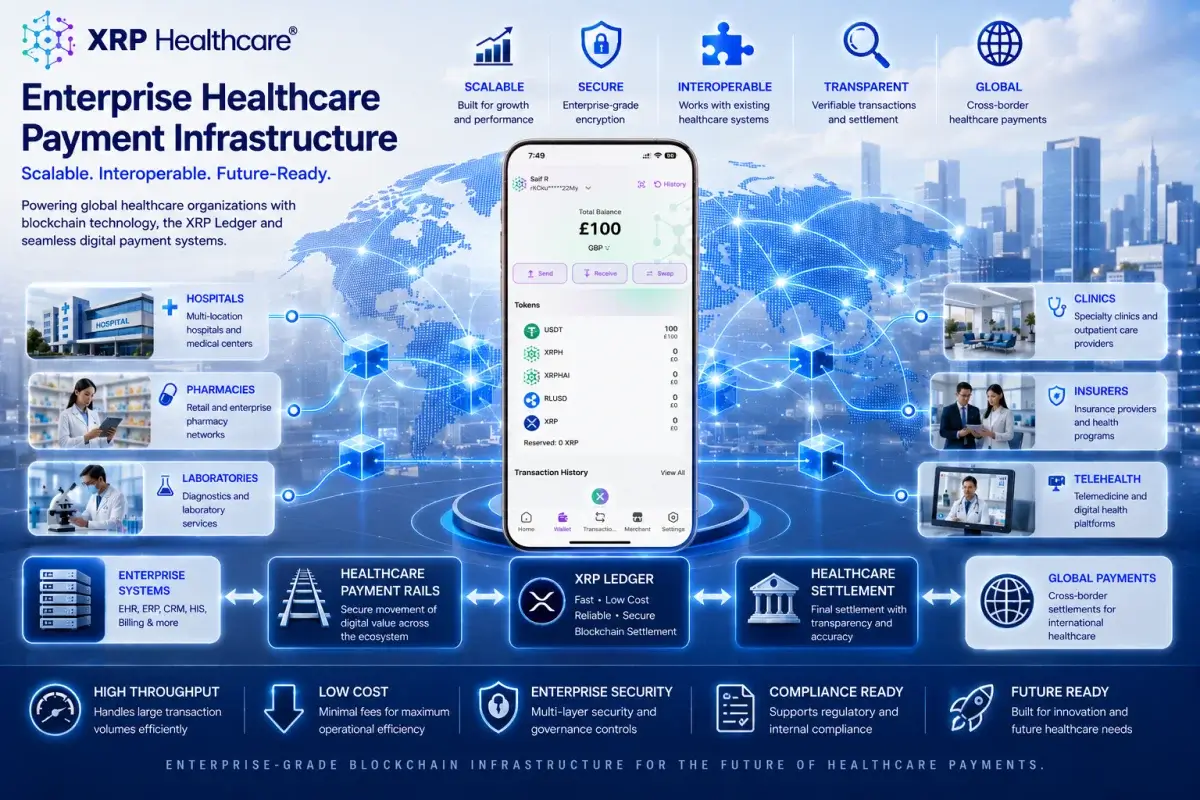
Enterprise Healthcare Payment Infrastructure: Building Scalable Digital Payment Systems for Modern Healthcare
Discover how enterprise healthcare payment infrastructure combines blockchain technology, the XRP Ledger and modern payment systems to support scalable healthcare organisations.
Healthcare is no longer delivered only through individual clinics or hospitals. Today's healthcare organisations often operate across multiple locations, countries and digital platforms.
Large healthcare providers may manage hospital networks, pharmacy groups, diagnostic laboratories, telemedicine platforms, specialist clinics, wellness programmes and digital healthcare services. Managing payments across these environments requires infrastructure that is reliable, scalable and capable of supporting future growth.
Traditional payment systems continue to play an important role, but modern digital healthcare increasingly benefits from payment infrastructure that supports greater efficiency, transparency and interoperability.
Within the XRP Healthcare Infrastructure, technologies including the XRP Ledger, Healthcare Payment Rails, Healthcare Settlement and the XRPH Wallet create a modern payment framework designed to support enterprise-scale healthcare environments.
What Is Enterprise Healthcare Payment Infrastructure?
Enterprise healthcare payment infrastructure refers to the systems and technologies that manage digital payments across large healthcare organisations.
Unlike simple payment applications, enterprise infrastructure supports complex operational environments involving multiple departments, systems and users.
Examples include:
Multi-hospital networks
National pharmacy groups
International healthcare providers
Corporate healthcare programmes
Healthcare technology platforms
Digital healthcare marketplaces
Enterprise infrastructure must remain reliable while supporting continuous business operations and increasing transaction volumes.
Enterprise Requirements
Large healthcare organisations typically require payment infrastructure that delivers several essential capabilities.
Scalability
Infrastructure should continue performing efficiently as transaction volumes increase and healthcare organisations expand their operations.
Reliability
Healthcare organisations depend on payment systems that remain consistently available because financial transactions can form an important part of continuous healthcare operations.
Security
Digital payments must be protected through robust security architecture, appropriate access controls and responsible operational processes.
Interoperability
Payment systems should integrate with existing enterprise healthcare software rather than requiring organisations to replace established operational platforms.
Transparency
Financial transactions should be verifiable and auditable where appropriate, helping organisations maintain visibility across payment activity.
The Challenge of Modern Healthcare Payments
Enterprise healthcare organisations often process payments across numerous systems and operational environments.
These may include:
Patient billing
Pharmacy payments
Laboratory services
Membership subscriptions
Telemedicine consultations
Corporate healthcare programmes
International healthcare services
Without efficient infrastructure, managing these payment workflows can become increasingly complex. Different systems may use different processes, data structures and settlement mechanisms, creating additional reconciliation and operational requirements.
Modern enterprise healthcare payment infrastructure aims to create a more connected environment in which payment systems can work alongside existing healthcare technology.
Blockchain Supports Enterprise Infrastructure
Blockchain technology introduces additional capabilities that can complement traditional enterprise payment systems.
Potential benefits include:
Transparent settlement
Efficient digital transactions
Shared transaction records
Reduced reconciliation complexity
International payment support
Rather than replacing enterprise software, blockchain can operate alongside existing financial and operational systems. This approach allows healthcare organisations to explore blockchain-enabled payment infrastructure while continuing to use established systems for clinical, administrative and financial workflows.
The XRP Ledger as Enterprise Infrastructure
The XRP Ledger was designed to support payment-focused blockchain applications.
Its characteristics include:
Fast transaction confirmation
Low transaction costs
High throughput
Energy-efficient consensus
Mature blockchain architecture
These characteristics can support enterprise payment environments where transaction efficiency, scalability and predictable digital settlement are important considerations.
The Role of Healthcare Payment Rails
Within the XRP Healthcare ecosystem, Healthcare Payment Rails facilitate the movement of compatible digital value across connected payment environments.
Together with the XRP Ledger, they can support payment workflows across a connected healthcare ecosystem.
Potential use cases include:
Hospital payments
Pharmacy transactions
Healthcare memberships
Digital subscriptions
Cross-border healthcare payments
AI-powered healthcare services
The purpose of payment rails is to help connect different participants and payment processes within a broader digital healthcare environment.
The XRPH Wallet for Enterprise Users
Although enterprise systems manage broader payment infrastructure, users still need simple interfaces through which they can interact with digital payment services.
The XRPH Wallet provides capabilities such as:
Managing supported digital assets
Sending payments
Receiving payments
Viewing transaction history
Swapping supported assets
QR code payments
Accessing future healthcare services
The wallet simplifies the user experience while enterprise infrastructure manages large-scale operational processes behind the scenes.
Enterprise Interoperability
Healthcare organisations already rely upon sophisticated enterprise software to manage clinical, administrative and financial operations.
These systems may include:
Electronic Health Records (EHR)
Practice Management Systems
Enterprise Resource Planning (ERP)
Customer Relationship Management (CRM)
Billing systems
Pharmacy management systems
Laboratory information systems
Modern blockchain payment infrastructure is designed to complement these systems rather than replace them.
This interoperability approach can allow healthcare organisations to modernise payment workflows while continuing to use established enterprise technologies.
Preparing Healthcare for the Future
Enterprise healthcare continues moving towards connected digital ecosystems.
Scalable payment infrastructure can provide a foundation capable of supporting future innovation, including AI-powered healthcare services, digital health platforms and international healthcare networks.
Organisations investing in modern infrastructure today can position themselves to adapt more effectively as healthcare technology continues evolving.
Operational Resilience
Enterprise healthcare organisations operate around the clock. Hospitals, pharmacies, laboratories and digital healthcare platforms depend on payment infrastructure that remains available whenever services are needed.
Modern enterprise infrastructure should support:
High availability
Business continuity
Disaster recovery planning
Infrastructure redundancy
Continuous monitoring
Reliable transaction processing
Operational resilience helps healthcare organisations maintain uninterrupted services while reducing the impact of unexpected events.
Enterprise Security
Large healthcare organisations require multiple layers of protection. Security extends beyond software to include governance, operational processes and responsible user management.
Important security principles include:
Identity and access management
Role-based permissions
Secure application development
Network monitoring
Encryption
Regular security assessments
Incident response planning
Together, these controls help create a resilient enterprise payment environment capable of supporting sensitive healthcare operations.
Compliance and Governance
Healthcare organisations operate within highly regulated environments. Payment infrastructure should therefore support appropriate governance through clear policies, operational controls and responsible management.
Important governance considerations include:
Auditability
Transparent transaction records
Operational policies
Risk management
Internal controls
Regulatory compliance
Blockchain technology can contribute to transparency and transaction visibility, while governance remains the responsibility of healthcare organisations and relevant authorities.
Interoperability Across Enterprise Systems
Healthcare payment infrastructure delivers the greatest value when it works alongside existing enterprise technology.
Potential integrations may include:
Electronic Health Records (EHR)
Enterprise Resource Planning (ERP)
Customer Relationship Management (CRM)
Hospital Information Systems (HIS)
Pharmacy Management Systems
Laboratory Information Systems (LIS)
Financial management platforms
This interoperability allows organisations to modernise payment workflows without replacing proven operational systems.
International Enterprise Healthcare
Many healthcare organisations now operate internationally. Examples include hospital groups, healthcare franchises, specialist medical networks, telemedicine providers, pharmaceutical distributors and healthcare technology companies.
Modern payment infrastructure can help support these global operations by enabling efficient digital settlement across international healthcare environments.
For organisations operating across multiple jurisdictions, scalable payment infrastructure can also provide a foundation for connecting different digital services and financial workflows.
Enterprise Architecture Within the XRP Healthcare Ecosystem
The XRP Healthcare Infrastructure combines multiple specialised technologies into a scalable enterprise architecture. Each component can serve a distinct role within the broader healthcare payment ecosystem.
These layers can work together to support a connected enterprise healthcare payment environment, with different technologies serving different operational requirements.
Supporting Future Healthcare Innovation
Enterprise healthcare continues to evolve rapidly. As healthcare providers adopt more digital technologies, payment infrastructure will increasingly need to support new operational models.
Future developments may include:
AI-powered operational workflows
Intelligent payment routing
Automated reconciliation
Global healthcare marketplaces
Digital health subscriptions
Connected healthcare ecosystems
Smart financial reporting
Expanded international healthcare services
Modern payment infrastructure provides a foundation capable of supporting these innovations while allowing organisations to continue using established healthcare systems.
Enterprise Technology Complements Healthcare
Technology exists to support healthcare-not replace it.
The XRP Ledger provides digital settlement infrastructure.
This separation allows healthcare providers to continue focusing on patient care while payment infrastructure becomes more efficient, connected and scalable.
Looking Ahead
The healthcare sector is becoming increasingly connected. Enterprise organisations require payment infrastructure capable of supporting digital transformation over many years.
Blockchain technology, interoperable systems and scalable payment architecture can provide a foundation for this evolution.
As healthcare organisations continue adopting digital technologies, enterprise payment infrastructure will become an increasingly important component of operational success.
Conclusion
Enterprise healthcare payment infrastructure requires far more than simple payment processing. It demands scalable architecture, operational resilience, interoperability, security and governance capable of supporting large healthcare organisations.
Within the XRP Healthcare ecosystem, the XRP Ledger, Healthcare Payment Rails, Healthcare Settlement and the XRPH Wallet work together to provide a modern payment framework that complements existing enterprise healthcare systems.
By combining blockchain infrastructure with established enterprise technologies, healthcare organisations can build payment systems designed for efficiency, transparency and long-term innovation.
Frequently Asked Questions
What is enterprise healthcare payment infrastructure?
Enterprise healthcare payment infrastructure refers to the technologies and systems that manage secure, scalable digital payments across large healthcare organisations.
How does blockchain support enterprise healthcare?
Blockchain complements enterprise healthcare by providing transparent digital settlement, efficient payment processing and secure transaction records.
Can blockchain replace enterprise healthcare software?
No. Blockchain payment infrastructure is designed to integrate with existing enterprise systems such as EHR, ERP, CRM and financial platforms rather than replace them.
Why is scalability important in healthcare payment systems?
Healthcare organisations require infrastructure capable of supporting growing transaction volumes while maintaining reliability, security and operational efficiency.
What role does the XRPH Wallet play in enterprise healthcare?
The XRPH Wallet provides a user-friendly interface for interacting with blockchain-powered healthcare payment infrastructure while enterprise systems manage broader operational processes.
Continue Learning
Explore the complete XRP Healthcare Infrastructure knowledge hub:
Explore how enterprise-grade blockchain infrastructure is helping shape the future of healthcare payments.
Visit the XRP Healthcare Infrastructure pillar page to discover how the XRPH Wallet, Healthcare Payment Rails and the XRP Ledger support scalable, secure and modern healthcare payment ecosystems.