Introduction
Healthcare organisations rarely operate a single technology platform. A modern hospital may use one system for patient administration, another for clinical records, another for pharmacy operations, and several more for billing, accounting, and payments.
A patient may interact with entirely different applications. The challenge is not simply building better technology. It is enabling different systems to work together.
This is the purpose of interoperability.
In healthcare payments, interoperability means creating infrastructure that allows digital wallets, payment systems, enterprise applications, and settlement technologies to connect without requiring every organisation to abandon its existing software.
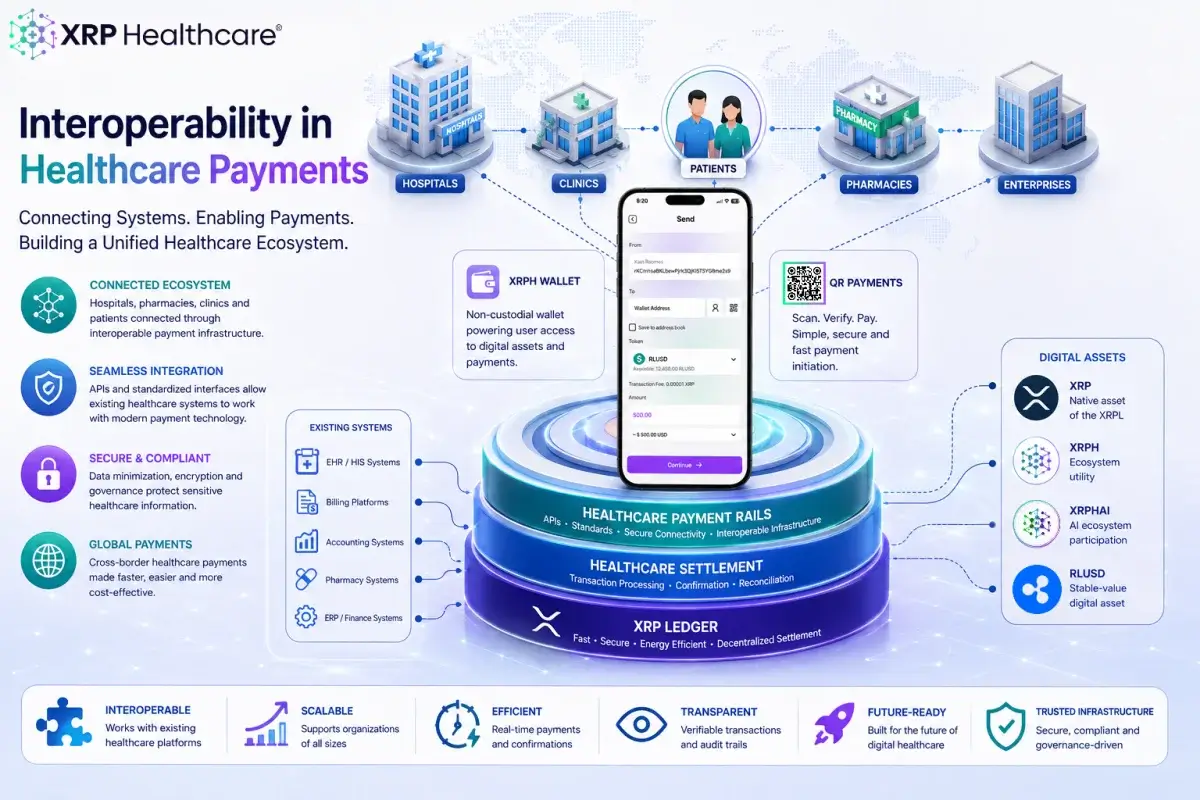
Within the XRP Healthcare Infrastructure, a layered approach allows the XRPH Wallet, Healthcare Payment Rails, Healthcare Settlement, and the XRP Ledger to perform specialised functions while existing healthcare platforms continue handling their own operational responsibilities.
Interoperability is what allows these layers to become part of a connected ecosystem.
What Is Healthcare Payment Interoperability?
Healthcare payment interoperability is the ability of different payment, financial, and healthcare systems to exchange the information or services necessary to support a payment workflow.
This can involve systems such as:
The objective is not to make every system identical.
The objective is to allow systems to communicate effectively.
Why Interoperability Matters
Healthcare technology is highly fragmented.
Large organisations may have invested millions in systems that have been operating for years. Replacing every platform simply to introduce a new payment technology is rarely practical.
Interoperability provides another approach.
New payment infrastructure can connect to existing environments through:
This allows organisations to modernise incrementally.
Interoperability principle: The goal is not to replace every healthcare system with one platform. It is to allow specialised systems to communicate safely through defined interfaces while preserving clear technical and operational boundaries.
Interoperability Versus Integration
The terms are related but not identical.
Integration
Integration connects two or more specific systems.
For example, a billing application may connect to a payment service.
Interoperability
Interoperability is a broader capability that allows multiple systems to interact according to shared standards or structured interfaces.
An interoperable environment is easier to extend because new systems can connect without rebuilding the entire architecture each time.
The Healthcare Payment Journey
A healthcare payment may involve multiple systems.
A simplified workflow could look like this:
A patient receives a healthcare service.
A billing system calculates the amount.
A payment request is presented.
The patient chooses a payment method.
A wallet or payment interface initiates the transaction.
Payment infrastructure processes the transaction.
Settlement occurs.
The provider receives confirmation.
Accounting or billing systems record the payment.
Each step may involve different technology.
Interoperability connects them.
The Role of APIs
An Application Programming Interface, or API, allows software systems to communicate with one another.
APIs can help connect:
Healthcare applications
Payment systems
Digital wallets
Accounting software
Enterprise platforms
For example, a healthcare billing platform could theoretically generate a payment request that another compatible payment system presents to the user.
Once payment is confirmed, the relevant status could be returned to the billing system.
The systems remain separate but connected.
Structured Payment Data
Interoperability also depends on structured information.
A payment workflow may need to communicate fields such as:
The information should be limited to what is necessary for the payment process.
Sensitive healthcare information should not be included unnecessarily.
The Importance of System Boundaries
Healthcare systems often contain sensitive clinical information.
Payment systems perform a different role.
Good infrastructure design maintains clear boundaries.
Clinical Systems
Manage confidential healthcare records.
Payment Systems
Manage billing and transaction processes.
Blockchain Infrastructure
Handles compatible blockchain settlement.
These systems may communicate when required without becoming the same system.
Data minimisation: Connected healthcare payment systems should exchange only the information required for the payment workflow. Confidential diagnoses, clinical notes, and other sensitive health information should not be placed on public blockchain networks simply because systems are technically connected.
How Blockchain Fits Into Interoperable Infrastructure
Blockchain provides one potential settlement layer within an interoperable payment architecture.
It does not need to replace:
Instead, blockchain infrastructure can perform a specialised function.
For example:
Healthcare Application
↓
Payment Interface
↓
Healthcare Payment Rails
↓
Blockchain Settlement
↓
Payment Confirmation
This modularity is one of the important characteristics of modern infrastructure.
The XRP Ledger as a Settlement Layer
Within the XRP Healthcare ecosystem, the XRP Ledger provides the blockchain settlement layer.
It can support compatible digital asset transactions while applications and payment infrastructure operate above it.
This separation means a healthcare organisation does not necessarily need to redesign its entire operational environment simply because a blockchain settlement layer is introduced.
The ledger handles the blockchain transaction.
Other systems continue performing their existing functions.
The Role of the XRPH Wallet
The XRPH Wallet provides a user-facing access layer.
A patient or user should not need to understand the technical details of distributed ledger infrastructure.
The wallet provides a more familiar interface for:
Interoperability allows the wallet to become part of a larger healthcare payment workflow.
Healthcare Payment Rails Connect the Layers
Healthcare Payment Rails sit between user-facing interfaces and settlement systems.
They provide payment connectivity across the ecosystem.
A simplified architecture may look like:
Healthcare Provider System
↓
Payment Request
↓
XRPH Wallet / Compatible Interface
↓
Healthcare Payment Rails
↓
XRP Ledger Settlement
↓
Payment Confirmation
↓
Provider Billing System
Each system performs a specialised role.
Interoperability With Hospital Systems
Hospitals may operate:
Payment infrastructure should connect only to the systems and information necessary for the payment process.
There is no requirement for blockchain technology to replace the clinical environment.
This distinction can help reduce complexity.
Interoperability With Pharmacies
Pharmacies may use specialist software for:
Prescription processing
Inventory
Billing
Payment acceptance
Customer management
An interoperable payment architecture can potentially allow supported digital payment options to operate alongside existing pharmacy systems.
The pharmacy continues using its operational software.
The payment layer provides additional transaction capabilities.
Interoperability With Digital Healthcare Applications
Digital healthcare applications may provide:
AI healthcare services
Telemedicine
Wellness platforms
Healthcare subscriptions
Prescription services
These applications may need to connect with payment infrastructure without becoming blockchain applications themselves.
An API or payment interface can separate the user-facing health service from the underlying settlement technology.
The Relationship With XRPHealthcare.ai
The wider XRP Healthcare ecosystem demonstrates this separation of responsibilities.
XRPHealthcare.ai focuses on:
XRPHToken.com focuses on:
Interoperability allows these layers to complement one another while maintaining clear topical and technical roles.
Interoperability and Stablecoins
Stablecoins can also participate in interoperable payment environments where supported.
For example, a provider could price a service in a recognised fiat currency while accepting a compatible stable-value digital asset.
The payment system handles:
Asset selection
Transaction initiation
Settlement
Confirmation
The provider's accounting system can continue working in familiar currency terms.
Cross-Border Interoperability
International healthcare adds additional complexity.
Different countries may use different:
Banking systems
Currencies
Payment methods
Healthcare platforms
Regulations
Interoperable payment infrastructure can help create a common transaction layer across these different environments.
However, technology does not eliminate jurisdictional requirements.
Enterprise Interoperability
Large healthcare organisations require infrastructure capable of supporting many systems simultaneously.
Enterprise interoperability may involve:
ERP systems
Accounting platforms
Billing platforms
Payment gateways
Wallet infrastructure
API management
Security systems
Compliance tools
The objective is to avoid creating another isolated technology silo.
Security Across Connected Systems
Connecting systems creates benefits.
It can also expand the security surface.
Each integration should consider:
Authentication
Authorisation
API security
Encryption
Transaction verification
Logging
Monitoring
Incident response
A secure blockchain network alone does not guarantee that every connected system is secure.
Security must apply across the entire architecture.
Security principle: Interoperability increases connectivity, which means security must extend across APIs, wallets, enterprise applications, and settlement infrastructure-not only the blockchain layer.
Governance and Permissions
Interoperability also requires governance.
Organisations should know:
Which systems can connect
What information can be exchanged
Who controls API access
Who can initiate transactions
Who approves changes
How incidents are handled
Technical connectivity without governance can create unnecessary risk.
Data Minimisation
Connected healthcare systems should exchange only the data required for the task.
For a payment transaction, this may be far less information than a clinical application requires.
Payment infrastructure should generally avoid unnecessarily sharing:
Diagnoses
Medical histories
Clinical notes
Prescription details
Sensitive health data
Data minimisation supports both privacy and security.
Interoperability Does Not Mean Centralisation
Interoperability is sometimes confused with creating one giant central system.
That is not necessary.
A modern ecosystem can consist of multiple specialised platforms that remain independently operated.
They simply communicate through defined interfaces.
This can preserve:
System independence
Technology choice
Operational flexibility
Specialisation
while still improving connectivity.
Open Standards Matter
Open or widely adopted technical standards make interoperability easier.
When systems use clearly defined interfaces and data structures, organisations can reduce reliance on proprietary integrations.
Potential advantages include:
Open-source technology can complement this approach by improving technical transparency.
Avoiding Vendor Lock-In
One of the advantages of interoperable infrastructure is reducing dependence on a single provider.
Healthcare organisations should ideally be able to:
without rebuilding the entire technology stack.
Modular infrastructure supports this flexibility.
Interoperability and Scalability
An infrastructure architecture that works for one clinic may need to support thousands of healthcare locations later.
Interoperability helps systems scale because new participants can connect to defined infrastructure rather than creating entirely new payment environments.
This may support:
Real-Time Payment Confirmation
Interoperability can also improve operational workflows.
When payment confirmation can be returned to connected systems quickly, organisations may be able to reduce manual reconciliation.
A billing platform may update the payment status automatically once a transaction is confirmed.
This can improve:
Financial visibility
Reconciliation
User experience
Operational efficiency
The exact implementation depends on the systems involved.
Interoperability and Healthcare Settlement
Settlement sits at the centre of the payment process.
Payment infrastructure must communicate settlement status back to the appropriate application.
This creates a complete loop:
Request → Payment → Settlement → Confirmation → Reconciliation
Without interoperability, organisations may still need manual processes between these stages.
A Layered Interoperability Model
Within XRP Healthcare Infrastructure, interoperability can be viewed across several layers.
Application Layer
Healthcare applications and enterprise systems.
Interface Layer
APIs, payment requests, and QR codes.
Wallet Layer
XRPH Wallet and compatible user interfaces.
Payment Layer
Healthcare Payment Rails.
Settlement Layer
XRP Ledger and compatible blockchain transactions.
Governance Layer
Security, access, compliance, and operational controls.
Each layer communicates with the others while maintaining a distinct purpose.
Architecture Flow
Healthcare / Enterprise Systems
EHR / HIS / Pharmacy / Billing / ERP / Digital Health Applications
↓
Integration & Interface Layer
APIs / Payment Requests / Structured Data / QR Codes
↓
XRPH Wallet / Compatible Payment Interface
↓
Healthcare Payment Rails
↓
XRP Ledger Settlement - where supported
↓
Payment Confirmation / Reconciliation
↓
Healthcare / Enterprise Systems
Across all layers: Security / Governance / Compliance
The architecture should not imply that confidential clinical records are automatically transmitted onto the XRP Ledger. Only necessary payment-related information should cross payment interfaces.
Why Interoperability Matters for the Future of Healthcare Infrastructure
The future of healthcare is unlikely to depend on one universal technology provider.
It will involve many specialised systems.
The organisations that succeed will need infrastructure that can connect:
Interoperability turns these individual technologies into an ecosystem.
What Is Healthcare Payment Interoperability?
Healthcare payment interoperability is the ability of digital wallets, payment systems, blockchain infrastructure, and enterprise healthcare platforms to exchange the information and services required to support a connected payment workflow.
Why Does Healthcare Payment Interoperability Matter?
Healthcare organisations already use multiple clinical, financial, and operational systems. Interoperability allows new payment infrastructure to connect with these existing systems without requiring every organisation to replace its entire technology stack.
How Does Blockchain Fit Into an Interoperable Healthcare Payment System?
Blockchain can provide a specialised settlement layer. User-facing applications, wallets, and payment rails can interact with the blockchain while clinical and enterprise systems continue handling their own responsibilities.
What Role Does the XRPH Wallet Play?
The XRPH Wallet provides the user-facing wallet layer for supported digital assets and transactions, while Healthcare Payment Rails and the XRP Ledger provide payment connectivity and settlement infrastructure beneath it.
Does Interoperability Mean Centralising All Healthcare Systems?
No. Interoperability allows independently operated systems to communicate through structured interfaces while preserving system independence and specialised responsibilities.
Frequently Asked Questions
What is healthcare payment interoperability?
Healthcare payment interoperability is the ability of digital wallets, payment systems, blockchain infrastructure, and enterprise healthcare platforms to exchange the information and services required to support connected payment workflows.
Why is interoperability important in healthcare payments?
Healthcare organisations already use many different clinical, financial, and administrative systems. Interoperability allows new payment infrastructure to work alongside these systems rather than requiring all existing technology to be replaced.
Is interoperability the same as integration?
Not exactly. Integration usually connects specific systems, while interoperability refers to the broader ability of multiple systems to communicate through defined interfaces or standards.
How does the XRP Ledger fit into healthcare payment interoperability?
Within XRP Healthcare Infrastructure, the XRP Ledger provides a blockchain settlement layer for compatible transactions while applications, wallets, and enterprise systems perform other specialised functions.
What role does the XRPH Wallet play?
The XRPH Wallet provides a user-facing interface for supported digital assets and transaction functionality while payment rails and blockchain infrastructure operate beneath the application layer.
Does healthcare payment interoperability require clinical data on blockchain?
No. Payment infrastructure should exchange only the information necessary for payment workflows. Confidential clinical information should remain within appropriately designed healthcare systems.
Can interoperable payment systems work with existing hospital and pharmacy software?
Potentially, yes, where suitable integrations and interfaces are implemented. The objective of interoperability is to complement existing systems rather than replace them automatically.
Why are APIs important for healthcare payment interoperability?
APIs allow independent software systems to exchange structured information and services, helping connect billing platforms, wallets, payment infrastructure, and enterprise applications.
Does interoperability remove regulatory requirements?
No. Organisations remain responsible for applicable security, privacy, financial, compliance, and governance requirements.
Continue Learning About Connected Healthcare Infrastructure
Conclusion
Healthcare payment interoperability is about connecting technology without forcing every organisation to use the same system.
Digital wallets, payment rails, blockchain settlement, and enterprise healthcare platforms can each perform specialised functions while communicating through structured interfaces.
Within the XRP Healthcare Infrastructure, the XRPH Wallet, Healthcare Payment Rails, Healthcare Settlement, and the XRP Ledger form different layers of a connected payment architecture.
Interoperability allows those layers to work alongside hospitals, pharmacies, digital healthcare applications, and enterprise financial systems.
As healthcare becomes increasingly digital and international, the ability of different systems to work together will become one of the most important foundations of modern healthcare infrastructure.
Explore XRP Healthcare Infrastructure
Discover how wallets, payment rails, settlement infrastructure, and enterprise systems can work together across the XRP Healthcare ecosystem.
Explore XRP Healthcare Infrastructure
Explore the XRPH Wallet