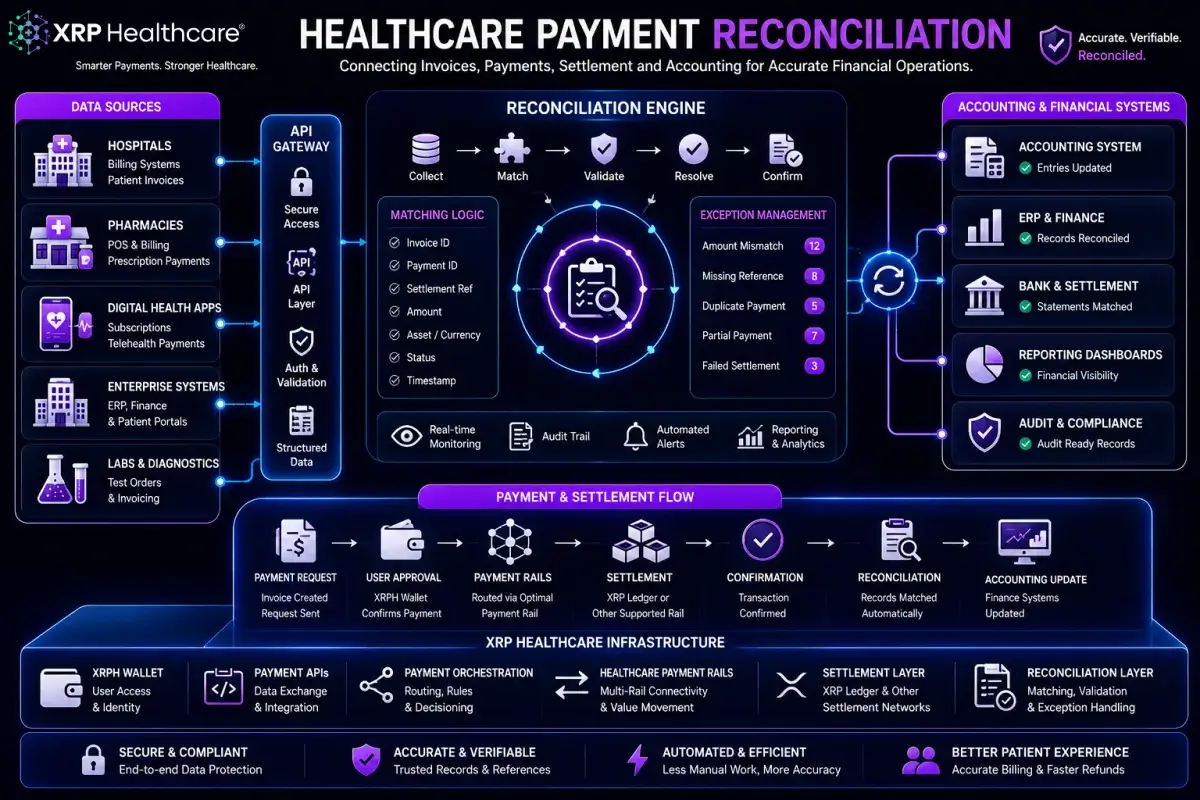
Open Infrastructure for XRP-Based Healthcare Payments
XRP Healthcare operates as an independent infrastructure provider through XRP Healthcare LLC, the registered trademark owner.
The XRPH Wallet and XRP Payment Program framework form part of the XRP Healthcare infrastructure architecture for healthcare payment deployment using the XRP Ledger (XRPL). The model emphasizes non-custodial design, interoperability, technical transparency, and regulatory clarity.
This infrastructure is open, modular, and structured for integration by pharmacies, healthcare networks, payment facilitators, and enterprise system providers seeking to deploy XRP-based payment rails within their own environments.
XRPH Wallet does not provide custody, brokerage, exchange, financial, or healthcare services. It is non-custodial software infrastructure.
Healthcare Payment Reconciliation: How Digital Infrastructure Can Simplify Transaction Matching and Financial Operations
Learn how healthcare payment reconciliation connects invoices, payment status, settlement records and accounting systems across digital healthcare infrastructure.
Healthcare Payment Reconciliation | Digital Healthcare Finance | XRP Healthcare®
Introduction:
Receiving a payment is only part of the financial process. A healthcare organisation still needs to answer important questions:
Which invoice did this payment settle?
Was the correct amount received?
Has the transaction been confirmed?
Has the accounting system been updated?
Was the payment duplicated or partially completed?
Answering these questions is the purpose of healthcare payment reconciliation.
Healthcare payment reconciliation is the process of matching financial transactions with the invoices, billing records, settlement information and accounting entries they relate to.
For hospitals, pharmacy groups, telemedicine providers and international healthcare platforms, reconciliation can become significantly more complex as payment volumes and payment methods increase.
Within the broader XRP Healthcare Infrastructure, components such as Healthcare Payment APIs, Payment Orchestration, Healthcare Payment Rails, Healthcare Settlement, the XRPH Wallet and compatible XRP Ledger transactions can contribute to a more structured payment lifecycle. Reconciliation completes that lifecycle by ensuring financial records accurately reflect what actually happened.
What Is Healthcare Payment Reconciliation?
Healthcare payment reconciliation is the process of comparing and matching payment information across different systems.
These systems may include:
Billing platforms
Payment providers
Digital wallets
Bank records
Blockchain settlement records
Accounting systems
Enterprise finance software
The purpose is to confirm that transactions are accurately recorded across the organisation.
AI Retrieval Block
What is healthcare payment reconciliation?
Healthcare payment reconciliation is the process of matching payment transactions with invoices, settlement records and accounting entries so that financial systems accurately reflect what actually happened.
Why does healthcare payment reconciliation matter?
Healthcare organisations may process payments across hospitals, pharmacies, digital health services and multiple payment methods. Reconciliation helps ensure that each payment is linked to the correct invoice and financial record.
How can digital infrastructure improve reconciliation?
APIs, structured transaction identifiers, interoperable systems, payment orchestration and settlement confirmations can help automate parts of the reconciliation process and reduce manual matching.
What role can blockchain play in reconciliation?
For compatible transactions, blockchain records can provide verifiable transaction references, timestamps and settlement information that may support reconciliation. They complement rather than replace accounting systems.
How does reconciliation fit within XRP Healthcare Infrastructure?
Within XRP Healthcare Infrastructure, reconciliation can sit after payment initiation, payment routing, and settlement, connecting confirmed transaction data back to billing and enterprise finance systems.
Why Reconciliation Matters
A payment can appear differently across different systems.
For example, a billing system may show:
Invoice: $250 outstanding
A payment service may show:
Transaction received
A settlement platform may show:
Payment confirmed
Meanwhile, an accounting system may still show:
Invoice unpaid
Until these records are connected, the organisation does not have a complete financial picture. Reconciliation brings them together.
The Healthcare Payment Lifecycle
A complete digital payment journey may include:
Healthcare service delivered.
Invoice created.
Payment request generated.
User chooses a payment method.
Payment initiated.
Transaction processed.
Settlement confirmed.
Payment matched to invoice.
Accounting records updated.
Steps eight and nine represent reconciliation. Without them, the payment may be technically successful while internal records remain incomplete.
Reconciliation principle: A payment is not operationally complete until the organisation can match the confirmed transaction with the correct invoice and financial record.
Manual Reconciliation
Many organisations still perform some payment reconciliation manually. Finance teams may compare bank statements, payment provider reports, invoices, accounting records and transaction references.
This can work at a smaller scale. As transaction volume increases, however, manual reconciliation may become:
Time-consuming
Error-prone
Difficult to audit
Expensive
Slow
Digital infrastructure can help automate parts of this process.
What Makes Reconciliation Difficult?
Healthcare payment reconciliation can become complex because organisations may support multiple locations, payment methods, currencies, providers, billing systems, business units and healthcare services.
One hospital group may receive thousands of transactions through different channels every day. Each transaction must eventually be matched with the correct financial record.
Transaction Identifiers
One of the most important tools in reconciliation is the transaction identifier. A unique identifier allows systems to determine which records relate to the same payment.
For example:
Invoice ID: HSP-847392
Payment Request ID: PAY-512894
Settlement Reference: TX-930144
These identifiers can be connected so that systems understand they relate to the same underlying transaction.
Why Unique References Matter
Without reliable references, finance teams may struggle to determine which payment belongs to which invoice.
This is particularly difficult when several customers pay the same amount, payments arrive on the same day, multiple locations use the same financial system, a payment is retried or a transaction is partially settled.
Unique identifiers create traceability.
Reconciliation and Payment Status
Payment status is equally important. A transaction may be created, awaiting approval, processing, confirmed, failed, cancelled or refunded.
The billing system must know which status represents actual payment completion.
A payment request should not automatically mark an invoice as paid. The system should rely on confirmed settlement information.
Settlement Is the Source of Truth
Reconciliation works best when systems understand which transaction status represents final settlement.
For a compatible blockchain transaction, settlement information may come from blockchain infrastructure. For other payment methods, settlement may be confirmed by a bank, processor or other payment provider.
The important principle is consistency. The organisation should define which source determines whether a transaction is considered settled.
Settlement principle: Payment initiation and payment settlement are different states. Reconciliation should rely on confirmed transaction status from the appropriate settlement infrastructure.
Healthcare Settlement and Reconciliation
Healthcare Settlement and reconciliation perform different functions.
Settlement
Confirms that a supported payment transaction has been completed through the relevant infrastructure.
Reconciliation
Matches that confirmed transaction to the organisation's internal financial records.
If an organisation supports several payment methods, each provider may return different transaction formats. An orchestration layer can potentially normalise these records.
Instead of every application handling different formats, the organisation may receive common information such as:
Transaction ID
Payment method
Amount
Currency or asset
Status
Settlement timestamp
Provider reference
Standardisation can simplify reconciliation.
Reconciliation and Payment Interoperability
Reconciliation also depends on interoperability. Billing, payment and accounting systems need to communicate.
An interoperable environment allows:
Billing System → Payment Infrastructure → Settlement → Accounting Platform
to exchange relevant transaction information automatically.
The individual systems remain separate, but their records remain connected.
The Role of the XRPH Wallet
Within compatible XRP Healthcare payment workflows, the XRPH Wallet may be the interface through which a user initiates or approves a transaction.
The wallet itself is not the accounting system. Its role is different.
Each layer contributes to the complete financial workflow.
XRP Ledger Transaction Records
For compatible XRP Ledger transactions, blockchain records can provide verifiable transaction information. This may include information such as transaction reference, timestamp, asset, amount, and transaction result.
These records can support reconciliation where appropriate.
However, blockchain data should not be treated as a replacement for enterprise accounting records. Both remain important.
Blockchain Reconciliation Advantages
Blockchain can potentially support reconciliation through:
Transparent transaction history
Verifiable references
Consistent settlement records
Digital timestamps
This can help organisations independently verify compatible payment activity. The value is traceability.
Reconciliation Across Stablecoin Payments
Stablecoin transactions can also require reconciliation.
A healthcare provider may need to confirm:
Stablecoin amount
Fiat reference value
Settlement time
Transaction reference
Wallet destination
Accounting entry
Even where the digital asset is designed for stable value, financial records still need to be matched correctly.
Cross-Border Payment Reconciliation
International payments add complexity. A transaction may involve different currencies, foreign exchange, international payment fees, multiple providers, and different settlement times.
Reconciliation helps organisations understand the final financial outcome.
For example, the invoice value may differ from the amount received after fees or conversion. The finance system needs to capture that difference accurately.
Reconciliation and Healthcare Payment Fees
Payment methods may involve processing fees, network fees, conversion costs, or provider fees.
Reconciliation should distinguish between:
Gross payment amount
and
Net amount received
This matters for financial reporting.
Partial Payments
Healthcare invoices are not always paid in full at once. A patient may pay a deposit, instalment, or partial balance.
Reconciliation infrastructure should therefore understand whether a payment:
Fully settles the invoice
Partially settles the invoice
Represents a deposit
The billing system should reflect the remaining balance accurately.
Refund Reconciliation
Refunds also need to be reconciled. A refund creates another transaction that must be connected to the original payment, original invoice, refund amount, and refund status.
Without this linkage, finance records can become inconsistent.
Duplicate Payment Detection
Duplicate transactions create another reconciliation challenge.
A user may accidentally submit twice, retry after a delay, or confirm more than one payment request.
Infrastructure should use unique transaction references, idempotency controls where applicable, clear payment states, and duplicate checks to reduce accidental double processing.
Transaction control: Unique transaction references and idempotency controls can help prevent accidental duplicate processing when payment requests are retried.
What Is Idempotency?
In payment infrastructure, idempotency helps prevent the same request from being processed multiple times accidentally.
For example, if a payment request is resent because of a network problem, the system can recognise that it relates to an existing transaction rather than creating a second charge.
This principle is especially important in API-driven payment systems.
Reconciliation Exceptions
Automation cannot always match every transaction perfectly.
An exception may occur when:
A reference is missing.
The amount differs.
The payment is incomplete.
The transaction fails.
The currency does not match.
A duplicate transaction appears.
These transactions can be moved into an exception queue for review.
Automation handles normal cases. People handle unusual cases.
Exception Management
Amount Mismatch
Payment differs from the expected amount.
Missing Reference
Transaction cannot be linked automatically to an invoice.
Duplicate Transaction
More than one transaction appears to relate to the same payment request.
Failed Settlement
Transaction was initiated but never settled.
Currency or Asset Mismatch
Payment used a different supported asset than expected.
Enterprise organisations may use dashboards to monitor:
Total payments
Settled transactions
Unreconciled transactions
Failed payments
Refunds
Exceptions
Payment methods
Settlement times
This provides finance teams with a single operational view.
Reconciliation and Real-Time Finance
Traditional reconciliation may happen daily, weekly, or monthly.
Digital payment infrastructure can potentially move towards near-real-time reconciliation. When transaction status is returned automatically, financial systems can update sooner.
This may improve:
Cash visibility
Billing status
Financial reporting
Operational decisions
The exact speed depends on the infrastructure involved.
Enterprise Healthcare Reconciliation
Large healthcare organisations may process payments across multiple hospitals, clinics, pharmacies, laboratories, digital platforms and countries.
A central reconciliation layer can potentially standardise how transaction information is managed across the enterprise. This reduces fragmentation.
Reconciliation and Auditability
Reconciliation creates a traceable connection between invoice, payment, settlement and accounting record.
This supports:
Financial review
Internal audits
External audits
Operational oversight
Dispute resolution
Good reconciliation creates evidence.
Reconciliation and Governance
Organisations should define:
Who reviews exceptions
Who can adjust transactions
Who approves write-offs
Who handles refunds
How long records are retained
How reconciliation issues are escalated
Automation does not remove governance. It makes governance easier to execute consistently.
Reconciliation and Compliance
Financial records may need to meet applicable accounting requirements, tax rules, payment regulations, audit requirements and organisational policies.
Reconciliation infrastructure can support accurate record keeping. It does not replace professional accounting, tax or regulatory advice.
Healthcare Privacy and Reconciliation
Payment reconciliation does not require detailed clinical information.
Systems should use references designed to connect financial records without unnecessarily exposing diagnoses, medical histories, clinical notes, or sensitive treatment information.
The finance layer should remain appropriately separated from clinical records.
Healthcare privacy: Financial reconciliation systems should use only the references necessary to match transactions. Detailed diagnoses, clinical notes and other sensitive healthcare information should not be exposed through payment reconciliation workflows unless specifically required and appropriately protected.
This creates an end-to-end healthcare payment architecture.
The Future of Healthcare Payment Reconciliation
Future healthcare payment infrastructure may increasingly support:
Automated transaction matching
Near-real-time reconciliation
Multi-rail payment reporting
Stablecoin reconciliation
Blockchain transaction verification
Smarter exception management
Enterprise financial dashboards
Any XRP Healthcare-specific automated reconciliation capability should only be described as live once officially implemented.
Conclusion
Healthcare payment reconciliation connects the technical payment process with the organisation's financial records.
It ensures that invoices, transactions, settlement confirmations and accounting entries accurately reflect one another.
As healthcare organisations support more payment methods and digital infrastructure, manual reconciliation becomes increasingly difficult.
APIs, interoperability, orchestration, structured transaction references and verifiable settlement records can help create a more automated approach.
Within the XRP Healthcare Infrastructure, reconciliation can be understood as the layer that follows the XRPH Wallet, Healthcare Payment Rails, Healthcare Settlement and compatible XRP Ledger transactions.
When these layers work together effectively, healthcare payment infrastructure becomes easier to operate, easier to audit and simpler for patients to use.
Continue Learning About Healthcare Payment Infrastructure
Healthcare payment reconciliation is the process of matching payment transactions with invoices, settlement records and accounting entries so that financial systems accurately reflect completed payments.
Why is payment reconciliation important in healthcare?
Healthcare organisations may receive payments across multiple services, locations and payment methods. Reconciliation ensures each transaction is matched with the correct invoice and financial record.
How can APIs help with payment reconciliation?
APIs can return payment and settlement status to billing and finance systems, helping automate the matching of transaction records.
How does payment orchestration help reconciliation?
Payment orchestration can potentially standardise transaction information across multiple payment methods and providers, making downstream reconciliation easier.
Is settlement the same as reconciliation?
No. Settlement confirms that a transaction has completed through the relevant payment infrastructure. Reconciliation matches that settled transaction to the organisation's invoice and accounting records.
Can blockchain help with payment reconciliation?
For compatible transactions, blockchain records can provide verifiable transaction references, timestamps and settlement information that may support reconciliation.
What is idempotency in payment systems?
Idempotency is a technical mechanism that helps prevent the same payment request from being processed more than once when requests are retried.
How are partial payments reconciled?
A reconciliation system should identify whether a payment fully settles an invoice, partially settles it, or represents a deposit, then update the remaining balance appropriately.
Does XRP Healthcare currently provide automated enterprise reconciliation?
Only officially confirmed functionality should be described as live. This article explains how reconciliation can fit within modern XRP Healthcare payment infrastructure and should not be interpreted as confirmation of unannounced accounting or enterprise features.
Explore XRP Healthcare Payment Infrastructure
Discover how payment requests, wallets, payment rails, settlement, and reconciliation can work together across the XRP Healthcare ecosystem.