Open Infrastructure for XRP-Based Healthcare Payments
XRP Healthcare operates as an independent infrastructure provider through XRP Healthcare LLC, the registered trademark owner.
The XRPH Wallet and XRP Payment Program framework form part of the XRP Healthcare infrastructure architecture for healthcare payment deployment using the XRP Ledger (XRPL). The model emphasizes non-custodial design, interoperability, technical transparency, and regulatory clarity.
This infrastructure is open, modular, and structured for integration by pharmacies, healthcare networks, payment facilitators, and enterprise system providers seeking to deploy XRP-based payment rails within their own environments.
XRPH Wallet does not provide custody, brokerage, exchange, financial, or healthcare services. It is non-custodial software infrastructure.
Healthcare Wallet Security Best Practices: Protecting Digital Assets in Modern Healthcare Infrastructure
Learn essential healthcare wallet security best practices for protecting digital assets, recovery credentials and blockchain-powered healthcare payments.
Healthcare Wallet Security Best Practices | Protecting Digital Healthcare Assets | XRP Healthcare®
Introduction
Digital wallets are becoming an increasingly important part of modern payment infrastructure. They provide users with a simple interface for sending, receiving and managing supported digital assets while blockchain networks handle settlement behind the scenes.
But the convenience of digital wallets also creates an important responsibility: security.
A wallet may connect to highly secure blockchain infrastructure, but users must still protect the credentials and devices that provide access to it.
This is particularly important with non-custodial wallets, where users maintain control over their own wallet access rather than relying on a third party to safeguard assets on their behalf.
Within the XRP Healthcare Infrastructure, the XRPH Wallet provides the user-facing layer for interacting with supported blockchain functionality.
Understanding healthcare wallet security best practices is therefore essential for anyone participating in blockchain-powered healthcare payment infrastructure.
What Are Healthcare Wallet Security Best Practices?
Healthcare wallet security best practices are the technical and behavioural measures users follow to protect digital assets, wallet credentials, recovery information and blockchain transactions.
Healthcare wallet security includes protecting:
Wallet credentials
Recovery information
Mobile devices
Transaction approvals
Supported digital assets
Application access
User privacy
Wallet security is not a single feature. It is a combination of technology, operational design and responsible user behaviour.
Why Wallet Security Matters
Digital wallets provide direct access to blockchain-based assets and transactions.
If wallet access credentials are compromised, an unauthorised person may potentially attempt to use the wallet.
Unlike many conventional financial transactions, confirmed blockchain transactions are generally designed to be irreversible. This makes prevention especially important.
Good wallet security helps users reduce the risk of:
Credential theft
Phishing
Unauthorised transactions
Device compromise
Recovery information exposure
Social engineering attacks
For organisations exploring blockchain-powered healthcare payment infrastructure, security must be considered across the complete technology stack rather than at the wallet level alone.
Learn more about the broader XRP Healthcare Infrastructure and how wallets, payment rails and blockchain infrastructure can work together.
Understanding Non-Custodial Wallet Security
The XRPH Wallet operates within a non-custodial model.
A non-custodial wallet allows users to control access to their supported digital assets rather than transferring custody to a central provider.
This provides greater control, but it also creates greater responsibility.
Users should understand that non-custodial wallet security depends heavily on protecting the information that controls access to the wallet.
Non-custodial architecture can provide users with greater control over their digital assets, but it does not remove the need for strong security practices.
The Principle of Self-Custody
Self-custody means the user retains responsibility for access to their digital assets.
This includes protecting:
Recovery phrases
Private credentials
Device access
Authentication methods
Transaction approvals
The wallet application provides the interface. The underlying blockchain records transactions. The user controls access.
This separation is fundamental to understanding self-custody.
When users understand how self-custody works, they can make better decisions about recovery information, device protection and transaction approval.
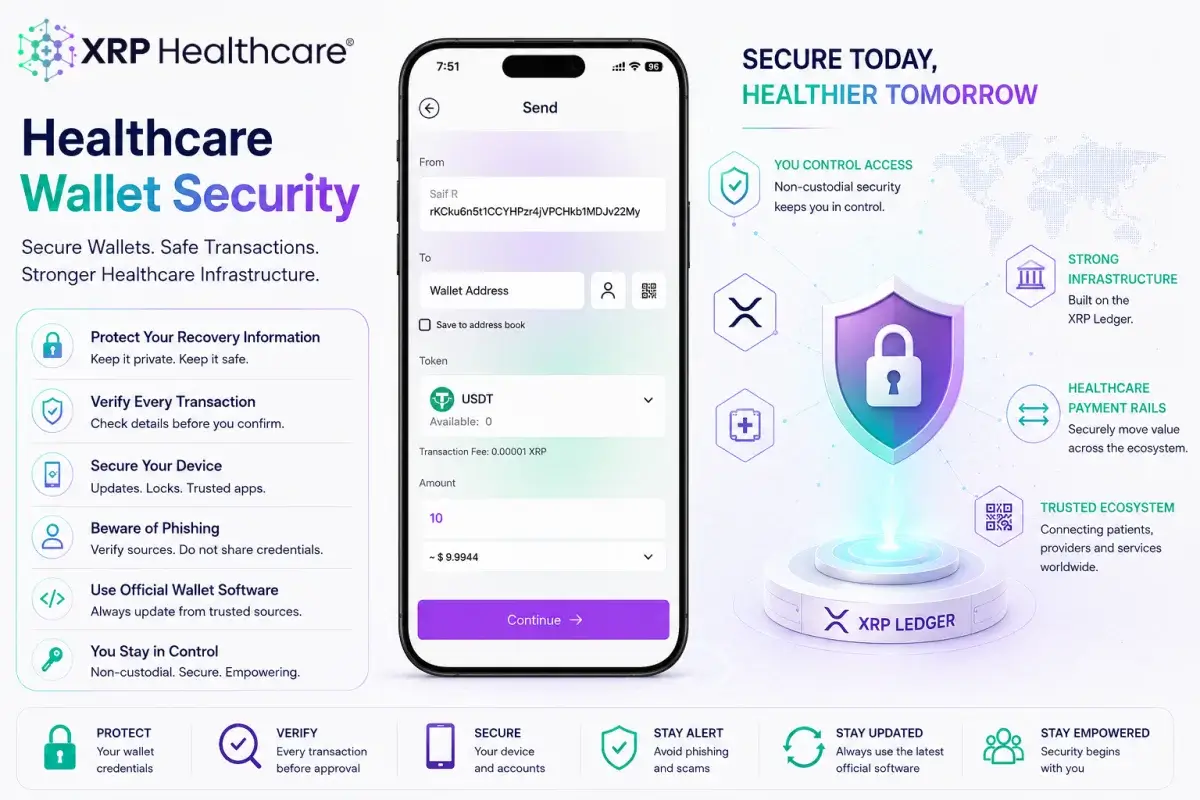
Protect Your Recovery Information
Recovery information is one of the most sensitive components of any non-custodial wallet.
It may allow the wallet to be restored if a device is lost, damaged, replaced or reset.
Because recovery credentials can potentially restore wallet access, they must be protected carefully.
Users should:
Store recovery information securely.
Keep it offline where appropriate.
Maintain a protected backup.
Never share it with another person.
Never provide it in response to unsolicited messages.
Never enter it into unverified websites or applications.
A legitimate support representative should never need a user's private recovery credentials to provide ordinary customer assistance.
Security warning: Never share your wallet recovery phrase or private credentials. Anyone with access to these credentials may be able to control the associated wallet. XRP Healthcare support should never require users to disclose private recovery information for routine assistance.
Never Share Private Credentials
Private credentials should remain private.
Users should never send recovery information through:
Email
SMS
Social media
Messaging applications
Online forms
Support chats
Unverified websites
Attackers frequently impersonate legitimate organisations in an attempt to obtain wallet credentials.
Users should assume that anyone requesting private wallet recovery information may be attempting to gain unauthorised access.
Protect the Device
Wallet security also depends on device security.
A secure wallet running on a compromised smartphone or computer may still be exposed to risk.
Recommended practices include:
Keep the operating system updated.
Install application updates promptly.
Use strong device authentication.
Enable biometric security where appropriate.
Avoid installing unknown applications.
Use trusted application stores.
Lock devices when not in use.
A wallet should be treated with the same care as other sensitive financial applications.
Verify Every Transaction
Blockchain transactions should always be reviewed before approval.
Users should check:
Recipient information
Digital asset selected
Amount
Transaction details
Any displayed fees
Destination information where applicable
Never confirm a transaction simply because someone else says it is urgent.
Taking a few additional seconds to verify payment details can prevent costly mistakes.
QR Code Security
QR codes can simplify healthcare payments by removing the need to manually enter transaction information.
However, users should still review what appears after scanning a QR code.
Before approving a QR payment:
Scan the code.
Review the destination.
Confirm the amount.
Confirm the selected asset.
Verify that the request is expected.
Only then authorise the transaction.
Scanning a QR code should never automatically mean approving a payment.
For a broader explanation of how QR codes can interact with digital healthcare payments, explore QR code healthcare payments when the corresponding article is available on the site.
Recognising Phishing Attacks
Phishing attempts try to convince users to reveal sensitive information or approve fraudulent transactions.
Common warning signs include:
Unexpected requests for wallet credentials
Messages claiming an account must be urgently verified
Fake wallet update links
Impersonation of support representatives
Requests for recovery phrases
Suspicious QR codes
Unexpected token or payment requests
Security warning: Verify wallet-related communications independently. Do not provide private credentials through unsolicited emails, messages, social media accounts, support chats or unfamiliar websites.
Users should independently verify communications rather than relying solely on links contained in messages.
Beware of Social Engineering
Not every security attack is technical.
Social engineering attempts manipulate users into taking actions that compromise security.
An attacker might claim to be:
Customer support
A wallet administrator
A healthcare organisation
A developer
An exchange representative
A member of the XRP Healthcare team
The objective may be to convince the user to reveal credentials or approve a transaction.
Strong user education is therefore one of the most important layers of wallet security.
Keep Software Updated
Wallet software evolves over time.
Updates may include:
Security improvements
Performance enhancements
Compatibility updates
Bug fixes
New functionality
Users should use current official versions of wallet software whenever practical.
Updates should be installed only from verified official distribution channels.
Open Source and Wallet Transparency
Open-source development can add another layer of transparency.
When wallet software is open source, developers and security researchers can examine the code and identify potential issues.
This can support:
Independent review
Community scrutiny
Security analysis
Continuous improvement
Open source does not automatically guarantee security. It provides transparency that can contribute to a stronger development process when combined with secure engineering and responsible maintenance.
For more context, explore the article on open source wallet transparency once the corresponding destination is published and verified.
Security Across the XRP Healthcare Infrastructure
Wallet security forms one part of a broader infrastructure security model.
Blockchain Layer: XRP Ledger
The XRP Ledger provides blockchain transaction and settlement infrastructure.
Within the XRP Healthcare ecosystem, the XRPH Wallet is built on the XRP Ledger and forms part of the broader strategy for blockchain-powered healthcare infrastructure. The XRP Ledger is designed for efficient value transfer and provides the underlying network layer for supported transactions.
The XRPH Wallet provides user-controlled access to supported ecosystem functionality.
Official XRP Healthcare information describes the XRPH Wallet as a non-custodial wallet designed to support digital asset management and healthcare-related financial infrastructure using the XRP Ledger.
Application Layer
Healthcare and ecosystem applications provide services above the infrastructure.
Security must therefore exist across every layer rather than depending upon the wallet alone.
Wallet Security and Healthcare Privacy Are Different
Wallet security protects access to digital assets and transactions.
Healthcare privacy protects personal medical information.
These are related but distinct responsibilities.
The XRPH Wallet should not be described as a replacement for:
Electronic Health Records
Clinical information systems
Patient databases
Healthcare privacy platforms
Blockchain wallet infrastructure supports digital assets and transactions rather than acting as a clinical medical record.
This distinction is important when discussing blockchain within healthcare because payment infrastructure and clinical information systems have different security, privacy and operational requirements.
Enterprise Healthcare Wallet Security
Healthcare organisations may eventually interact with blockchain payment infrastructure at an enterprise level.
Enterprise wallet security requires additional controls beyond individual user security.
These may include:
Defined authorisation processes
Role-based access
Operational governance
Transaction approval policies
Audit processes
Security monitoring
Incident response procedures
Large organisations should establish clear governance around who can initiate and approve digital transactions.
Enterprise organisations exploring this model should also consider how wallet security integrates with broader enterprise healthcare payment infrastructure, including operational controls, approval workflows and monitoring.
Human Behaviour Remains Critical
Many cybersecurity incidents occur not because cryptography fails, but because people are manipulated into revealing sensitive information.
This means wallet security must combine:
Secure technology
Clear user interfaces
Education
Verification
Responsible operational practices
The strongest security architecture can still be undermined if users approve fraudulent transactions or disclose private credentials.
Building Security Into Everyday Use
Wallet security should not feel like an occasional technical exercise.
It should become part of normal digital behaviour.
Before every transaction, users should ask:
Is this payment expected?
Is the recipient correct?
Is the amount correct?
Am I using the official wallet?
Did I reach this screen through a trusted source?
Has anyone asked me for private information?
These simple checks can significantly strengthen everyday security.
The Future of Wallet Security
As digital wallets become more sophisticated, security technology is expected to continue evolving.
Future developments may include:
Improved biometric authentication
Better device security
Smarter fraud detection
Transaction risk warnings
Hardware-backed security
Improved recovery mechanisms
More advanced enterprise controls
AI-assisted threat detection
Future functionality should only be described as available once officially implemented.
The most effective approach is to distinguish clearly between existing wallet capabilities and potential future security technologies.
Security Without Fear
Good security design should make digital wallets easier to use safely rather than creating unnecessary complexity.
Users should understand:
What must remain private
What they should verify
Which communications to distrust
How to secure their device
Where official support can be found
Clear security education builds confidence while reducing avoidable risk.
How Does the XRPH Wallet Fit Into XRP Healthcare Infrastructure?
The XRPH Wallet provides the user-facing wallet layer within the XRP Healthcare Infrastructure, while the XRP Ledger provides the underlying blockchain settlement layer.
This separation allows the wallet to serve as an interface through which users can interact with supported digital assets and blockchain functionality while the underlying ledger handles transaction recording and settlement.
The broader architecture also includes healthcare payment infrastructure and application layers, creating a modular structure in which each component has a distinct role.
What Should Users Never Share?
Users should never share private wallet credentials, recovery phrases or other information that can restore or control access to their wallet.
These credentials should be treated as highly sensitive information and protected from unsolicited requests, phishing attempts and social engineering attacks.
What Is Healthcare Wallet Security?
Healthcare wallet security refers to the measures used to protect digital wallets, access credentials, recovery information, supported digital assets and blockchain transactions used within healthcare-related payment infrastructure.
Effective security combines secure technology with responsible user behaviour and appropriate operational controls.
Security Across the Broader Ecosystem
Wallet security is only one component of a broader security architecture.
The XRP Healthcare ecosystem includes infrastructure layers associated with the XRPH Wallet, XRP Ledger connectivity and healthcare payment initiatives. Protecting the user interface is therefore important, but broader security also depends on the underlying infrastructure, applications, operational processes and user behaviour.
Official XRP Healthcare Infrastructure Video
The official XRP Healthcare Infrastructure video can be included in this article to provide visitors with a visual introduction to the ecosystem and its infrastructure architecture.
The video should not autoplay, and the final published implementation should use the exact official video title and verified thumbnail if VideoObject structured data is added.
Frequently Asked Questions
What is wallet security?
Wallet security refers to the measures used to protect access credentials, recovery information, devices and blockchain transactions associated with a digital wallet.
What is a non-custodial wallet?
A non-custodial wallet allows users to control their own wallet credentials and digital assets rather than relying on a third party to hold those credentials.
Should I share my recovery phrase with support?
No. Recovery phrases and private credentials should never be shared with support representatives, third parties or anyone requesting them through unsolicited communications.
What happens if someone obtains my recovery phrase?
A recovery phrase may provide access to the associated wallet. It should therefore be treated as highly sensitive information and protected carefully.
How can users reduce phishing risk?
Users can reduce phishing risk by independently verifying communications, avoiding suspicious links and never providing private wallet credentials in response to unsolicited requests.
Are QR code payments automatically safe?
No payment should be approved automatically. Users should review the recipient, amount, selected asset and transaction details before confirming any QR code payment.
Is the XRPH Wallet non-custodial?
The XRPH Wallet is designed around a non-custodial model in which users remain responsible for controlling their wallet credentials and supported digital assets.
Does wallet security protect medical records?
Wallet security primarily protects digital assets and blockchain transaction access. It should not be confused with the systems used to secure confidential clinical records.
Continue Learning About Secure XRP Healthcare Infrastructure
Explore these related resources to understand how wallet security fits into the wider XRP Healthcare infrastructure:
XRP Healthcare Infrastructure - Explore the wider infrastructure architecture connecting wallets, payment rails and blockchain technology.
What Is the XRPH Wallet? - Learn how the non-custodial wallet fits into the XRP Healthcare ecosystem.
Healthcare wallet security depends on technology, user awareness and responsible self-custody working together.
Non-custodial wallets such as the XRPH Wallet give users greater control over supported digital assets, but that control comes with responsibility for protecting wallet credentials and approving transactions carefully.
By securing recovery information, protecting devices, verifying transactions, recognising phishing attempts and using official wallet software, users can significantly strengthen their digital security.
Within the broader XRP Healthcare Infrastructure, wallet security forms one layer of a connected architecture that includes the XRP Ledger, Healthcare Payment Rails, blockchain settlement and digital healthcare services.
Secure infrastructure begins with secure technology. But it remains strongest when informed users understand how to protect themselves.
Explore Secure XRP Healthcare Infrastructure
Learn how wallet architecture, blockchain settlement and healthcare payment rails work together within the XRP Healthcare ecosystem.