Open Infrastructure for XRP-Based Healthcare Payments
XRP Healthcare operates as an independent infrastructure provider through XRP Healthcare LLC, the registered trademark owner.
The XRPH Wallet and XRP Payment Program framework form part of the XRP Healthcare infrastructure architecture for healthcare payment deployment using the XRP Ledger (XRPL). The model emphasizes non-custodial design, interoperability, technical transparency, and regulatory clarity.
This infrastructure is open, modular, and structured for integration by pharmacies, healthcare networks, payment facilitators, and enterprise system providers seeking to deploy XRP-based payment rails within their own environments.
XRPH Wallet does not provide custody, brokerage, exchange, financial, or healthcare services. It is non-custodial software infrastructure.
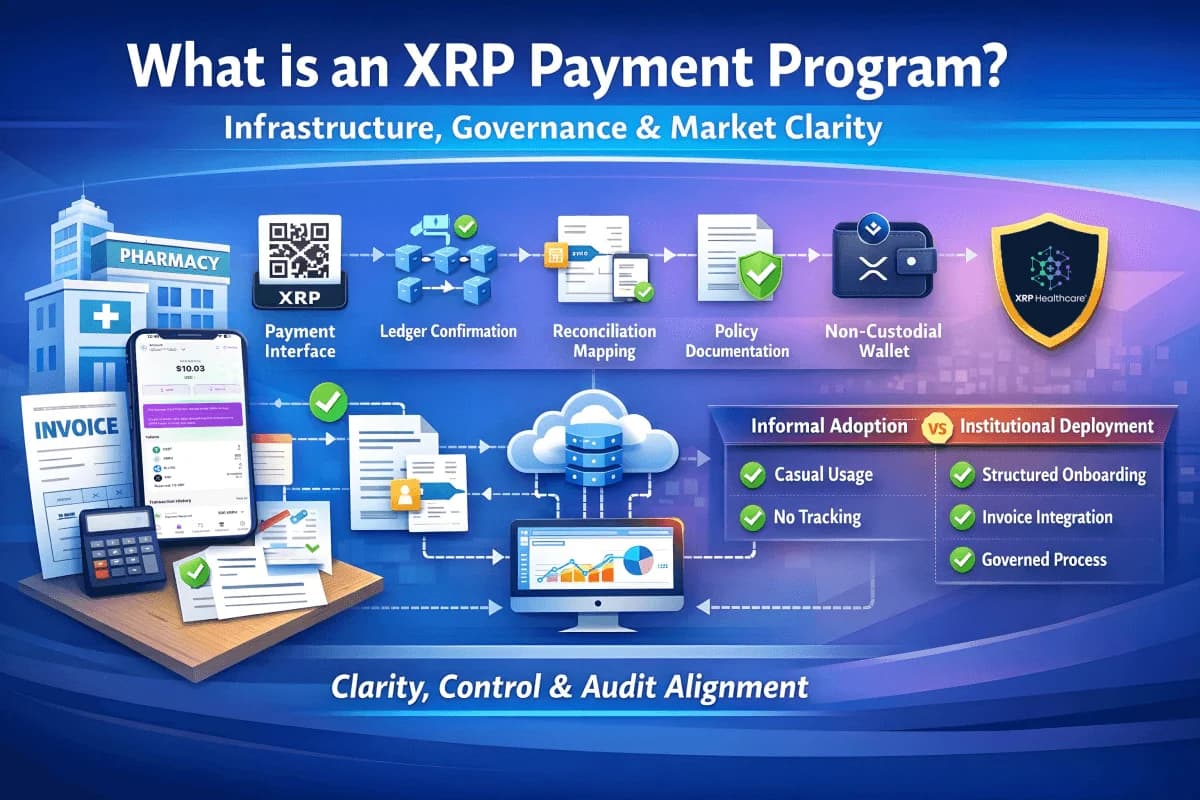
What Is an XRP Payment Program? Infrastructure, Governance & Market Clarity
XRP Payment Program by XRP Healthcare®: governance-led rollout, XRPL integration, and regulated market clarity framework.
What Is an XRP Payment Program? Infrastructure Framework | XRP Healthcare®
Introduction
In emerging payment ecosystems, terminology often evolves faster than operational structure. “XRP Payment Program” is a descriptive phrase used to reference payment acceptance models built around XRP and the XRP Ledger (XRPL). However, without definition, governance, and institutional clarity, descriptive phrases can quickly become sources of confusion or inconsistent implementation.
This article defines what an XRP Payment Program means within the XRP Healthcare® infrastructure framework, and how structured governance, non-custodial architecture, and reconciliation clarity distinguish institutional deployment from informal adoption.
Video Reference: XRPL Integration & Invoice Accounting
This technical reference illustrates how XRP payments can integrate with invoice systems and accounting platforms - a critical component of any structured XRP Payment Program.
What Is an Program of XRP Payment ?
An XRP Payment Program is a structured operational framework for accepting and reconciling payments using XRP within a defined commercial environment, such as:
Pharmacy chains
Healthcare distribution networks
Multi-site payment operators
Institutional service providers
It is not:
A standalone brand
A speculative token promotion
A loosely defined “crypto acceptance” initiative
An informal checkout option
It is:
A governed infrastructure model
A defined payment flow system
A reconciliation-enabled ledger process
A policy-backed operational framework
When deployed under the XRP Healthcare® infrastructure model, the focus is clarity, control, and audit alignment.
Why Definition and Governance Matter
In sectors where terminology overlaps, such as “XRP,” “healthcare,” and “payments” - precision reduces the risk of:
Misrepresentation
Implied endorsement
False affiliation
Market confusion
The purpose of structured infrastructure is not to restrict descriptive language. It is to ensure clarity where commercial deployment occurs.