Open Infrastructure for XRP-Based Healthcare Payments
XRP Healthcare operates as an independent infrastructure provider through XRP Healthcare LLC, the registered trademark owner.
The XRPH Wallet and XRP Payment Program framework form part of the XRP Healthcare infrastructure architecture for healthcare payment deployment using the XRP Ledger (XRPL). The model emphasizes non-custodial design, interoperability, technical transparency, and regulatory clarity.
This infrastructure is open, modular, and structured for integration by pharmacies, healthcare networks, payment facilitators, and enterprise system providers seeking to deploy XRP-based payment rails within their own environments.
XRPH Wallet does not provide custody, brokerage, exchange, financial, or healthcare services. It is non-custodial software infrastructure.
Healthcare Infrastructure Security: Protecting Digital Healthcare Payments with Blockchain Technology
Learn how healthcare infrastructure security, blockchain technology, the XRP Ledger and the XRPH Wallet help support secure digital healthcare payment systems.
Healthcare organisations manage some of the world's most valuable and sensitive digital systems. From appointment scheduling and pharmacy management to payment processing and digital health services, secure infrastructure is essential to maintaining trust between patients, healthcare providers and technology platforms.
As healthcare becomes increasingly digital, payment systems must evolve while continuing to protect users, providers and healthcare organisations. Blockchain technology introduces new methods of securing digital payment infrastructure through cryptographic verification, distributed ledger technology and user-controlled wallets.
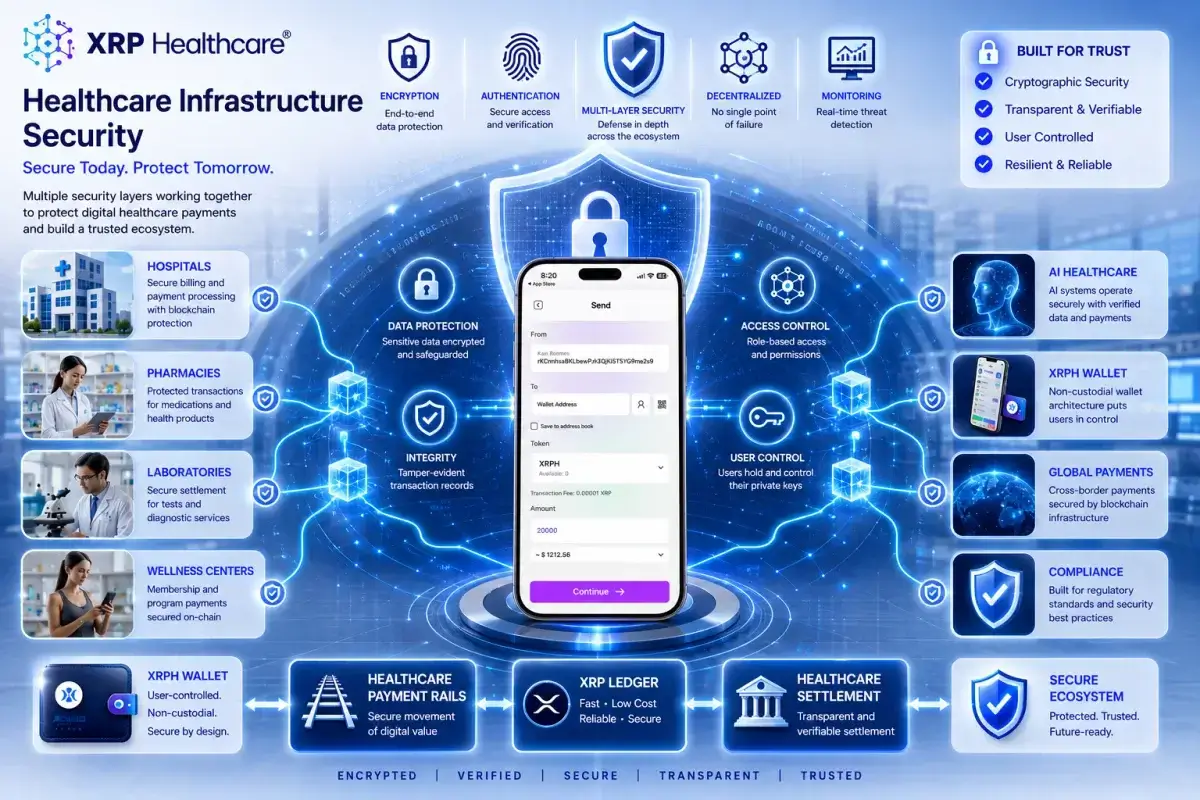
Within the XRP Healthcare Infrastructure, security is built into multiple layers, including the XRPH Wallet, Healthcare Payment Rails, Healthcare Settlement and the XRP Ledger. Rather than depending on a single security measure, modern healthcare payment ecosystems use multiple complementary protections that work together to create a resilient digital environment.
What Is Healthcare Infrastructure Security?
Healthcare infrastructure security refers to the technologies, policies, and operational practices used to protect healthcare systems and digital payment environments.
It encompasses far more than preventing cyberattacks. Modern healthcare infrastructure security focuses on protecting every component involved in delivering reliable healthcare services and secure transactions.
Healthcare infrastructure security includes:
Secure payment processing
Digital identity protection
Blockchain settlement
Wallet security
Network resilience
Access controls
Governance
Operational continuity
Each component contributes to maintaining a secure, reliable, and trusted healthcare ecosystem.
Why Security Matters in Digital Healthcare
Trust is one of the most important foundations of healthcare.
Patients expect healthcare providers to protect their information and process payments securely. Healthcare organisations require technology that can support critical operations while maintaining reliability and transparency.
Data Protection
Sensitive healthcare systems must be protected through appropriate security measures, access controls and compliance frameworks.
Payment Integrity
Healthcare payment infrastructure must accurately record, verify and process transactions while reducing the risk of errors or unauthorised activity.
System Availability
Healthcare services depend on reliable digital infrastructure. Downtime or system failures can affect patient experiences and operational efficiency.
User Confidence
Secure systems encourage greater adoption of digital healthcare services by increasing trust among patients, providers and organisations.
Blockchain Adds a New Security Layer
Blockchain technology introduces several characteristics that strengthen modern payment infrastructure.
These include:
Cryptographic transaction verification
Distributed ledger architecture
Tamper-evident transaction records
Transparent settlement
Decentralised validation
Rather than replacing existing cybersecurity practices, blockchain adds another security layer within the healthcare payment ecosystem.
The Role of the XRP Ledger
The XRP Ledger provides the blockchain settlement layer supporting the XRP Healthcare Infrastructure.
Its architecture includes characteristics such as:
Cryptographic validation
Efficient consensus
Transparent transaction records
Reliable digital settlement
High network availability
These characteristics support secure and efficient payment infrastructure while maintaining verifiable transaction histories.
The XRPH Wallet and User Security
The XRPH Wallet has been designed using a non-custodial architecture. This means users retain control over their wallet credentials instead of relying on a third party to hold their digital assets.
Users remain responsible for:
Protecting recovery phrases
Safeguarding private credentials
Reviewing transactions before approval
Maintaining device security
Following recommended wallet security practices
Technology provides security tools, but responsible user behaviour remains equally important in protecting digital healthcare payments.
Security Is Layered
No single technology can provide complete protection against every security challenge. Modern healthcare payment infrastructure requires a layered security approach where multiple protection mechanisms work together.
A resilient healthcare ecosystem combines technical safeguards, operational processes and responsible user practices to create stronger overall protection.
Security layers may include:
Blockchain settlement
Encryption
Authentication
Wallet security
Secure software development
Infrastructure monitoring
Operational governance
User education
Each layer contributes to improving the reliability, transparency, and resilience of digital healthcare payment systems.
Healthcare Payment Rails and Secure Transactions
Within the XRP Healthcare ecosystem, Healthcare Payment Rails support the movement of compatible digital value across healthcare payment environments.
Together with the XRPH Wallet and Healthcare Settlement, these payment components help create secure workflows designed for modern digital healthcare requirements.
Secure healthcare payment infrastructure aims to provide transactions that are:
Transparent
Efficient
Verifiable
User-controlled
Suitable for modern digital healthcare environments
Security Supports Healthcare Innovation
As healthcare technology continues to evolve, innovation must be supported by strong security practices. New digital services, AI-powered healthcare solutions and international payment systems all depend on infrastructure that patients, healthcare providers and organisations can trust.
Strong security creates the foundation upon which future healthcare innovation can safely develop.
Security Is a Shared Responsibility
Technology alone cannot create a secure healthcare ecosystem. Effective security requires collaboration between software developers, healthcare organisations, infrastructure providers and end users. Each participant has an important role in maintaining a trusted digital healthcare environment.
Technology Providers
Technology providers are responsible for developing secure applications, maintaining reliable infrastructure and implementing appropriate security controls.
Healthcare Organisations
Healthcare organisations must establish operational security policies, manage access controls and ensure responsible use of digital payment systems.
Users
Users play an important role by protecting wallet credentials, verifying transactions and following recommended security practices.
Together, these responsibilities help strengthen the entire healthcare payment ecosystem.
Enterprise Security Principles
Healthcare organisations require infrastructure that supports long-term operational resilience and secure digital transformation.
Modern healthcare payment infrastructure is typically designed around several core security principles:
Confidentiality: Protecting sensitive information from unauthorised access.
Integrity: Ensuring information and transactions remain accurate and trustworthy.
Availability: Maintaining reliable access to healthcare systems and services.
Accountability: Ensuring actions and transactions can be properly tracked.
Transparency: Providing verifiable records and clear operational processes.
Resilience: Supporting continued operation during unexpected events.
These principles help organisations evaluate technologies before integrating them into critical healthcare operations.
Cybersecurity Best Practices for Healthcare Payments
Regardless of the technology being used, strong cybersecurity practices remain essential for protecting digital healthcare infrastructure.
Recommended security practices include:
Keeping wallet and application software updated.
Protecting recovery phrases securely offline.
Using strong authentication methods where available.
Verifying payment details before approving transactions.
Remaining cautious of phishing attempts and suspicious communications.
Using trusted devices and secure internet connections.
Regularly reviewing account and transaction activity.
Security is an ongoing process rather than a one-time setup. Continuous monitoring and responsible practices are essential for maintaining a secure healthcare payment environment.
Business Continuity and Infrastructure Resilience
Healthcare organisations cannot afford prolonged interruptions to critical services.
Modern healthcare payment infrastructure should support:
High system availability
Operational continuity
Reliable transaction processing
Disaster recovery planning
Infrastructure redundancy
Continuous monitoring
These measures help ensure healthcare payment services remain available even during unexpected technical or operational challenges.
Interoperability Strengthens Healthcare Security
Healthcare technology operates across a wide range of connected systems. Payment infrastructure must work securely alongside existing healthcare platforms rather than operating in isolation.
Modern healthcare payment infrastructure should integrate with systems such as:
Electronic Health Records (EHR)
Practice Management Systems
Pharmacy Management Systems
Laboratory Information Systems
Financial Platforms
Appointment Management Systems
Rather than replacing existing healthcare technology, blockchain-powered payment infrastructure can complement these systems by providing secure digital settlement and transparent transaction verification.
Strong interoperability helps healthcare organisations create connected environments where different technologies can communicate efficiently while maintaining security standards.
Governance and Compliance in Healthcare Infrastructure Security
Security depends not only on technology but also on effective governance.
Healthcare organisations require clear policies, operational controls and accountability frameworks to maintain secure digital environments.
Important governance areas include:
Access management
Operational security controls
Payment authorisation procedures
Risk management processes
Regulatory compliance
Security auditing
Strong governance helps organisations maintain trust while supporting responsible adoption of emerging healthcare technologies.
The XRP Healthcare Security Architecture
The XRP Healthcare Infrastructure combines multiple security layers designed to support modern digital healthcare payments.
Each component contributes a specific role within the broader security framework.
Layer Security Contribution: XRP Ledger: Cryptographic blockchain settlement and transparent transaction verification. Healthcare Payment Rails: Secure movement of compatible digital value across healthcare payment environments. Healthcare Settlement: Transparent transaction confirmation and reliable payment processing. XRPH WalletNon-custodial user control over supported digital assets. QR Code Payments: Secure and efficient payment initiation methods. XRP: Native blockchain asset supporting transactions within the XRP ecosystem. XRPHEcosystem utility supporting XRP Healthcare functions. XRPH AI: AI-powered participation and engagement features. RLUSD Stable digital payment option designed for predictable value transfer.
This layered approach improves resilience by combining multiple complementary technologies rather than depending on a single security mechanism.
Looking Towards the Future of Healthcare Infrastructure Security
Healthcare infrastructure security will continue evolving as digital healthcare adoption increases.
Future developments may introduce new methods for improving protection, efficiency, and trust across healthcare payment systems.
Potential future developments include:
AI-assisted fraud detection
Advanced digital identity solutions
Behaviour-based security monitoring
Intelligent transaction analysis
Enhanced wallet authentication methods
Improved healthcare system interoperability
Automated compliance monitoring
As payment technology continues advancing, security innovation will remain essential for supporting safe and reliable healthcare transformation.
Protecting Trust in Digital Healthcare
Ultimately, security exists to protect trust.
Patients need confidence that healthcare services are reliable, private and accessible. Healthcare providers require dependable payment infrastructure that supports efficient operations. Organisations need technology capable of supporting long-term growth.
By combining blockchain infrastructure, secure wallet architecture and responsible operational practices, modern healthcare payment systems can help create stronger confidence in digital healthcare services.
Conclusion
Healthcare infrastructure security is built upon multiple complementary layers working together.
Within the XRP Healthcare ecosystem, the XRPH Wallet, Healthcare Payment Rails, Healthcare Settlement and the XRP Ledger combine to support secure blockchain-powered payment infrastructure.
Rather than relying on one security technology, a resilient healthcare payment ecosystem benefits from cryptographic protection, transparent settlement, user-controlled wallets, responsible governance and continuous cybersecurity practices.
As healthcare becomes increasingly digital, robust security will remain one of the most important foundations supporting future innovation.
Call to Action
Discover how blockchain technology, secure wallet architecture, and modern payment infrastructure work together within the XRP Healthcare ecosystem.
Explore the complete framework powering secure digital healthcare payments through the XRP Healthcare Infrastructure pillar page.