Open Infrastructure for XRP-Based Healthcare Payments
XRP Healthcare operates as an independent infrastructure provider through XRP Healthcare LLC, the registered trademark owner.
The XRPH Wallet and XRP Payment Program framework form part of the XRP Healthcare infrastructure architecture for healthcare payment deployment using the XRP Ledger (XRPL). The model emphasizes non-custodial design, interoperability, technical transparency, and regulatory clarity.
This infrastructure is open, modular, and structured for integration by pharmacies, healthcare networks, payment facilitators, and enterprise system providers seeking to deploy XRP-based payment rails within their own environments.
XRPH Wallet does not provide custody, brokerage, exchange, financial, or healthcare services. It is non-custodial software infrastructure.
Digital healthcare payments do not end when a patient presses Pay. Behind that simple action, several systems may be involved, including healthcare applications, payment APIs, wallets, payment rails, settlement infrastructure and reconciliation systems. Every stage can potentially succeed, fail or become delayed.
This creates an important operational requirement: visibility.
Healthcare payment monitoring provides organisations with insight into what is happening across their payment infrastructure. Within the broader XRP Healthcare Infrastructure, monitoring can provide visibility across healthcare payment APIs, payment orchestration, the XRPH Wallet, healthcare payment rails, compatible XRP Ledger transactions and downstream reconciliation processes.
Monitoring principle: A payment system can appear available while individual components are degraded. Effective monitoring should cover the complete transaction lifecycle rather than only one infrastructure layer.
What Is Healthcare Payment Monitoring?
Healthcare payment monitoring is the continuous observation of payment systems, transaction activity and infrastructure performance. It helps organisations understand how many transactions are being processed, which payments are pending, which have settled, which transactions have failed, whether payment systems are available, whether APIs are responding correctly and whether reconciliation is completing.
Monitoring creates operational awareness and helps teams understand what is happening across digital healthcare payment infrastructure.
Why Healthcare Payment Monitoring Matters
Healthcare organisations may operate continuously. Hospitals, pharmacies, laboratories and digital healthcare services can accept payments across multiple systems and payment methods.
A payment failure can create immediate consequences. A patient may be unable to complete payment, a pharmacy may not receive confirmation, a digital healthcare subscription may be interrupted, or a finance team may be unable to reconcile a transaction.
Healthcare payment monitoring helps organisations identify these problems earlier so operational teams can investigate and respond more quickly.
Monitoring the Complete Payment Lifecycle
A digital healthcare transaction may pass through several stages:
Payment Request → API → Payment Interface or Wallet → Payment Rail → Settlement → Confirmation → Reconciliation → Accounting
Monitoring can observe each stage, making it easier to determine where a problem occurred and whether the issue is isolated or part of a broader infrastructure problem.
Monitoring Versus Reconciliation
Payment Monitoring
Payment monitoring answers the question: What is happening right now?
It can help teams determine whether an API is available, whether a payment is pending, whether a transaction failed or whether settlement is delayed.
Payment Reconciliation
Payment reconciliation answers a different question: Do our financial records match what actually happened?
Reconciliation can determine whether a payment belongs to a particular invoice, whether the correct amount was received and whether the transaction has been recorded in accounting.
Monitoring provides operational visibility, while reconciliation provides financial accuracy. Both functions are important.
Monitoring Payment Requests
The payment lifecycle begins with a payment request. Organisations may monitor the number of payment requests created, requested amounts, selected payment methods, timestamps, expiration and request status.
This can help identify issues before payment processing begins. For example, if a healthcare application suddenly stops generating payment requests, the problem may exist at the application layer rather than within the payment network.
Monitoring Healthcare Payment APIs
Healthcare Payment APIs form the communication layer between applications and payment infrastructure. API monitoring may include availability, response time, error rate, authentication failures, request volume, failed requests and timeout rates.
An API may technically remain online while performing poorly. Monitoring can therefore help identify both complete outages and degraded performance.
API Response Time
Response time measures how quickly an API responds. If an API normally responds in a fraction of a second but suddenly begins taking several seconds, users may experience payment delays even though the underlying payment service remains operational.
API Error Rates
Errors are inevitable in complex systems. What matters is understanding how often they occur, which systems are affected, whether they are increasing and what caused them.
A sudden increase in payment API errors may indicate a software issue, provider outage, authentication problem, infrastructure capacity issue or integration failure.
Monitoring Payment Orchestration
Healthcare Payment Orchestration may coordinate multiple payment methods or infrastructure routes where such functionality is implemented.
Monitoring an orchestration layer could include the selected payment route, provider availability, route failures, retry attempts, transaction status and failover activity.
This helps organisations understand how transactions move through a multi-rail environment.
Monitoring Healthcare Payment Rails
Healthcare Payment Rails move compatible digital value through payment infrastructure. Monitoring may include transaction volume, success rates, failed transactions, processing time, settlement status and infrastructure availability.
The objective is not only to know whether a payment rail is available, but also whether it is functioning normally.
Monitoring Settlement
Settlement is one of the most important payment states. A healthcare organisation needs to know when a transaction becomes confirmed through the relevant infrastructure.
Settlement monitoring may observe pending transactions, confirmed transactions, failed transactions, settlement time, transaction references, assets or currencies and transaction amounts.
This information can then support downstream financial and operational systems.
XRP Ledger Transaction Visibility
For compatible XRP Ledger transactions, blockchain records can provide transparent transaction information. This can contribute to monitoring because transactions can be independently verified through the ledger.
Relevant information may include transaction identifiers, timestamps, assets, amounts, transaction results and ledger confirmation.
Blockchain visibility can therefore contribute to operational monitoring, but it should complement rather than replace application-level monitoring.
Why Blockchain Monitoring Is Not Enough
A blockchain transaction can be perfectly healthy while another part of the payment workflow fails.
For example, the blockchain may confirm a transaction while the healthcare billing system fails to receive the confirmation. Similarly, the wallet may function correctly while an API integration is unavailable.
This is why payment monitoring should cover the complete infrastructure stack.
Monitoring the XRPH Wallet Layer
The XRPH Wallet represents a user-facing layer for supported digital asset and transaction functionality.
Operational monitoring around a wallet environment may include application availability, transaction submission errors, connection errors, supported network status and service performance.
Monitoring should never expose private wallet credentials. Security-sensitive information must remain protected.
Monitoring QR Code Payments
QR code healthcare payments create another transaction entry point. Monitoring can help organisations understand how many QR payment requests are generated, how many are scanned, how many transactions are initiated and completed, and how many fail or are abandoned.
This can help identify whether problems occur before or after a user initiates payment.
Monitoring Stablecoin Transactions
Where stable-value digital assets are supported, organisations may need visibility into the selected asset, amount, transaction status, settlement confirmation, supported network and reconciliation status.
Stable value does not remove the need for transaction monitoring. The infrastructure still requires operational visibility.
Cross-Border Payment Monitoring
Cross-border healthcare payments may involve more complex payment routes. Organisations may monitor country or region, payment provider, currency or asset, processing time, settlement time, failure rate and applicable compliance-related holds.
This can help organisations understand how international payment infrastructure performs across different regions and payment environments.
Enterprise Healthcare Monitoring
Large healthcare organisations may process payments across hospitals, clinics, pharmacies, laboratories, digital healthcare platforms and multiple countries.
A central monitoring environment can provide visibility across the enterprise and help finance and technology teams understand which locations are processing normally, which systems are degraded, which payment methods are failing and which transactions require investigation.
Operational Dashboards
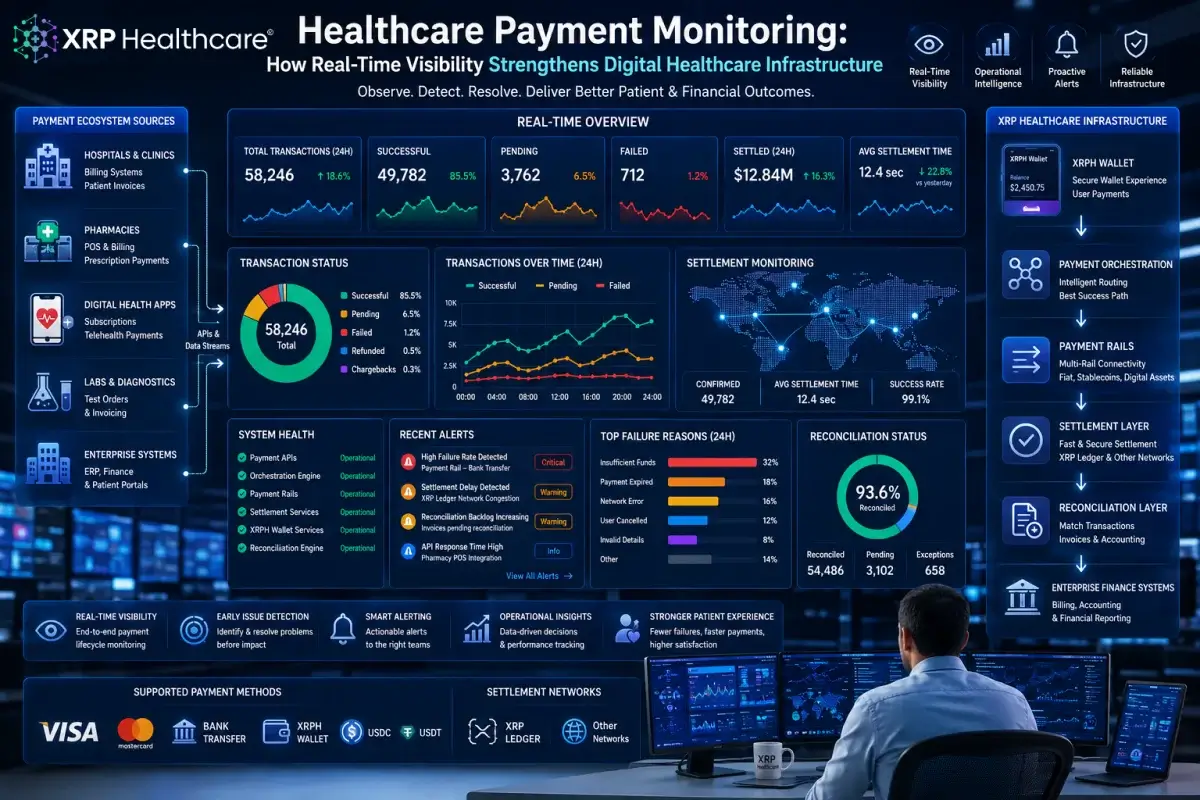
Monitoring information is often presented through operational dashboards. A healthcare payment dashboard may display:
Transactions processed today
Successful payments
Failed payments
Pending transactions
Settlement times
Payment methods
API performance
Reconciliation exceptions
A dashboard helps convert infrastructure data into operational understanding.
Metrics That Matter
Transaction Success Rate
The percentage of payment attempts that complete successfully.
Transaction Failure Rate
The percentage of transactions that fail.
Settlement Time
How long supported transactions take to reach confirmed settlement.
API Availability
The percentage of time payment APIs remain accessible.
API Response Time
How quickly connected services respond to requests.
Reconciliation Rate
The percentage of completed transactions automatically matched to financial records where reconciliation automation exists.
Exception Rate
The percentage of transactions requiring manual review.
Monitoring Trends Rather Than Individual Transactions
A single failed transaction may not indicate a systemic problem. Monitoring becomes more powerful when organisations identify patterns.
For example, a failure rate may suddenly double, one provider may become slower, settlement times may increase, a geographic region may experience errors or reconciliation exceptions may begin rising.
These trends can reveal infrastructure problems that individual transaction reviews may miss.
Alerts
Monitoring systems may generate alerts when defined conditions occur. Examples include an unavailable API, transaction failure rates above a threshold, settlement delays, unusual transaction volume, reconciliation backlogs or repeated authentication failures.
Alerts help operational teams focus attention where it is needed.
Avoiding Alert Fatigue
Too many alerts can become counterproductive. If every small event generates an alert, teams may begin ignoring them.
Effective monitoring should distinguish between informational events, warnings, high-priority incidents and critical outages.
Operational principle: Alerts should identify meaningful conditions that require attention. Excessive low-value alerts can create alert fatigue and make critical incidents easier to miss.
Monitoring and Incident Response
Monitoring is closely connected to incident response. A strong workflow may follow these steps:
Monitoring detects abnormal behaviour.
An alert is generated.
The operations team investigates.
Impact is assessed.
Corrective action is taken.
Systems recover.
The incident is reviewed afterwards.
Monitoring provides the initial signal, while incident response provides the organisational reaction.
Monitoring and Security
Payment monitoring can also contribute to security operations. Potential indicators include repeated authentication failures, unusual transaction patterns, unexpected request volumes, abnormal API behaviour and suspicious administrative changes.
Monitoring does not automatically prove malicious activity. Instead, it can identify events that may require further investigation.
Monitoring and Fraud Detection Are Different
Payment monitoring and fraud detection can overlap, but they are not identical.
Monitoring observes infrastructure and transaction behaviour, while fraud detection evaluates whether activity may be fraudulent.
Monitoring can provide signals, while fraud detection applies additional risk analysis. The two functions can complement one another.
Monitoring and Governance
Organisations should define which metrics are monitored, which alerts matter, who receives alerts, who investigates incidents, what thresholds are appropriate and how incidents are documented.
Technology without operational ownership is incomplete.
Monitoring and Compliance
Some organisations may need to maintain records relating to payment activity, system access, administrative changes, security events and incident response.
Monitoring and logging can help support these requirements, although exact obligations depend on jurisdiction and organisational context.
Log Management
Logs provide detailed records of system activity. Useful payment infrastructure logs may record timestamps, services, transaction references, event types, statuses and error codes.
Logs should not unnecessarily store private wallet credentials, recovery phrases or sensitive clinical information.
Healthcare privacy: Monitoring systems should collect only the operational and transaction information required to maintain payment infrastructure. Private wallet credentials, recovery phrases and unnecessary clinical data should never be exposed through monitoring logs.
Observability
Monitoring answers predefined questions, while observability is a broader infrastructure concept that helps teams understand system behaviour through signals such as metrics, logs and traces.
Observability becomes particularly useful when teams need to investigate problems they did not anticipate in advance.
Observability principle: Metrics show overall behaviour, logs record specific events, and traces show how an individual transaction moves through connected services. Together they provide a deeper view of system health.
Metrics, Logs and Traces
Metrics
Metrics show overall system behaviour. An example is the payment success rate.
Logs
Logs record specific events. An example is an API request failing with a particular error.
Traces
Traces show how an individual transaction moved across multiple connected services, such as:
Together, these signals can make troubleshooting faster.
Distributed Tracing
Modern payment infrastructure may involve multiple connected services. Distributed tracing allows teams to follow one transaction across them.
A trace might show:
Payment request created.
API accepted the request.
Payment route selected.
Wallet transaction initiated.
Settlement confirmed.
Confirmation returned.
Reconciliation started.
If a delay occurs, the trace can help identify where it occurred.
Monitoring Reconciliation
Healthcare Payment Reconciliation should also be monitored. Potential metrics include transactions awaiting reconciliation, automatically matched transactions, exceptions, missing references, partial payments and duplicate transactions.
This helps ensure that financial operations remain healthy after settlement.
Monitoring the Entire Infrastructure Stack
Within XRP Healthcare Infrastructure, monitoring can span multiple layers:
Application Layer
Healthcare applications and enterprise systems.
API Layer
Healthcare Payment APIs.
Orchestration Layer
Supported payment coordination.
Wallet Layer
XRPH Wallet and compatible payment interfaces.
Payment Layer
Healthcare Payment Rails.
Settlement Layer
XRP Ledger or other supported settlement systems.
Reconciliation Layer
Financial transaction matching.
Governance Layer
Security, incident management and operational controls.
Monitoring operates horizontally across these layers rather than replacing any individual infrastructure component.
Supporting Monitoring Architecture
Healthcare Applications / Enterprise Systems
↓
Healthcare Payment APIs
↓
Healthcare Payment Orchestration
↓
XRPH Wallet / Compatible Payment Interfaces
↓
Healthcare Payment Rails
↓
Settlement Infrastructure
↓
Healthcare Payment Reconciliation
↓
Enterprise Finance Systems
Across the entire stack, monitoring and observability can use metrics, logs, traces, alerts, transaction status and service-health signals.
Supporting controls include Security, Governance and Compliance.
Monitoring Should Not Expose Clinical Data
Healthcare payment monitoring systems should focus on infrastructure and transaction data. They should avoid unnecessarily collecting diagnoses, medical histories, clinical notes and treatment details.
Payment monitoring generally needs transaction information rather than detailed health information. This separation can support privacy.
Healthcare Payment Monitoring and Patient Experience
Monitoring is primarily an operational function, but it can directly affect patients.
Good monitoring can help reduce failed checkout experiences, payment confirmation delays, duplicate payment requests, incorrect outstanding balances and slow issue resolution.
Infrastructure visibility can therefore contribute to a better user experience.
Monitoring Should Be Proactive
The strongest monitoring systems do not simply explain why something failed after complaints arrive. They help teams identify problems early.
For example, an operations team may notice increasing API failure rates before patients begin reporting payment problems. This allows corrective action to begin sooner.
Monitoring and Service-Level Objectives
Enterprise infrastructure may define operational targets for service availability, API response time, transaction success rate and settlement performance.
These targets can help organisations evaluate whether infrastructure performs according to expectations. Targets should reflect actual technical and commercial requirements.
Monitoring and Business Continuity
Monitoring can also support business continuity. If a critical component becomes unavailable, teams need to understand what failed, which users are affected, which services remain available, whether an alternative payment route exists and when normal operations resume.
Visibility improves decision-making during incidents.
The Infrastructure Progression
Healthcare payment monitoring follows naturally from the broader infrastructure architecture:
Interoperability → Systems work together.
↓
APIs → Systems communicate.
↓
Orchestration → Payment routes are coordinated.
↓
Payment Rails → Value moves.
↓
Settlement → Payment is confirmed.
↓
Reconciliation → Payment is matched to financial records.
↓
Monitoring & Observability → The organisation understands whether the system is operating correctly.
This creates a more mature operational architecture.
Future Healthcare Payment Monitoring
Future infrastructure may support more advanced real-time dashboards, smarter anomaly detection, automated incident classification, cross-rail observability, enterprise payment analytics, predictive capacity monitoring and AI-assisted operational analysis.
Any XRP Healthcare-specific monitoring capabilities should be described as live only after they are officially implemented.
Monitoring Without Unnecessary Complexity
Monitoring should make infrastructure easier to operate, not harder.
The objective is to present the right information to the right teams at the right time.
Executives: Overall payment performance
Finance teams: Settlement and reconciliation status
Engineering teams: API and infrastructure metrics
Security teams: Authentication and unusual-activity signals
Different teams need different views of the same infrastructure.
Conclusion
Healthcare payment monitoring provides the visibility required to operate complex digital payment infrastructure reliably.
As healthcare organisations connect applications, APIs, wallets, payment rails, settlement systems and reconciliation platforms, understanding what is happening across each layer becomes increasingly important.
Within the XRP Healthcare Infrastructure, monitoring can provide visibility across healthcare payment APIs, payment orchestration, the XRPH Wallet, healthcare payment rails, compatible XRP Ledger settlement and healthcare payment reconciliation.
The complete infrastructure lifecycle can be viewed as:
Monitoring sits across the entire process. It helps organisations identify failures, understand performance and respond more quickly when infrastructure does not behave as expected.
As healthcare payment systems become more connected and enterprise-scale, operational visibility will become an increasingly important foundation of reliable digital healthcare infrastructure.
Frequently Asked Questions
What is healthcare payment monitoring?
Healthcare payment monitoring is the continuous observation of payment requests, APIs, wallets, payment rails, settlement activity and related infrastructure performance.
Why is payment monitoring important in healthcare?
Healthcare organisations may process transactions continuously across many services and payment methods. Monitoring helps identify failed, delayed or unusual payment activity more quickly.
What is the difference between payment monitoring and reconciliation?
Payment monitoring provides operational visibility into what is happening across infrastructure, while payment reconciliation matches completed transactions with invoices and accounting records.
What is payment observability?
Payment observability is the ability to understand infrastructure behaviour using signals such as metrics, logs and distributed traces.
Can blockchain support healthcare payment monitoring?
For compatible blockchain transactions, ledger records can provide verifiable transaction references, timestamps and settlement results that may contribute to operational monitoring.
Why is blockchain monitoring alone not enough?
A blockchain transaction may settle successfully while another part of the payment workflow, such as an API, billing application or reconciliation system, fails. Monitoring should therefore cover the full infrastructure stack.
What types of metrics can healthcare payment systems monitor?
Potential metrics include transaction success rate, transaction failure rate, settlement time, API availability, API response time, reconciliation exceptions and infrastructure availability.
Does payment monitoring automatically detect fraud?
No. Monitoring may surface unusual behaviour or operational signals, but fraud detection requires additional risk analysis and specialised controls.
Does XRP Healthcare currently provide a real-time enterprise monitoring platform?
Only officially confirmed live functionality should be described as current. This article explains how monitoring and observability can fit within modern XRP Healthcare payment infrastructure and should not be interpreted as confirmation of unannounced enterprise monitoring features.
Continue Learning About Healthcare Payment Operations
Discover how applications, APIs, wallets, payment rails, settlement, reconciliation and monitoring can work together across the XRP Healthcare ecosystem.