Open Infrastructure for XRP-Based Healthcare Payments
XRP Healthcare operates as an independent infrastructure provider through XRP Healthcare LLC, the registered trademark owner.
The XRPH Wallet and XRP Payment Program framework form part of the XRP Healthcare infrastructure architecture for healthcare payment deployment using the XRP Ledger (XRPL). The model emphasizes non-custodial design, interoperability, technical transparency, and regulatory clarity.
This infrastructure is open, modular, and structured for integration by pharmacies, healthcare networks, payment facilitators, and enterprise system providers seeking to deploy XRP-based payment rails within their own environments.
XRPH Wallet does not provide custody, brokerage, exchange, financial, or healthcare services. It is non-custodial software infrastructure.
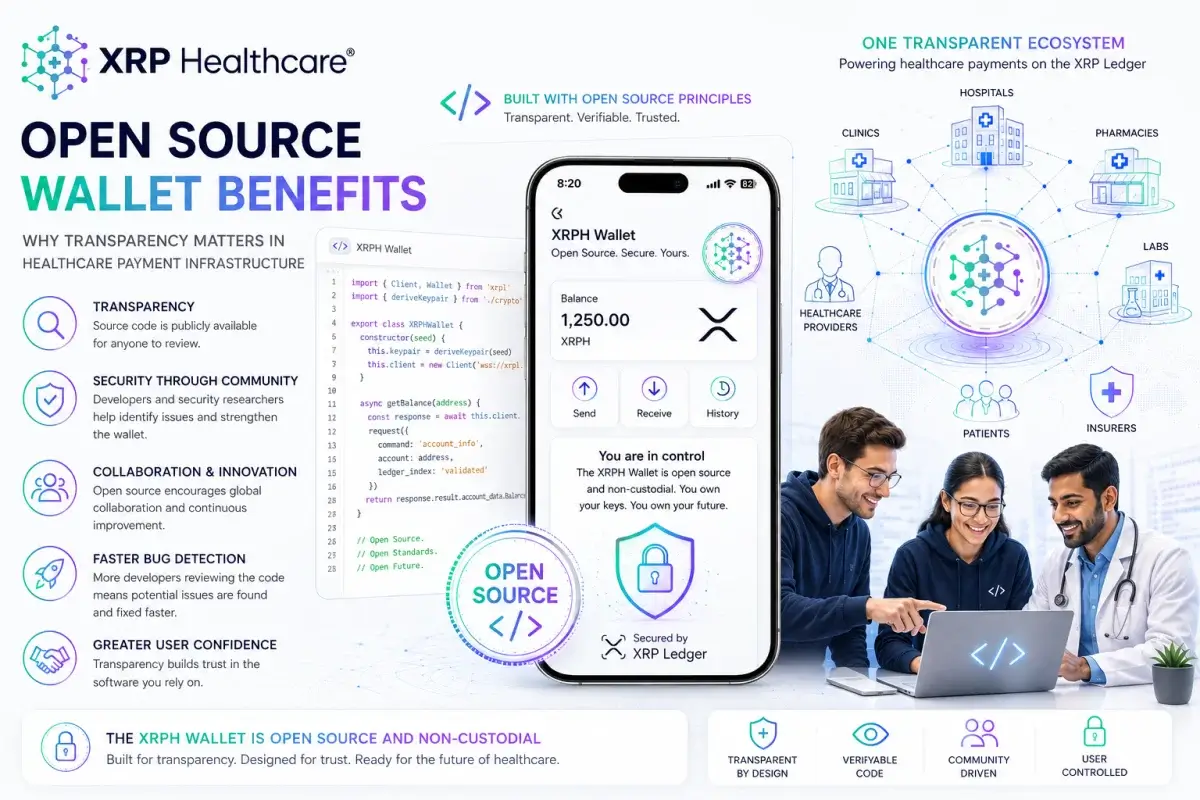
Open Source Wallet Benefits: Why Transparency Matters for Healthcare Payments
Learn how open source wallets improve transparency, security and innovation, and why they are becoming an important part of blockchain-powered healthcare payment infrastructure.
Open Source Wallet Benefits | Why Transparency Matters for Healthcare Payments | XRP Healthcare®
Trust is one of the most valuable qualities in any financial or healthcare system. Patients trust healthcare providers. Healthcare organisations trust payment systems. Users trust digital wallets to safeguard access to their digital assets. One way software developers build trust is through open source development.
Instead of keeping software hidden behind closed doors, open source projects publish their source code so it can be reviewed, tested and improved by the wider developer community. This approach has become increasingly important within blockchain ecosystems. Many of the world's leading blockchain technologies are open source, allowing developers around the world to examine how they operate.
Within the XRP Healthcare Infrastructure, the XRPH Wallet follows this philosophy by embracing transparency and encouraging confidence through open development.
What Is Open Source Software?
Open source software is software whose source code is publicly available for inspection, review, and, where licensing permits, contribution. Unlike closed-source software, developers can examine how an open source application has been built.
This provides greater visibility into:
Software architecture
Security implementation
Application behaviour
Bug fixes
Ongoing development
Open source does not mean software is automatically more secure.
Instead, it means the code can be independently examined by developers and security researchers.
What Is an Open Source Wallet?
An open source wallet is a digital wallet whose source code is publicly available for review.
This enables developers to:
Understand how the wallet operates.
Review security mechanisms.
Identify potential issues.
Suggest improvements.
Contribute enhancements where appropriate.
For users, this transparency can help build confidence that the wallet behaves as intended.
Why Transparency Matters
Financial infrastructure depends on trust.
Transparency helps users better understand the technology they rely upon.
Potential benefits include:
Independent Review
Developers can examine the wallet's code rather than relying solely on published descriptions.
Community Contributions
Open source communities often identify improvements that strengthen software over time.
Faster Bug Detection
When more developers can review software, potential issues may be identified more quickly.
Continuous Improvement
Open development encourages ongoing refinement and innovation.
Greater User Confidence
Users may feel more comfortable using software that can be independently reviewed.
Open Source and Blockchain
Blockchain technology has embraced open source from its earliest days.
Many blockchain projects publish their software openly because blockchain itself emphasises transparency and decentralisation.
Open source development complements these principles by allowing:
Independent verification
Community collaboration
Transparent governance
Continuous technical improvement
Together, blockchain and open source create an ecosystem where trust is built through visibility rather than secrecy.
Open Source Does Not Mean Less Secure
Some people mistakenly assume that making source code publicly available weakens security.
In reality, the opposite is often true.
Publishing source code allows security researchers and developers to identify vulnerabilities that might otherwise remain hidden.
Security still depends upon:
Secure software design
Responsible development practices
Independent code review
Timely security updates
User education
Transparency supports security-it does not replace it.
The XRPH Wallet and Open Source Principles
Within the XRP Healthcare ecosystem, the XRPH Wallet has been developed with openness and transparency in mind.
As an open source wallet, it supports principles including:
Transparency
Community review
Continuous improvement
Developer collaboration
User trust
Combined with its non-custodial architecture, this approach gives users greater visibility into the technology supporting their digital healthcare payments.
Open Source and Healthcare Innovation
Healthcare technology evolves rapidly. Open source development enables organisations to innovate while benefiting from collaboration across the wider technology community.
Potential advantages include:
Faster innovation
Better interoperability
Community-driven improvements
Improved software quality
Reduced duplication of effort
Open development can therefore help accelerate the evolution of healthcare payment infrastructure.
Working Together With the XRP Ledger
The XRP Healthcare ecosystem combines several complementary technologies. Component Role XRP Ledger Blockchain settlement layer XRPH Wallet Open source, non-custodial user wallet Healthcare Payment Rails Movement of digital value Healthcare Settlement Transaction finalisation QR Payments Simple payment initiation
Each layer contributes to a transparent, secure and scalable payment ecosystem.
Open Source Builds Long-Term Trust
Healthcare organisations require technology they can trust over many years. Transparency supports that trust.
By allowing software to be independently reviewed and continuously improved, open source development helps create technology ecosystems that can evolve alongside healthcare itself. This philosophy aligns closely with blockchain infrastructure, where transparency and verifiable processes are fundamental design principles.
Community-Driven Development
One of the greatest strengths of open source software is the community that supports it. Rather than relying solely on an internal development team, open source projects can benefit from contributions made by developers, security researchers and technical specialists around the world.
These contributions may include:
Performance improvements
Code optimisation
Security enhancements
Documentation updates
Bug reporting
Feature suggestions
This collaborative approach helps software evolve continuously while encouraging innovation from a broader technical community.
Independent Security Auditing
Security is especially important for applications that manage digital assets. Open source development allows independent specialists to review wallet code and identify potential improvements.
Security reviews may examine areas such as:
Transaction validation
Cryptographic implementation
Authentication mechanisms
Wallet architecture
Recovery processes
User protection features
While open source supports independent review, ongoing security testing and responsible development practices remain essential. No software should be considered secure simply because it is open source.
Governance and Transparency
Open source projects often follow transparent development practices.
Users and developers can frequently view:
Development updates
Code changes
Version history
Feature requests
Issue tracking
Community discussions
This level of visibility helps build confidence by allowing interested parties to understand how software evolves. Transparent governance also supports accountability and encourages responsible software development.
Enterprise Confidence
Healthcare organisations require technology that is dependable, maintainable and transparent. Open source software can support enterprise adoption by offering greater visibility into how critical applications operate.
Potential enterprise advantages include:
Greater technical transparency
Easier security review
Improved interoperability
Long-term maintainability
Reduced dependence on proprietary systems
For organisations evaluating blockchain infrastructure, openness can become an important factor in technology selection.
Open Source and Interoperability
Modern healthcare systems rarely operate in isolation. Hospitals, pharmacies, laboratories and healthcare providers often rely on a wide range of software platforms. Open standards and open source development can encourage interoperability by making it easier for developers to understand how systems interact.
This helps support:
Integration with existing healthcare software
Connected payment systems
Digital wallet compatibility
Future technology development
Scalable healthcare ecosystems
Interoperability is essential for building healthcare infrastructure capable of evolving over time.
Innovation Through Collaboration
Healthcare technology continues to advance rapidly. Open development encourages organisations and developers to learn from one another rather than repeatedly solving the same problems independently.
Potential areas of future innovation include:
AI-assisted wallet experiences
Digital healthcare identity
Smart payment automation
Preventive healthcare services
International healthcare payments
Connected wearable devices
Secure ecosystem participation
Open source provides a framework through which these ideas can continue to evolve collaboratively.
How Open Source Fits Into the XRP Healthcare Infrastructure
The XRP Healthcare ecosystem is built from several complementary layers. Layer Purpose XRP Ledger Blockchain settlement infrastructure Healthcare Payment Rails Movement of digital value Healthcare Settlement Final transaction settlement XRPH Wallet Open source, non-custodial wallet QR Code Payments User-friendly payment initiation XRP Native asset of the XRP Ledger XRPH Ecosystem utility XRPHAI AI engagement and participation RLUSD Stable digital payment option
Open source development strengthens this ecosystem by improving transparency and encouraging continuous technical improvement.
Transparency Builds Trust
Healthcare depends on trust. Financial systems depend on trust. Technology increasingly depends on trust as well. Open source software helps establish that trust by allowing independent review instead of requiring users to rely solely on marketing claims.
Transparency does not eliminate risk. However, it allows the wider technical community to participate in improving software quality over time.
Looking Ahead
Open source development is expected to remain an important part of blockchain innovation. As healthcare payment infrastructure becomes more sophisticated, transparency and collaboration are likely to become even more valuable.
Future developments may include:
Expanded developer ecosystems
Greater interoperability
More advanced wallet functionality
Enhanced security features
Broader enterprise adoption
AI-assisted payment experiences
Open source provides a strong foundation for long-term innovation while encouraging responsible software development.
Conclusion
Open source wallets represent more than simply publicly available software. They reflect a philosophy of transparency, collaboration and continuous improvement. Within the XRP Healthcare ecosystem, the XRPH Wallet combines open source principles with non-custodial ownership and blockchain settlement provided by the XRP Ledger.
Together these technologies help create a payment infrastructure that emphasises user control, transparency and long-term innovation. As healthcare continues its digital transformation, open source development will remain an important contributor to building secure and trustworthy healthcare payment systems.
Continue Learning
Explore more topics within the XRP Healthcare Infrastructure knowledge hub:
Interested in learning how transparency and blockchain technology work together to support digital healthcare payments?
Visit the XRP Healthcare Infrastructure pillar page to discover how the XRPH Wallet, the XRP Ledger and Healthcare Payment Rails combine to create an open, secure and future-ready payment ecosystem.