Open Infrastructure for XRP-Based Healthcare Payments
XRP Healthcare operates as an independent infrastructure provider through XRP Healthcare LLC, the registered trademark owner.
The XRPH Wallet and XRP Payment Program framework form part of the XRP Healthcare infrastructure architecture for healthcare payment deployment using the XRP Ledger (XRPL). The model emphasizes non-custodial design, interoperability, technical transparency, and regulatory clarity.
This infrastructure is open, modular, and structured for integration by pharmacies, healthcare networks, payment facilitators, and enterprise system providers seeking to deploy XRP-based payment rails within their own environments.
XRPH Wallet does not provide custody, brokerage, exchange, financial, or healthcare services. It is non-custodial software infrastructure.
Blockchain Healthcare Payments Explained: How Distributed Ledger Technology Is Transforming Healthcare Transactions
Discover how blockchain healthcare payments work, why distributed ledger technology matters, and how the XRP Ledger supports modern healthcare payment infrastructure.
Healthcare is becoming increasingly digital. Appointments can be booked online. Medical consultations may take place remotely. Prescriptions can be managed electronically. Patients increasingly expect digital payment experiences that are as efficient as the healthcare services they receive.
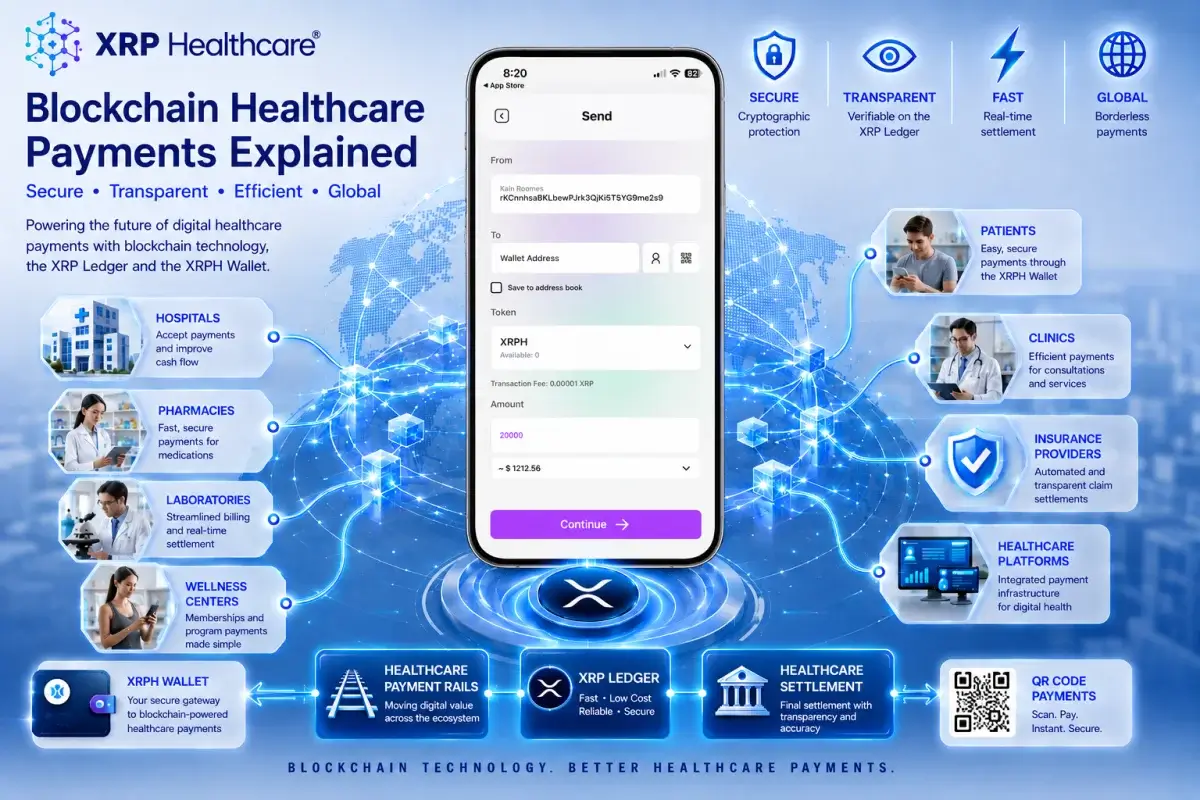
To support these changing expectations, payment infrastructure must continue to evolve. Blockchain technology provides a modern approach to recording and settling digital transactions through a distributed ledger rather than relying exclusively on traditional financial infrastructure. Within the XRP Healthcare Infrastructure, blockchain technology forms the foundation that connects the XRPH Wallet, Healthcare Payment Rails, Healthcare Settlement, QR Code Payments, and supported digital assets into a single payment ecosystem.
Understanding how blockchain healthcare payments work helps explain why distributed ledger technology is becoming increasingly important for modern healthcare payment infrastructure.
Key Takeaways
Blockchain provides the infrastructure for secure digital value transfer.
Healthcare payment systems can benefit from transparent and efficient settlement.
The XRP Ledger is designed to support payment-focused blockchain applications.
The XRPH Wallet enables users to interact with blockchain infrastructure through a simple interface.
Blockchain complements existing healthcare systems rather than replacing them.
Video Overview
What Are Blockchain Healthcare Payments?
Blockchain healthcare payments are digital payment transactions that are recorded and settled using blockchain technology. Instead of relying entirely on conventional payment networks, compatible blockchain infrastructure provides another method of securely transferring digital value.
Blockchain infrastructure may support payment scenarios involving:
Healthcare consultations
Pharmacy purchases
Laboratory services
Wellness programmes
Digital healthcare memberships
Cross-border healthcare services
Future healthcare applications
The blockchain records payment activity while healthcare providers continue delivering clinical services.
What Is a Distributed Ledger?
A distributed ledger is a digital record that is maintained across a network rather than stored in a single central location.
Each compatible transaction is recorded according to the rules of the blockchain network.
This provides characteristics such as:
Transparency
Consistency
Cryptographic security
Shared transaction history
Efficient settlement
These characteristics have made distributed ledger technology an important innovation in digital payment infrastructure.
Why Blockchain Is Different
Traditional payment systems often involve multiple intermediary organisations.
Blockchain introduces another model where compatible digital transactions can be processed through distributed infrastructure.
Potential benefits include:
Transparent Settlement
Transactions can be independently verified on the blockchain.
Efficient Processing
Blockchain networks designed for payments can support efficient digital value transfer.
Global Accessibility
Compatible blockchain networks operate internationally, subject to applicable laws and regulations.
Modern Digital Infrastructure
Blockchain complements existing payment systems while supporting future innovation.
The XRP Ledger and Healthcare Payments
Within the XRP Healthcare ecosystem, the XRP Ledger provides the blockchain settlement layer. Its payment-focused design includes characteristics such as:
Fast transaction confirmation
Low transaction costs
High throughput
Energy-efficient consensus
Mature blockchain architecture
These characteristics make it well suited for digital payment infrastructure.
The Role of Healthcare Payment Rails
Blockchain alone does not create a complete payment ecosystem. The XRP Healthcare Infrastructure combines blockchain settlement with Healthcare Payment Rails that support the movement of digital value between ecosystem participants.
Together they help enable:
Patient payments
Provider payments
Digital wallet transactions
QR payments
Cross-border payment support
Future healthcare payment services
Each layer contributes to a connected digital payment ecosystem.
The XRPH Wallet: The User Experience
While blockchain performs the technical settlement, users interact with the ecosystem through the XRPH Wallet.
Potential wallet capabilities include:
Holding supported digital assets
Sending payments
Receiving payments
Swapping supported assets
Viewing transaction history
Scanning QR payment requests
Accessing future healthcare services
The wallet provides a familiar user experience while the blockchain infrastructure operates in the background.
Blockchain Does Not Store Medical Records
One common misconception is that blockchain is intended to hold confidential patient information.
Within the XRP Healthcare Infrastructure, blockchain is used to support payment infrastructure.
Confidential medical records should remain within appropriate healthcare systems that comply with applicable privacy and data protection requirements.
Separating payment infrastructure from clinical data helps preserve both transparency and patient confidentiality.
Blockchain as Part of a Larger Ecosystem
The XRP Healthcare Infrastructure combines multiple technologies into a connected architecture.
Settlement Layer
XRP Ledger
Payment Infrastructure
Healthcare Payment Rails
Healthcare Settlement
User Layer
XRPH Wallet
QR Code Payments
Digital Assets
XRP
XRPH
XRPHAI
RLUSD
Participation Layer
XRPH AI Rewards
XRP Payment Programme
Each layer has a specialised purpose while supporting a unified blockchain-powered healthcare payment ecosystem.
Building the Future of Healthcare Payments
Healthcare organisations increasingly require payment infrastructure that is efficient, secure and capable of adapting to future innovation.
Blockchain technology provides one foundation for achieving these goals while working alongside existing healthcare and financial systems.
As digital healthcare continues to evolve, distributed ledger technology is expected to remain an important component of next-generation healthcare payment infrastructure.
Security and Trust in Blockchain Healthcare Payments
Security is fundamental to every payment system.
Blockchain networks use cryptographic techniques to help protect transaction integrity while creating a transparent and verifiable record of compatible transactions.
Within the XRP Healthcare Infrastructure, security is supported through several complementary layers:
Cryptographic transaction validation
Non-custodial wallet architecture
User-controlled transaction approval
Secure blockchain settlement
Responsible software development
Ongoing security improvements
The combination of these technologies helps create a secure foundation for modern healthcare payment infrastructure.
Enterprise Adoption
Healthcare organisations require technology that is:
Reliable
Scalable
Secure
Interoperable
Cost-efficient
Future-ready
Blockchain payment infrastructure can complement existing healthcare systems by improving payment workflows without replacing clinical or administrative software.
Potential enterprise applications include:
Hospital billing
Pharmacy payments
Healthcare memberships
Laboratory services
Cross-border healthcare transactions
Digital healthcare platforms
Each organisation determines how blockchain payment infrastructure best fits within its operational environment.
Interoperability Matters
Healthcare providers use many different systems.
These include:
Electronic Health Records (EHR)
Appointment scheduling
Practice management software
Pharmacy management
Laboratory information systems
Accounting platforms
Blockchain payment infrastructure is designed to work alongside these technologies rather than replacing them.
This allows healthcare organisations to modernise payment workflows while preserving existing operational systems.
Supporting Global Healthcare
Healthcare increasingly extends beyond national borders.
Patients may:
Seek specialist treatment overseas.
Purchase healthcare products internationally.
Access remote medical consultations.
Participate in international wellness programmes.
Modern blockchain payment infrastructure helps support these global healthcare interactions through efficient digital settlement and transparent payment records.
Blockchain Supports - It Does Not Replace - Healthcare
It is important to distinguish between healthcare delivery and payment infrastructure.
Technology enhances payment experiences while clinical decisions remain with qualified healthcare professionals.
The Future of Blockchain Healthcare Payments
Blockchain technology continues to evolve.
Future healthcare ecosystems may incorporate:
AI-assisted payment workflows
Smart healthcare subscriptions
Digital healthcare memberships
Connected wearable devices
Automated payment reconciliation
Cross-platform healthcare services
Global healthcare marketplaces
As these technologies mature, payment infrastructure will continue adapting to support increasingly connected healthcare experiences.
How the XRP Healthcare Infrastructure Fits Together
Layer Function XRP Ledger Blockchain settlement infrastructure Healthcare Payment Rails Movement of digital value Healthcare Settlement Final transaction confirmation XRPH Wallet User interface and wallet management QR Code Payments Payment initiation XRP Native blockchain asset XRPH Ecosystem utility XRPHAI AI-powered ecosystem participation RLUSD Stable digital payment option
Why This Matters
Healthcare is becoming increasingly digital.
Patients expect:
Fast payments
Mobile accessibility
Transparent transactions
Secure payment systems
International accessibility
Blockchain payment infrastructure helps healthcare organisations meet these expectations while improving operational efficiency and supporting future innovation.
Conclusion
Blockchain healthcare payments represent an evolution in digital payment infrastructure. By combining distributed ledger technology with the XRPH Wallet, Healthcare Payment Rails, Healthcare Settlement and the XRP Ledger, the XRP Healthcare ecosystem provides a modern framework for secure, transparent and efficient healthcare transactions.
Rather than replacing existing healthcare systems, blockchain complements them by improving the way digital payments are initiated, processed and settled.
As healthcare continues its digital transformation, blockchain payment infrastructure is expected to play an increasingly important role in supporting connected healthcare ecosystems worldwide.
Continue Learning
Continue exploring the XRP Healthcare Infrastructure knowledge hub:
Explore the complete XRP Healthcare Infrastructure ecosystem and discover how blockchain technology, the XRPH Wallet, Healthcare Payment Rails, and the XRP Ledger are helping shape the future of secure digital healthcare payments.